Unscripted SEO · Host: Jeremy Rivera · Guest: Ross Hudgens, founder and CEO of Siege Media · Recorded September 22, 2026
Ross Hudgens has run Siege Media for going on fifteen years, and he has changed what the agency calls itself twice. It started as a content marketing agency, became an organic growth agency, and is now a full-service GEO agency. When he joined me on Unscripted SEO, my first question was whether that change was cosmetic or foundational. His answer, and the rest of the hour, is a working map of what moves AI search visibility right now: versus pages, proof on the page, being “best for” something, and community treated as a service.
Ross also has a book out with Wiley on October 12, 2026: Generative Engine Optimization: The Definitive Guide to AI SEO. Listen to the full episode, then subscribe to Unscripted SEO so you catch the next one.
Foundational, not cosmetic: why Siege Media became a GEO agency
Ross didn’t hedge on the question.
“I’d like to say it’s foundational.”
The organic growth rebrand came first, because “SEO” undersold the mix of consulting, digital PR and content work Siege was doing. Then AI search accelerated and clients needed more. Siege added affiliate partnerships “because we’re seeing so many of those third party citations,” plus community management and Reddit marketing. The book idea landed early last year, and leaning into GEO felt like decent timing. He admits it was “very nerve wracking” and “felt a little early.”
I told him my own frame: SEO isn’t a circle overlapping AI anymore. It has been consumed inside the AI bubble. Ross agreed, with a sharper point about what changed. Signals like reviews used to help indirectly, by keeping a searcher from bouncing back to the results page. Now, in his words, “it’s just more clearly a direct” line to what LLMs and generative engine optimization reward.
Versus articles showed up in Siege’s correlation study
Siege ran a correlation study with Claude across its clients’ transactional URLs, asking which attributes the sites with the most AI search traffic had in common. One stood out.
“The Spearman correlation was I believe 0.56, which, I’m no mathematician, Claude is, but it effectively said those with versus articles were the most likely to have AI search traffic.”
Ross is careful about what that means. The versus articles themselves weren’t the top traffic pages. The sites that had them got the most AI traffic. His read: a versus page lets you own a comparison conversation and get framed positively, and it’s a less competitive prompt, so the click is more likely to land on your site. LLM use is heavy on late-stage product comparison, and without that page “potentially you may be missing out on a leverage point.”
CRO is GEO
I brought up how Matt Brooks at SEOteric frames this work: Claude, ChatGPT and Perplexity have appointed themselves your off-site customer service reps, and you have to train them. Ross liked it, and matched it with a reframe he got from Andy Crestodina of Orbit Media.
“What you’re ultimately trying to do is a lot of the things that may impact directly your conversion rate on your site are also gonna impact LLMs.”
So Siege now looks hard at home pages and product pages. Are the case studies there? The data points? Are reviews front and center, so an LLM doesn’t have to go find them? Put those consideration points on the about page, the home page and every transactional page, and “seems like LLMs are gonna recommend you a lot more.”
When I asked about bots with wallets, Ross added one more build: long-tail use case pages. Go three layers deep on the permutations your business solves instead of two. Pull the descriptors customers use in your review data, combine them with keyword data from Ahrefs or Semrush, and build landing pages that “educate that robot buyer.”
How Ramp carves AI traffic out of direct
Ross’s best conference takeaway came from Eric Wu at Ramp. Direct traffic that lands on non-branded URLs, anything that isn’t the home page, is probably bots. Carve that out in analytics and you have an AI bucket. The next step Eric is working on: bots behave differently, so a distinct engagement rate can reasonably be called AI too. Ross said Ramp’s traffic is “actually up” once they bundle it all back together.
That matched something I found by accident. I connected Claude Code to Google Analytics, Search Console and Microsoft Clarity while researching dark clicks in Search Console. Visits bucketed as direct in GA matched Clarity sessions by timestamp, and Clarity flagged them as bots. If you run a second analytics tool, ask your AI assistant to compare the timestamps.
Stop calling yourself best overall
This was the story that surprised Ross most. A client showed up several times on page one of a “best X” search and still wasn’t in the AI Overview. His thesis: they called themselves the best overall.
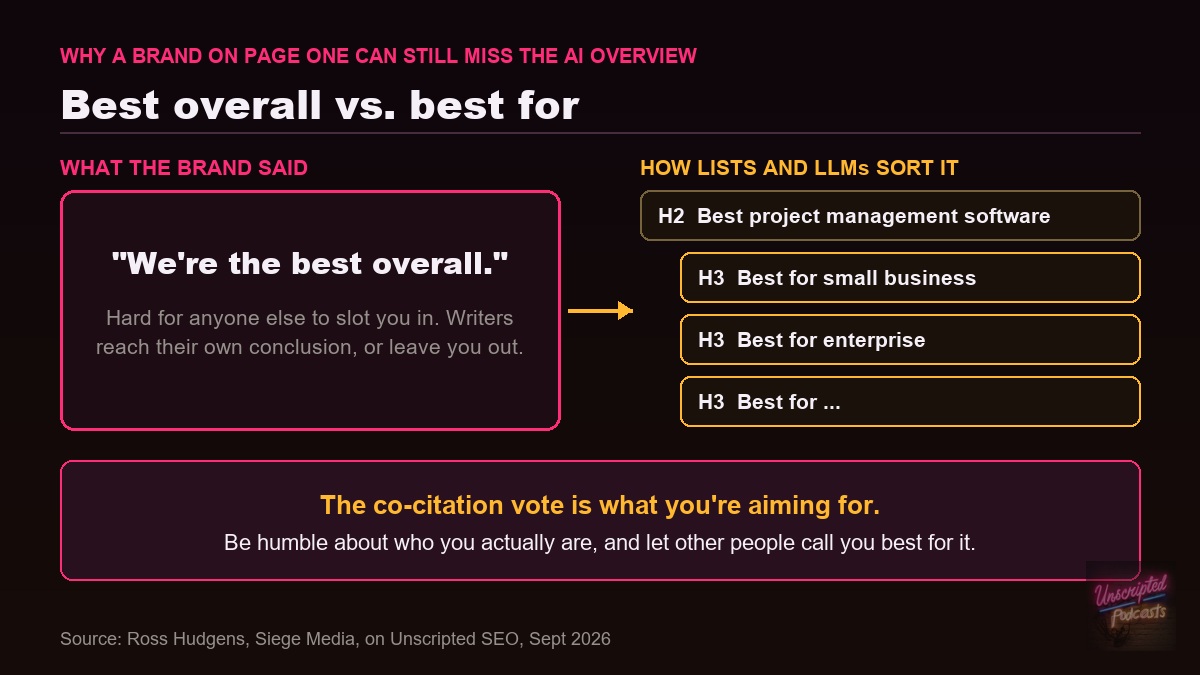
LLMs build answers like H2s and H3s under a parent topic. Best project management software for small business, for enterprise, and so on. They rarely recap the best overall. When you claim everything, you make it harder for other writers to “slot you in their own decision,” so they call you something you didn’t define, or they leave you out. “That co-citation vote is more what we’re aiming for,” Ross said.
“Our general advice is be humble about who you actually are and you’ll get those great customers and you won’t get the ones you won’t, and people who land on that will trust you a little bit more.”
Community is a service, not a platform
Reddit citations have dropped in ChatGPT but stay highly visible in Google. Ross reframes the work as community management plus reputation management: respond to reviews fast, ask happy reviewers to review you in other places, and turn the people who respond well into evangelists.
That reminded me of my conversation with Gisele Navarro of HouseFresh. She lost her Google traffic to the helpful content update, built community on Reddit and YouTube, and now earns mentions across other subreddits from the people she engaged. Reddit is hard on shills. It rewards brands people love enough to bring up on their own.
Ross calls his version “evolving from network to service.”
“Really what that is, is community management. It’s reputation management. And that’s agnostic to the platform. And that will always be a thing somewhere.”
The next services Siege adds follow that rule. Ross said it out loud on the show: CRO is becoming a deliberate service with a specialist, and he’s thinking about review generation, including testimonial videos. On affiliate, his view is that “even if you’re paying to play, that’s a signal of a good business,” but he still grounds it in SEO fundamentals. His warning: “people go get citations that have zero traffic.”
SEO is more of an account management job than ever
I pushed on the business model. If you define SEO as four blog posts, two backlinks and three optimized pages, a client can prompt that in four minutes. Stephanie Long said it on this show: SEOs are already in the right seat to answer how a business should optimize for AI. You have to bring strategy and partner with the email, PPC and PR teams to do it.
Ross agreed: “It’s more of an account management function than it ever has been.” Siege’s account managers now own the service split for each client and the prompts they track. Siege also has a director of automation, a former content marketer who builds internal tools with Claude Code.
PR came up from both sides. I told Ross about a launch with national coverage that went out with no domain and no links. He countered with a lesson from his VP of PR: if you want a publisher covering you for ten years, asking them to add a link may not be worth the ask. And on the PPC side, I pointed to what Lisa Raehsler covers on AI, Ads & Beyond: Google’s AI Max sends ad traffic to pages it finds on your site, so the organic page you optimize now shapes the PPC campaign too. “It goes back to CRO,” Ross said.
Ross is on an SEO tour for the book. He’ll be at Ahrefs Evolve the week it launches, giving away copies. Grab Generative Engine Optimization, follow Ross on LinkedIn, and subscribe to Unscripted SEO for the next conversation.