Unscripted SEO · Host: Jeremy Rivera · Guest: Laura Smith, Head of Client Strategy at ICS-digital
Anytime I get a guest with expertise overseas, I find it fascinating, and Laura Smith brought plenty of it. She leads client strategy at ICS-digital, a UK agency working in over 100 languages across digital and translation, and she’s been in marketing for more than 15 years. We covered why a campaign has to be localized and not just translated, the hreflang and media mistakes SEOs make in new markets, whether memes are cringe, and her white paper on being remembered by both people and AI. Listen to the full episode, then subscribe to Unscripted SEO so you catch the next one.
Why a translated campaign falls flat
I asked Laura for the most surprising positive from international work. Her answer was a lesson she learned after moving to ICS: “the importance of not just translating a campaign, but localising it.” Plenty of agencies run one great idea the same way in every market, and she isn’t calling that wrong.
“I feel like the actual exciting bit of the campaign comes from actually localising it to the culture of the market that you’re going live in.”
I pushed for a concrete example, and she had one. On a German campaign she wanted to go all in on Twitter, since Twitter was carrying the UK work. Experts in the market told her Germans don’t use Twitter in the same way. “The words are literally too long.” They didn’t fit the character limit. Laura isn’t fluent in other languages, so she relies on native speakers who know where the work can land.
Fractured teams and enterprise red tape
International analytics are tricky on their own, but Laura said the bigger challenge sits above the tools: “the teams can be quite fractured as well.” Separate market teams don’t always talk, and the agency ends up as the go-between. ICS sticks to focused reporting frameworks. What’s the overall goal, which indicative metrics show you’re hitting it, and how does that change by market?
I told her we always say you have to look at a campaign through the lens of revenue, and at this scale that revenue comes in euros and dollars. Her answer for the red tape is to get ahead of it at kickoff and keep checking over the first one to six months. She also works with the client’s internal experts, who are usually very capable. ICS is often brought in to support specific pieces or keep the strategy consistent.
Expat audiences and starting from scratch
What about English speakers living in Spain, or Spanish speakers in the US? Laura brought it back to audience understanding. ICS uses GWI for audience analysis. A blanket insight might say a French audience is slower to believe an ad. That stops being useful if you’re targeting UK expats in Paris, who may still use channels the way they did at home. Her rule is “not being afraid to start from scratch” and asking what you need to know for this brief, this month.
AI search moves at a different speed in every market
Some countries still don’t have AI Overviews, and some don’t have access to ChatGPT. Laura’s answer was to avoid chasing tactics: “we always want to make sure that we’re not just going after the next hacky thing that might work.” What we know about modern search still applies across markets.
She also warned against chunking content purely to land in an AI Overview. She wants content that is “not just appearing, but also the human reading it,” which matters more when your brand has to sound consistent across languages.
The pitfalls: hreflang and “I’ve done this before”
If you’re a US SEO and a referral suddenly calls from Canada, what trips you up? Technically, Laura said it’s hreflang. Even when it’s on a site, her tech team often finds it isn’t configured for the best outcome. Google’s own guide to localized versions of your pages is where to start checking yours.
The bigger pitfall is strategic. For digital PR, the US is “a completely different media landscape to what we have in the UK.” Breaking data down by city works for UK regional press. Slicing the same campaign by state won’t interest US state and local media.
“I think the biggest pitfall is thinking, I’ve done this before, so I’ll just do it the way I’ve always done it, and not digging into the market, or even just being open that you don’t know.”
She tells clients when ICS hasn’t done something in a market and asks for time to look into it. As she put it, “you have to be very honest with yourself when you don’t know.”
Laura’s new-market checks are now an eight-step procedure: SEO SOP: Localize a Campaign Before You Launch It in a New Market – the one-page PDF is free inside The Vault.
A press release deleted in full
I asked how the agency’s own shoes fit. Laura admitted agency marketing “can be last on the list when clients are calling.” Then I asked for a favorite client story, and she picked a rough one. About 11 years ago, as an account manager, she sent a new marketing director a press release. He sent it back with tracked changes that deleted the whole thing and told her to rewrite it. It taught her that client work isn’t always smooth sailing, and the rewrite was better. “But I’d still do it now, so I must like it a lot.”
Meme culture: global, and usually cringe
Is meme culture an American thing? No. “Meme culture definitely exists everywhere in a unique way,” said Laura, a self-confessed chronically online person. Should brands try it? “My first reaction is that it’s cringe.” She thinks some brands can pull it off, but only with a detailed understanding of the culture and where the brand fits in it. Hopping on a TikTok trend after it has millions of views isn’t that. Her advice: give it a go, and be willing to call it cringe and never post it.
Authenticity takes reps
How do you stay authentic when a big organization has to onboard lots of people to one message? Laura’s answer was to “support people to find their own voice,” and she’s been doing it herself. She started a TikTok this year to get comfortable listening to her own voice. She stopped running her LinkedIn posts through AI and just posts them now.
“It’s okay if you post something on LinkedIn and it gets no impressions and one like, it’s totally fine.”
Her first podcast fits the same pattern. It was on the ICS Podcast, recorded before she had even started at the agency as digital PR director. A friendly conversation got the first one out of the way, and after that she knew she could do another.
Digital PR’s moment in SEO
I admitted I’ve ignored digital PR, or been siloed out of it, for a long time. Laura started digital PR in 2017, when SEOs and PR sat in separate rooms with maybe a weekly meeting. “I didn’t know what a link was until 2017,” she said. The SEOs who wanted high-authority links were always PR’s champions. What’s new is “the link to brand”: AI search rewards the brand entity, third-party citations and brand mentions that digital PR builds. Whether you work in-house or at an SEO agency like SEOteric, that makes the PR team worth a standing meeting. Ross Hudgens made a similar case on this show about why being best for something wins in AI search.
The Human-Machine Memory Gap
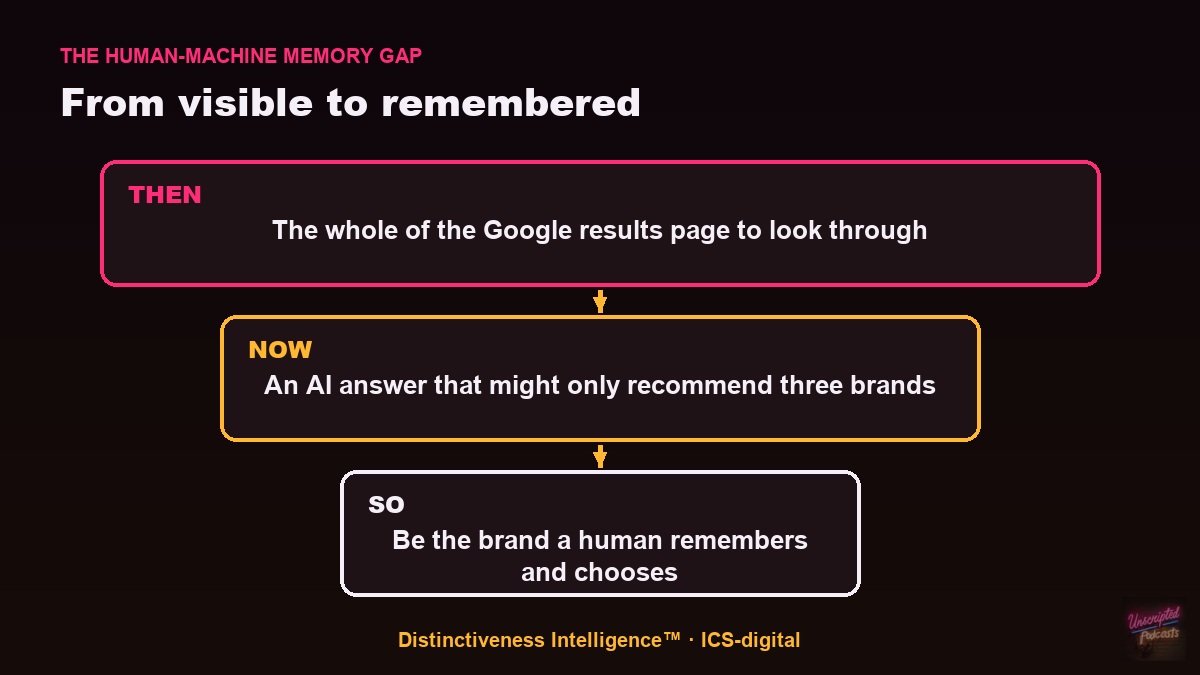
Laura’s big release this year is a white paper she authored, though she’s quick to call it a team effort: The Human-Machine Memory Gap. It launched alongside ICS’s framework, Distinctiveness Intelligence, which she calls her baby. It covers the behavioral science of how people remember brands, what’s affecting AI, and sector examples.
“You need to understand why a human is going to choose your brand, which is especially important when an AI might only recommend three brands, compared to previously having the whole of the Google search to look through.”
For the retail angle, read her article The New Shelf Space, on retail visibility moving from search rankings to AI retrieval. Connect with Laura on LinkedIn, see what ICS-digital is working on, and subscribe to Unscripted SEO. Yes, that was me asking you to like and subscribe. It never stops feeling awkward.