🎧 Listen to this episode
Erika Braeger is back on the Unscripted SEO Podcast, now as Director of Strategy at Ten Speed, where she oversees the strategy team and innovation. If you missed her first episode, start there. This time I asked her what the most consequential part of SEO is right now, and she answered in two words: machine readability. Here’s the recap. Subscribe to Unscripted SEO so the full conversation lands in your feed.
If a machine can’t read your site, you won’t show up
You might expect a content strategist to say content. Erika went straight to the plumbing. Speaking broadly, it’s machine readability, and zoomed in, it’s technical SEO.
Because if a machine cannot easily parse and understand your site, then it’s going to be much more difficult for you to show up in AIOs, for you to show up in AI mode, in organic search, in LLM search. — Erika Braeger
Her point is that the job now reaches well past organic. AI Overviews, AI Mode, the regular results and LLM answers all lean on the same thing: a site a crawler can parse without a fight.
Page speed and redirect debt are the holes you can’t see
I asked where companies have holes in their clothes they don’t know about. Erika named two: page speed, and technical debt that has ballooned from URL updates. She watched clients kick page speed down the road for years. Now a page over a certain size is harder for a machine to read and harder to load on mobile and desktop. Her phrase for it was a snowball effect.
The URL side showed up with a client the same week we recorded.
They sunsetted a blog, but it wasn’t redirected, and because it was so frequently linked across the site, it created 4xxs. — Erika Braeger
Every URL you sunset or change without a redirect creates 3xx and 4xx errors, and the pile grows with every update. Ten Speed has a rundown of common technical SEO issues and how to fix them if you want the full list. Erika’s fundamentals are short. Is the site fast? Does it load well on a phone? Does it have strong technical health?
How she proves speed matters to a client
When a client loses ground in a SERP or an LLM, Erika compares their page speed against the two or three competitors that pulled ahead. If speed is the biggest difference she can find, that’s the case she makes. I added the 2012 Walmart study, which tied conversion gains to load time: up to 2% more conversions for every 1 second of improvement, and up to 1% more revenue for every 100 ms. Shoppers who converted saw 3.22-second page loads; those who didn’t saw 6.02 seconds.
So even as you approach near instantaneous, there’s still money to be uncovered or recovered, however you want to view it. — Jeremy Rivera
Erika’s B2B SaaS spin made it sharper. A shopper who bounces costs one transaction. In SaaS, the visitor you lose was monthly or annual recurring revenue that would have repeated over time.
Images, scripts and video slow the page down
Images came first, specifically images sized wrong, which drag down the load and can cause layout shifts. Then third-party JavaScript firing before user-facing content when it could fire after. Then video that isn’t set to an iframe, autoplays, or runs motion graphics.
On lazy loading, she agreed it helps, with one hard rule: keep it below the fold.
I’ve seen where a blog image, like the hero image of the blog or a hero image of a core page, is set to lazy load, and that can really scramble things. — Erika Braeger
Load the hero first and lazy load what’s under it. When I asked about WebP or a Cloudflare CDN, she said she hasn’t dealt a lot in that. She hands clients a good, better, best set of image options instead, because every server and dev team works a bit differently. On WordPress, that can be as simple as a compression plugin.
The two-megabyte line
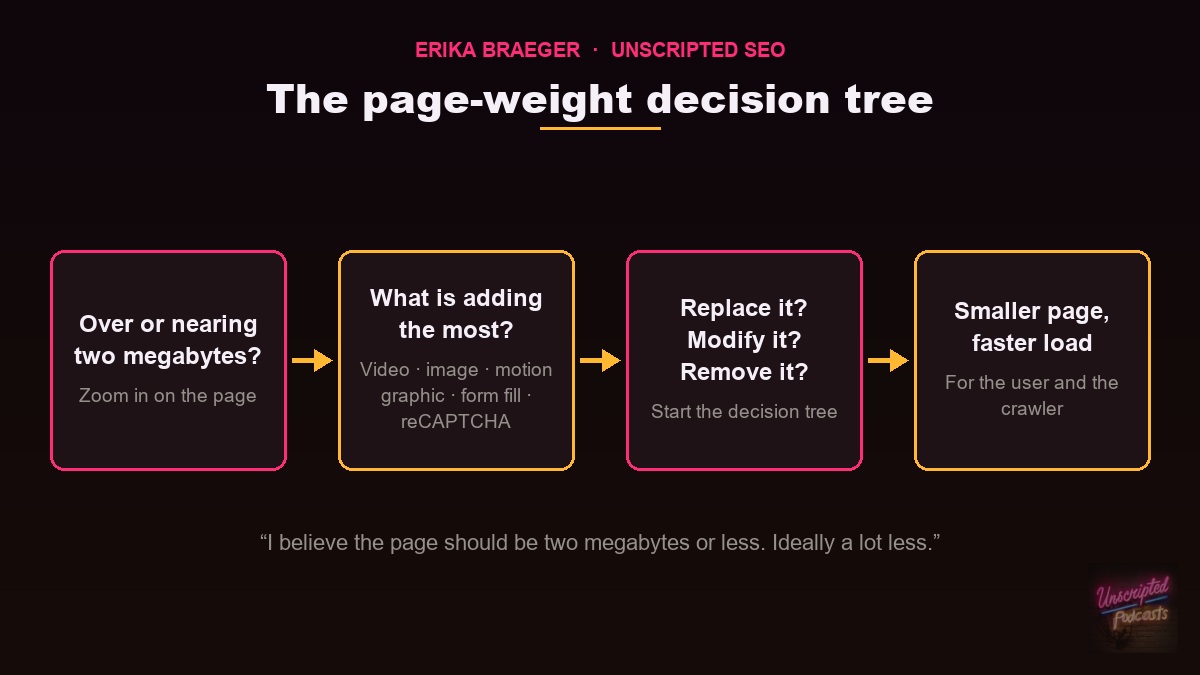
I believe the page should be two megabytes or less. — Erika Braeger
Ideally a lot less, she added. The crawler won’t pass you over, but it takes a lot more time. When a page gets near two megabytes, she asks what’s adding the weight: a video, an image, a motion graphic, a form fill, a reCAPTCHA. Then she runs the decision tree. Replace it, modify it or remove it. Two megabytes is her rule of thumb, not a published Google limit.
PDFs get more leeway. She mostly uses them for bottom-of-funnel content and thinks you have a lot more wiggle room there than with the rest of the site.
Win enterprise buy-in with the biggest splash first
One of Erika’s clients told her, “we’re cleaning up two years worth of tech debt in 90 days.” She sends that team new work every week, page speed one week and 3xx or 4xx cleanup the next, and picks each delivery by what will move the needle most.
On enterprise accounts, where the SEO has to push tickets and PRs to developers, she starts with the global, big ticket items. When one moves the needle, she takes the win to every team it touches.
So you really have to work piece by piece and you have to work with the pieces that are going to make the biggest splash first to get buy-in to continue to build trust across the organization before you can go for, I guess, the fruit at the top of the tree. — Erika Braeger
She also uses Claude as a second set of eyes. Upload chunks of a Screaming Frog crawl and it surfaces and prioritizes issues faster than reading the crawl yourself, then turns the findings into graphs a client can follow. You still make your own decisions before you feed it anything.
That led to a question I keep chewing on. If Claude Code can pull GA, GSC and Clarity into one dashboard, does SEO SaaS turn into a data vendor? Erika sees AI lowering the barriers and the learning curve. She remembers learning Data Studio, Looker Studio and complicated formulas just to stitch separate systems together. Now she pulls it in through Claude’s API, and Gemini in Google Sheets handles the formulas. Her worry is the other side of that: she learned SEO on Stack Overflow, forums and Slack communities, not Claude and ChatGPT. Mine is the paid junior positions where people used to learn SEO on the company dime. She’s seeing it too, and doesn’t think it’s unique to SEO.
EEAT and schema are what’s new for LLMs
For LLM optimization, Erika puts a much heavier emphasis on EEAT and schema. Top of funnel has “moved far past the era of the ten blue links” and is now an awareness driver, so clients who resist refreshing it miss those moments. Mid and bottom of funnel is where EEAT does its work.
So it’s not enough to say that we can solve these pain points. We need to show stories from real customers, real users that have solved these pain points and what success looked like for them. — Erika Braeger
You need to tell a consistent story and back it with first-party data. Schema used to be a lever for SERP features like People Also Ask. Now, she says, it’s a lever for AI search because it supplies extra context about what’s on the page. Review schema is her example: for a B2B SaaS company, it connects your site to G2 and Trustpilot, where people have spoken well of you. Ten Speed’s 12-week generative engine optimization rollout plan and its research on what AI cites for B2B evaluation-stage prompts go deeper.
Backlinks and a consistent story across the web
I asked Erika if she’d seen Ben Wills’ research at OppAlerts on an actual specific AI ranking factor. She hadn’t, so I walked her through it, with apologies to Ben for not being perfect on his quotes. His hypothesis was that backlinks still matter for LLMs. He pulled the backlink profiles of sites with high visibility in AI results and checked whether the linking pages fell into the same vector-embedding category as the site they linked to. As I read his initial findings, a topically aligned backlink profile showed a positive correlation with top AI visibility across several models, with branded linked mentions slightly behind and unlinked mentions slightly behind that. That’s Ben’s study and my summary of it, and a correlation, so read his report before you act on it. You can hear how Ben tests models in his own Unscripted SEO episode.
Erika hadn’t seen the study, and she connected it to something she’s been telling clients that goes beyond backlinks: how you show up across the web has to line up.
LLMs are looking for that confirmation that you’re spoken about in the same way outside of your site that you’re spoken about, that you speak about yourself on your site. — Erika Braeger
That’s the shift I see too. In 2014 I was happy in my little box, optimizing pages and leaving the rest of the business to the client. “That doesn’t fly anymore.” Reputation management, PR, how the site works and how you treat return customers all feed the story machines read about you.
Your one takeaway: sample page speed across your site
Erika’s one recommendation is to dig into page speed and sample across your site.
Don’t sample only a singular page because not every page is going to tell the same story. — Erika Braeger
Check four or five pages, not one. That’s how you find the global fixes and make a bigger impact early as you work down your list.
Erika’s takeaway is now an eight-step procedure: SEO SOP: Find Global Page Speed Fixes by Sampling Five Pages – the one-page PDF is free inside The Vault.
Connect with Erika Braeger
- Company: Ten Speed
- LinkedIn: Erika Braeger
- Ten Speed blog: 7 common technical SEO issues and how to fix them
- Ten Speed research: What AI cites for B2B evaluation-stage prompts
The Unscripted SEO Podcast is hosted by Jeremy Rivera. Subscribe on Apple Podcasts and find every episode at unscriptedseo.com.