Unscripted SEO · Host: Jeremy Rivera · Guest: Lum Kamishi, SEO consultant at LumKamishi LLC and founder of Assertio.ai
Unscripted SEO Podcast
GEO Is SEO Plus Digital PR – Lum Kamishi of Assertio.ai
What the web says about you, why niche-relevant links matter more now, topical proximity, and building Assertio to tackle AI slop.
“GEO is basically what the web is saying about you.” That’s how Lum Kamishi answered when I asked what his foundation for AI optimization is. Lum is a Kosovo-based SEO consultant at LumKamishi LLC and the founder of Assertio.ai, and on this episode of Unscripted SEO he makes the case that GEO is SEO plus digital PR, that niche-relevant links matter more now than they did five years ago, and that most blogs need to be mapped back to the service pages they’re supposed to support. I’ve been saying versions of this on the show for a while, so I pushed him on the details. If you like it, subscribe to Unscripted SEO wherever you get podcasts.
Lum has been in SEO for 11+ years. He got in through a friend’s small agency while he was studying math (“That’s when I realized that math’s not for me really”), spent about eight years in-house at marketplaces, and started taking clients in 2025. Today he contracts for an agency based in Scotland and builds Assertio on the side.
GEO is what the web is saying about you
Lum calls himself a conservative guy on this one. GEO, AEO and the rest of the acronyms are, in his words, “basically just an extension of good SEO”: content, technical foundations and external citations. The problem is that clients have heard the new word and want to buy it.
“So if I go around and tell them that’s just good SEO with some extra steps and a holistic approach to SEO, they would not really buy it.”
What he has been able to reproduce points to one primary factor: citations. Not local directory listings, but mentions from niche-relevant publications with relevant content pointing to your site. A link helps. It isn’t required. He also noted that Reddit used to carry a lot of weight here until ChatGPT pulled back from using it as a main source.
“So I would go like: GEO is SEO plus digital PR.”
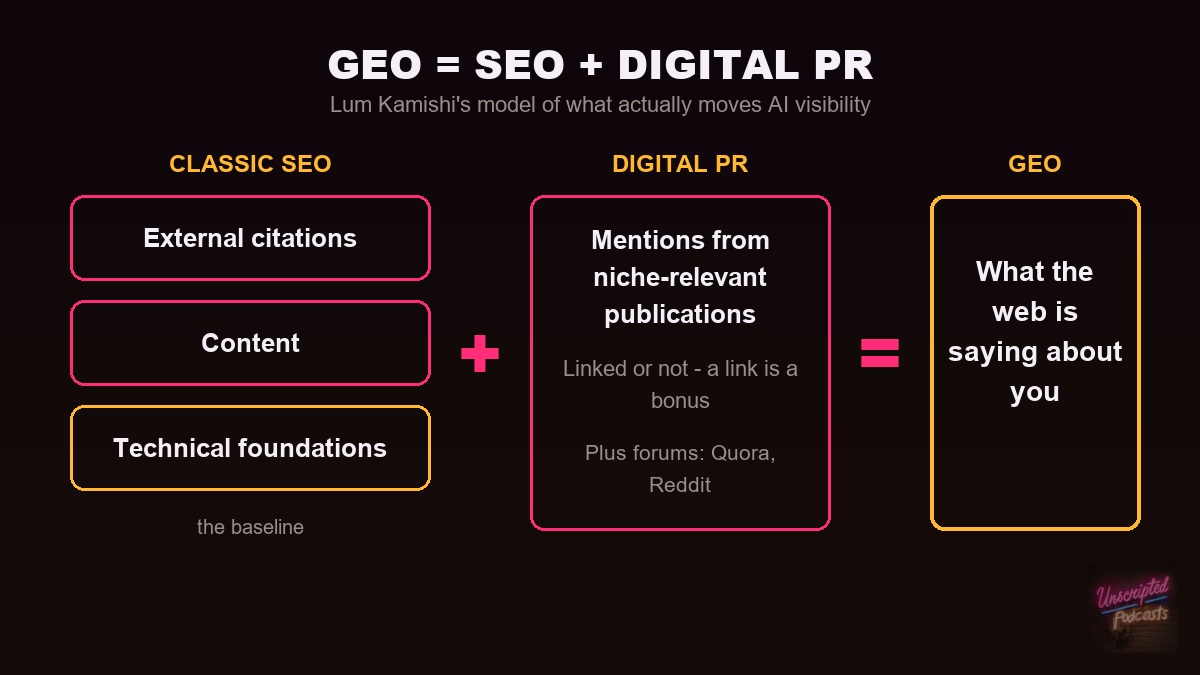
Digital PR wasn’t new to him. The company he worked for in-house first discovered it in 2017-18, so when GEO concepts showed up, the playbook looked familiar. If you want another practitioner’s take on the same overlap, Chris Panteli’s episode on digital PR and brand signals pairs well with this one.
Why niche-relevant links matter more than five years ago
I brought in the ranking factors study Ben Wills ran through OppAlerts. As I summarized it on the show, he found 20,000 cases where a backlink profile from pages in the same vector embedding category was a positive match, and zero cases where it was a negative one. If you’re in home improvement, your links come from sites that read as home improvement.
Lum’s first job in SEO was a Penguin recovery, so he has seen what bad links do. His read is that LLMs are behind Google on this:
“LLMs are basically way more primitive than Google when it comes to ranking.”
Google has spent years playing whack-a-mole with people who built links for a living. ChatGPT and Perplexity haven’t, which makes them more prone to being manipulated, and it’s why links carry more weight now:
“It’s not that links now still matter, but in fact they matter more than five years ago, right?”
He calls it a resurrection of links, with a condition. The links have to be niche relevant, with “cosine similarities really, really close to the site as a topic and to the network as a whole.” Lum doesn’t build links himself anymore and hasn’t since before COVID, but the link builders he has managed all tell him the same thing: they have to pay for links now. The cost has gone up. (That matches the argument in links are getting rarer, which is why they’re about to matter more.)
Topical proximity: every blog post works for a service page
On content, Lum described a project for a home renovation site. He mapped each blog post to a core service and calculated what he calls topical proximity, “the semantic distance between a blog post and a service page.” Each service gets a mini cluster of two or three posts that assist it.
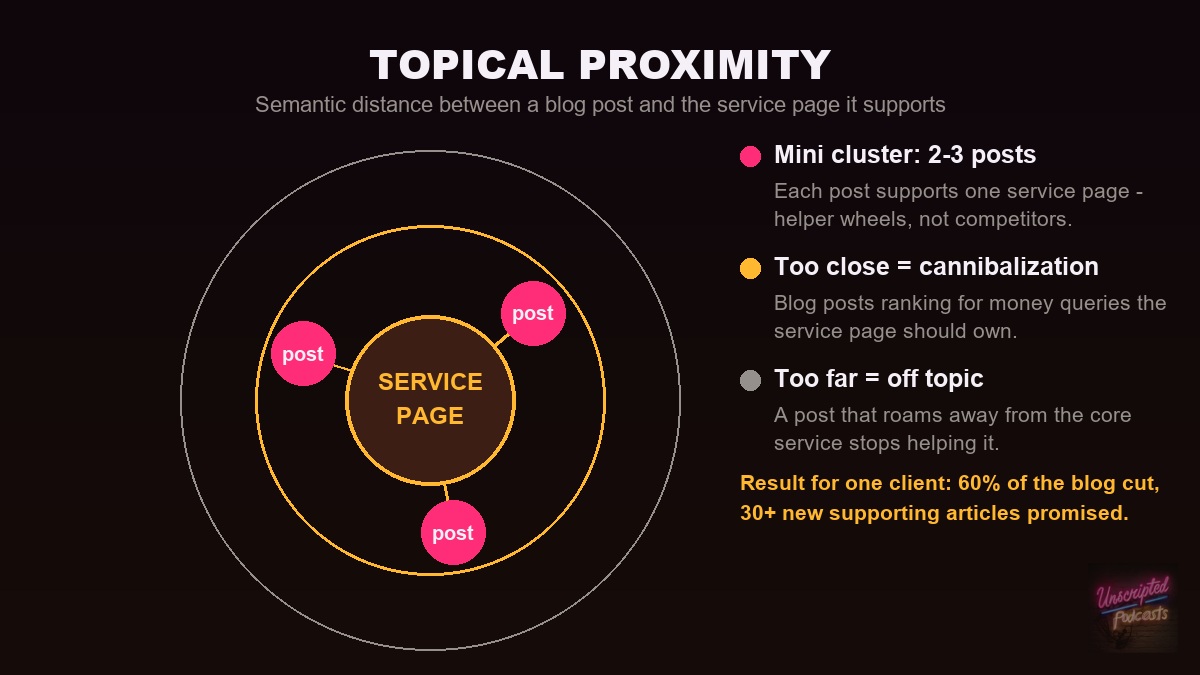
The failure he keeps seeing is blog posts ranking for money queries when the service page should have ranked. So he angles each post to stay near the service without competing with it. “I use the blog posts as just a helper, or some wheels for the service page.” Vector embeddings are only one layer; as a self-described failed mathematician, he also writes his own formulas for similarity across larger groups of topics.
The result for that client was blunt: “I killed sixty percent of their blog.” I go deeper on how to apply the method in the SEO Arcade breakdown of topical proximity, and if pruning makes you nervous, the content quality ratio covers when cutting beats rewriting.
Want to run this on a client’s blog? I turned Lum’s method into a step-by-step SOP: how to audit blog posts for topical proximity to service pages.
“I don’t care about budgets, I care about results”
I asked Lum whether the old agency package of four blogs and two links a month still works. He agreed completely that it’s done in competitive niches. For the home renovation client, he promised at least thirty new articles.
“I don’t care about budgets, I care about results. So if I believe that thirty blog posts would bring you better results, then I would promise thirty blog posts.”
He left room for exceptions: low-competition local niches and regional markets may still get by on the package. “If it works, it works.” I wrote up what this changes for consultants on my own site in why four blogs and two links a month is dead.
Polluted answers and the SEO voices we lost
Lum’s biggest challenge right now is that you can’t lean on the tools for strategy. Ask Claude for help on a topical map and “the result will be garbage, right?” because the web it learned from is polluted. He misses the era when Moz and Ahrefs were the place to go, and when people like Rand Fishkin, Cyrus Shepard and Gianluca Fiorelli were who you turned to.
“And pretty much maybe this is the challenge: the fact that you can’t rely on anything anymore.”
At a conference in Croatia in June, he found mostly doom and gloom and AI agents. The bright spot was meeting Gus Pelogia, “a breath of fresh air, both personally and professionally.” We also got into how the SEO community scattered across Slack, Bluesky, Mastodon and Threads. My own example: John Mueller replied to one of my dark click studies when I posted it in an SEO Slack community, and nowhere else. Lum’s: a friend of his once landed a client off a single comment on the Moz blog. Now he gets AI-generated replies under his LinkedIn posts. On Facebook groups, which I still see working for home services here in Cookeville, he had the line of the episode: “It’s a nightmare for sellers, it’s a dream for buyers.”
What Lum wants from Google, and why he isn’t counting on it
Lum hopes the AI hype dries out and “value will prevail.” For search, he wants Google to be more transparent:
“And as for SEO, I just hope that Google will stop lying.”
He doesn’t want ranking factors handed over. He wants Google to stop stealing clicks, move toward “a human-first search engine,” and stop hurting publishers, who he says are the hardest hit by AI Overviews and AI Mode. “Don’t pick a fight with SEOs, right? Let’s work together on this.” Then, honestly: “This is wishful thinking, man.”
I’m a little more hopeful. When an AI video popped up while I was showing the kids in my homeschool tutorial what Oktoberfest is, they called it fake on sight, and we ended up chanting “AI slop.” Kids already spot the fingerprint AI slop leaves, and Lum’s point is that people in the industry are learning to as well.
AI drafts need a lot of food
My answer to thin AI drafts is recorded conversation. An episode like this one is thousands of words of unique, relevant human dialogue, or as Matt Brooks of SEOteric puts it, human chow. You can’t keyword-research your way to it. When I described Claude’s first drafts as wishy-washy, Lum put it this way: “They basically need a lot of food.” He has measured the trade-off. A writer producing 2,000-word articles by hand averaged two articles per three days. With Claude, he got that to two per day.
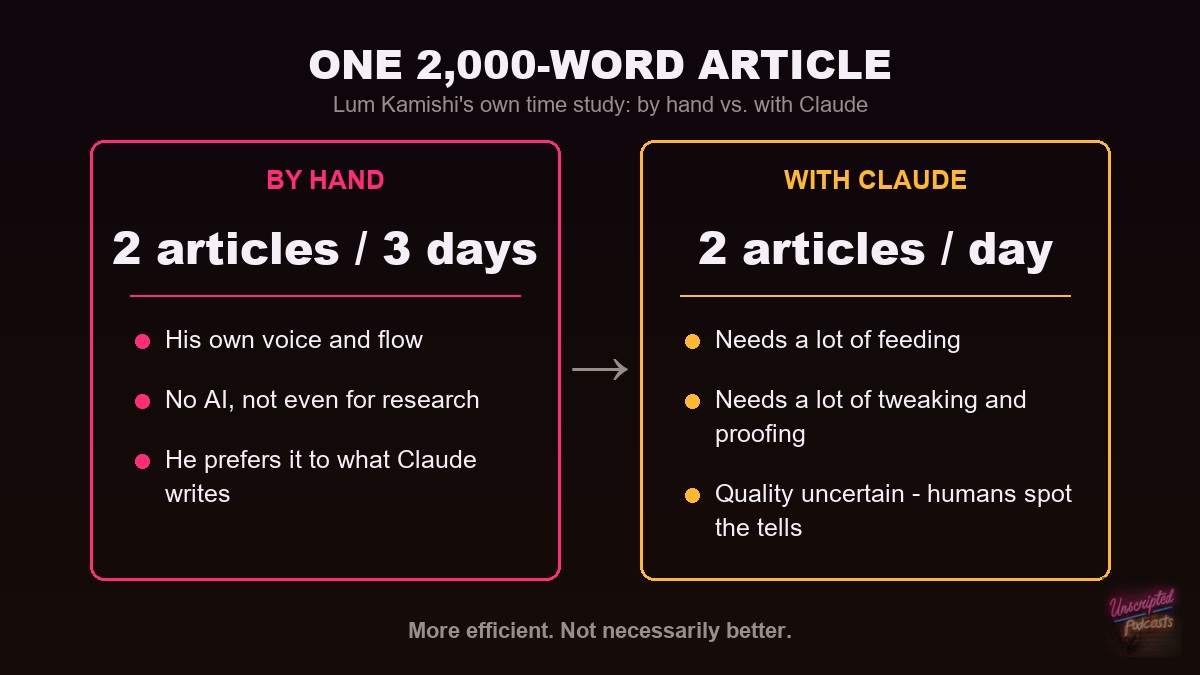
“So we’re more efficient, but I’m not sure about quality at all.” As a non-native English speaker, he still prefers his own writing to whatever Claude produces from his prompts. That’s why he built Assertio:
“I built Assertio to tackle AI slop.”
It’s still in beta. Assertio is a multi-agent pipeline where one agent only does research, client knowledge goes in as JSON or CSV, and the output follows the answer-first formats that used to win featured snippets: lists, tables and direct paragraphs. Lum runs it as a white-label service because he still puts his own hands on every piece. “Assertio is like a projection of my whole decade-long experience in content.”
Where to find Lum Kamishi
Lum works mostly with marketplaces and large sites, including sites with billions of pages in the index, plus e-commerce, local and SaaS businesses. His focus is content strategy, content creation, technical foundations and AI search performance. You can reach him through lumkamishi.com, see what he’s building at Assertio.ai, or connect on LinkedIn.
🎧 Listen to the full episode or watch it on YouTube, and subscribe to Unscripted SEO so you catch the next one.