
Jeremy Moser co-founded uSERP, a link-building and digital-PR agency, roughly eight or nine years ago. He got there the long way: local SEO for small businesses around Denver out of college, then three or four years at a content-marketing agency where he moved from writing to strategy to distribution — and found that promotion, getting eyeballs onto what companies had already made, was the part he enjoyed.
🎧 Listen to this episode
The full episode is audio. The 72-second clip below is the one piece of it on YouTube.
Listen on Castos: Jeremy Moser of uSERP: AI Search Still Comes Down to Good SEO
Which puts him in an interesting seat. His entire business is off-page work, and off-page work is what the AI-visibility conversation has rediscovered. His read on that conversation, after having it daily with C-suites and VPs, is deflating in the best way.
Every AI Conversation Ends At The Same Place
Moser started noticing the shift around the end of 2025. Before that, uSERP’s clients arrived pre-educated — they knew they needed link building and wanted to talk programme design rather than fundamentals. Then the questions changed. Suddenly every discussion was about showing up in AI search, and rather less about SEO.
His position is that the distinction is mostly imaginary. “They’re both just complimentary,” he said. “Whenever we do good stuff in SEO, it shows up better in AI search and increases visibility there. If we do specific stuff on the brand side that you could argue is maybe a little bit more geared towards AI search, that also impacts positively on the SEO side.” And then the line that gives this piece its title:
“So we find that all the conversations, like when we actually dig into it, boiled down to just a fundamentally good SEO strategy with a little bit more brand building in there as well.”
That is not a dismissal of AI search. It is a claim about where the work lands. Every serious version of the AI-visibility conversation, once you get past the acronym, becomes a request for the same deliverables uSERP has produced for the better part of a decade.
Where Brand Building Actually Adds Lift
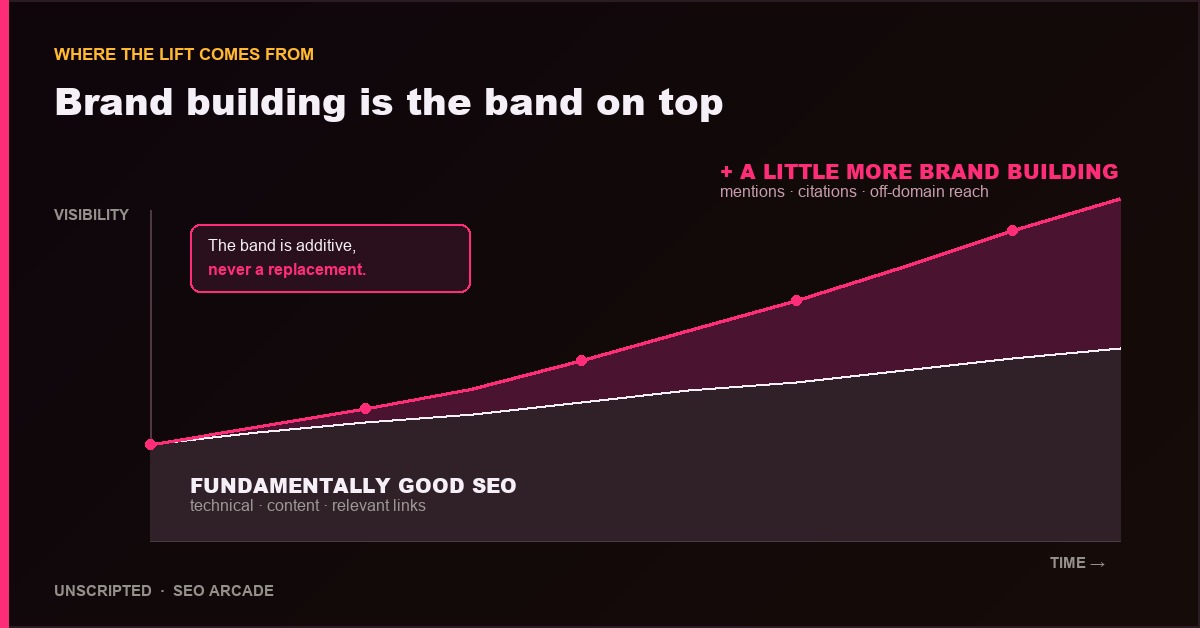
The “little bit more” is doing real work in that sentence, and Moser has a number he leans on to size it. “I think HubSpot came out with some recent data… getting mentioned basically in LLMs, 92% of it boiled down to content that wasn’t on your own domain.” He lists what that off-domain content is: “social media, links from other sites, directories, roundups, listicles, all the sort of like off-page traditional SEO stuff that you would do.”
He is careful with the figure — “maybe,” “I want to say” — and it is worth carrying that hedge forward rather than hardening it into a stat. But the direction makes it useful in a budget meeting. If the overwhelming majority of what a model says about you originates somewhere other than your website, the lever is off-page, and that lever already has a name and an owner inside most organisations.
Which is why he says these conversations have got easier: “it is getting a little bit easier for us, I’d say, to just showcase how it impacts both.” The same work, shown to be doing two jobs. Brand building is the band stacked on top of a functioning SEO programme — additive, not a substitute for the thing underneath it.
The corollary is a warning he gave at length. He sees people putting AI search first as a methodology, at the expense of traditional SEO, which still accounts for the vast majority of traffic. Worse, it compounds: tank your traditional visibility now and you have less of a footprint in whatever the next model trains on. On self-promotional listicles, he thinks they have worked longer than they should have and expects the models to correct for them:
“Yes, those things can work on maybe a one to six month basis and we see some good results from them, but there’s just — it’s a ticking time bomb, right?”
What uSERP Changed And What It Did Not
What changed is the framing of the sales conversation. What did not change is the evaluation criteria, which Moser walked through in order when asked what he looks for in a link.
First: is this a real company? “Is this an actual brand, domain, website, company that has either been around for a while or you think will be around long into the future?” The failure mode he screens out is the content farm — the site that either openly advertises guest posts or obviously sells them — and an experienced SEO makes that call visually in seconds.
Second: authority and traffic health together, not either alone. An authority score from SEMrush or Ahrefs as a proxy, combined with actual traffic, the shape of that traffic over time, and what the site ranks for. His test for the last part is memorable — are they ranking for legitimate business terms, or for “what age is Justin Bieber or something?”
Third: contextual fit. “If we were to actually place a link there, does it make sense contextually?” Anchor text and surrounding copy matter, “but those will come kind of secondary to that initial review to make sure that this is even a domain that’s worth going after.”
Notice that AI search appears nowhere in that list. The criteria that survived the last eight years are the criteria he still runs — the same conclusion other practitioners on this show have reached from different starting points, collected in our hub on link building and digital authority.
His risk posture did not move either. For uSERP’s typical B2B SaaS clients he essentially never recommends anything gray-hat, and around 99% of the time tells people to invest elsewhere — partly because recovery has got so much worse. Sites that once did 200,000 sessions a month and crash to 20,000 mostly do not come back.
Advice For Teams Chasing The Newest Acronym
Given the floor to say one thing to other SEOs, Moser used it on the claim that AI tools can replace strategy — not augment the work or make people faster, but replace the thinking. His illustration came from outside the industry. Putting an offer on a piece of real estate, he wanted particular language in the contract, so he asked Claude to describe it in legalese and sent the paragraph to his attorney. “The first thing he told me was, did you put this in the ChatGPT? Like, how did you make this? And I said yeah, and he’s like, okay, I could tell, right, and we need to change a few things here.”
SEO strategy behaves identically. The output reads correctly to anyone who does not already know the answer — his mother, he said, would tell him it “sounds technically right” — and an expert spots the problems immediately. The reason is that these tools mostly recirculate what is already public, not what is proprietary to you or drawn from your own experience.
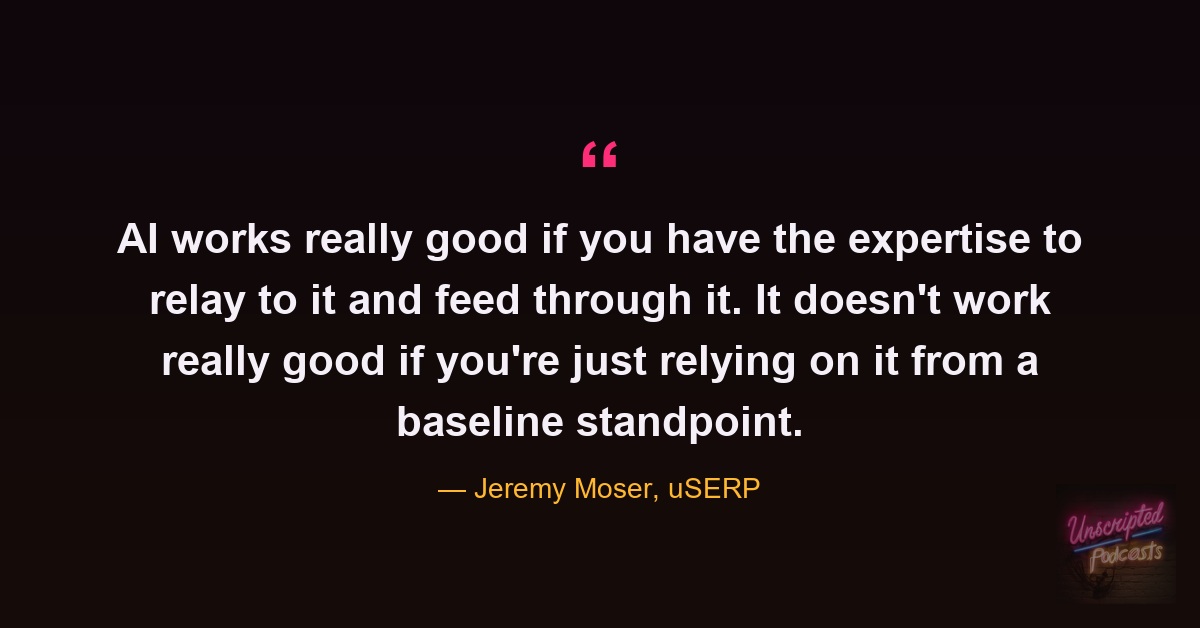
“AI works really good if you have the expertise to relay to it and feed through it. It doesn’t work really good if you’re just relying on it from like a baseline standpoint.”
His empirical claim is flat: he has yet to see a single company announce it was going all-in on AI content and then sustain or improve performance. The pattern he does see is a two-month spike on a thousand new pages, then losing all of it and ranking worse for the terms that actually mattered.
The practical advice underneath the rant matches what he said about AI search itself: go deeper rather than broader. He offered a uSERP page targeting a keyword Ahrefs scored at zero to ten searches a month, built for sales enablement, which pulled over 400 organic clicks in the 30 to 60 days after publishing. Keyword tools miss the terms real buyers use. Sales calls do not.
Jeremy Moser is co-founder of uSERP, and points people toward the agency’s annual State of Backlinks report. For more on how practitioners read this shift, see our hub on AI and the future of search, or browse the full episode guide.