Jon Henshaw co-founded Raven Tools back when SEO was still treated as a dark art. Since selling it he’s worked inside CNET, GameSpot, the Paramount Plus launch team, Vimeo, and now Yahoo — and writes at Coywolf. He lives on Mastodon, not X.
We go back a long way, so this one ran long and got specific. What follows is the conversation, cleaned up and tightened, but it’s his words.
🎧 Listen to this episode
Also on the Unscripted SEO feed and wherever you get podcasts.
📺 Watch the interview
Coywolf, and why he left the big platforms
Jeremy: Tell me about Coywolf. I’ve been a member a long time, but what is it you’d say you do there?
Jon: The name is similar to how I named Raven. Raven came from a time when SEO was considered a dark art. My background is mostly entrepreneurial — if I have a claim to fame it was co-founding Raven, which people probably don’t use as much today, but they did for a while. And you were there.
Jeremy: You spend most of your social time on decentralized platforms now. Why?
Jon: Most people are familiar with Bluesky, which uses the AT Protocol. The one that came before that is Mastodon, based on ActivityPub. That’s where I spend the majority of my time. I interviewed Eugene while he was stepping down — I wanted to know what got him bold enough to think he could compete with the giants. We also talked about working with Meta’s Threads to integrate ActivityPub, which looked really good for a little bit and then completely fell flat.
“It’s SEO, it’s SEO, it’s SEO”
Jeremy: Between the Helpful Content Update, Google’s focus on brand, LLMs, and the “SEO is dead” panic redirecting budgets — it’s become harder to be in SEO. What’s the state of play?
Jon: One of the reasons SEO has become so difficult has to do with misinformation and running with hype. You have people promoting acronyms beyond SEO that are LLM-AI-specific — as if that’s where the puck is going, and if you’re still talking about the fundamentals of SEO you obviously don’t know what you’re talking about.
And you have managers and stakeholders who don’t do SEO reading these things from the loudest voices, or from people trying to sell something. It’s sounding complicated for the sake of sounding complicated.
It’s SEO, it’s SEO, it’s SEO. It’s just slightly different. The fundamentals haven’t changed — certain things have just become more important.
Jon Henshaw
Jeremy: So what specifically got more important?
Jon: Writing complete answers in paragraphs, including the question in the answer. Investing more in multimodal content — video, audio, inside the content itself. Not necessarily link building, but doing more for brand mentions, in your own content and from other people.
And technical SEO is more important than it has ever been, particularly for these new systems that come and evaluate your HTML and content. Being on top of your schema markup, making sure everything is easily comprehended by a bot. In the past there was so much focus on how you write or whether you include this keyword. Now it’s how well you’re putting content together for a bot.
“Drinking all the milkshakes”
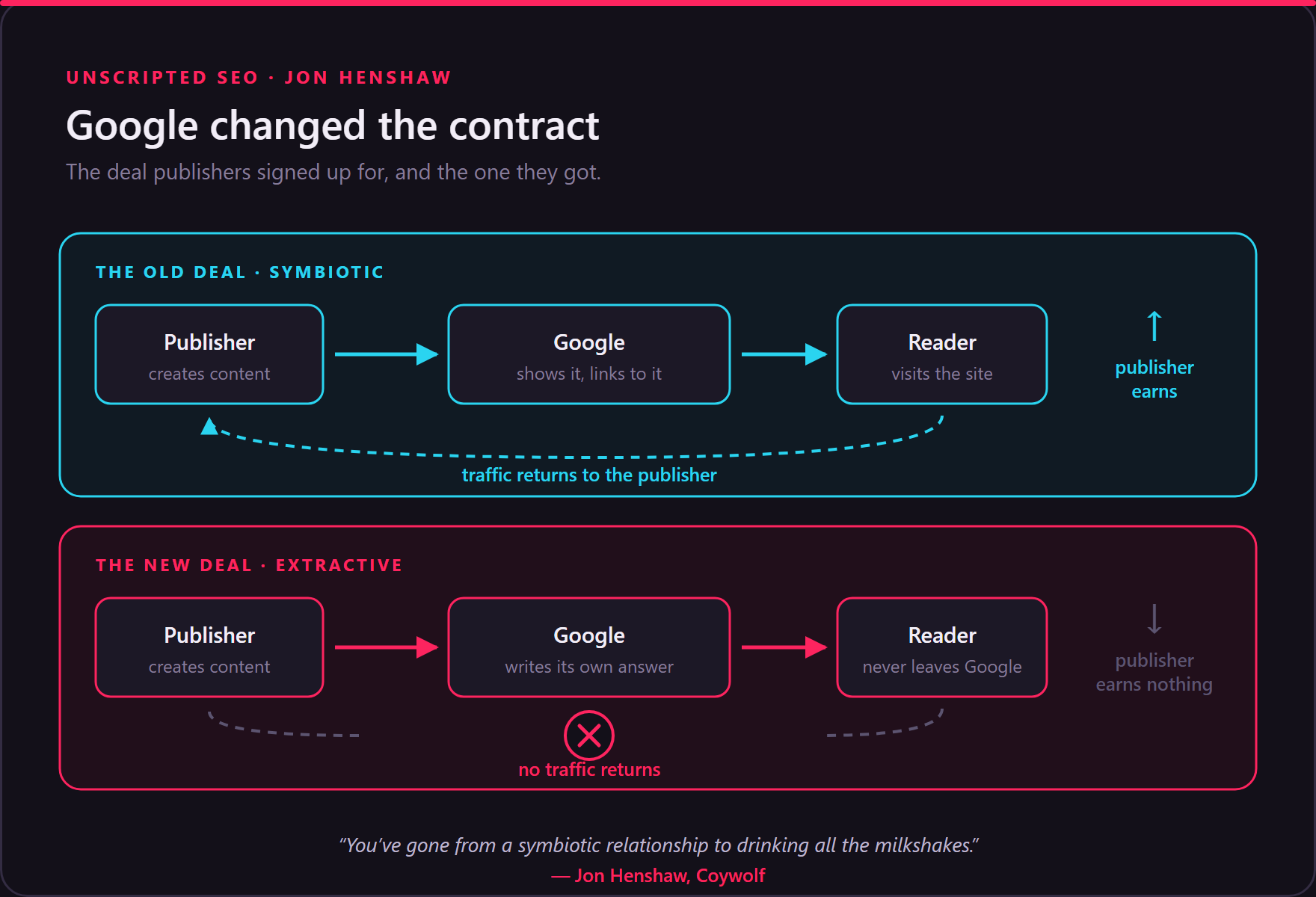
Jon: Google has changed the contract with publishers and content makers. It went from “we will show your content and clearly link to it” to “we’re going to take all your content and write our own answer. We might do a little link as a reference, but for the most part, through AI overviews or AI mode, we’re just going to leave you here.”
It’s the ultimate closed garden — you’ve gone from a symbiotic relationship to drinking all the milkshakes. And I don’t know how that’s sustainable for Google.
Jon Henshaw
Jon: What’s here to stay is the loss of traffic. The answers are more comprehensive, they’re the first thing you see, and I myself — as just a user — am not visiting sites as often anymore. The only time I go visit a site is if I’m unsure about the answer, or I still need more details. My best guess is my level of curiosity doesn’t represent the majority of the populace.
Jeremy: There was a social contract around publisher rights, vociferously discussed from 1998 to 2004. Newspapers gave up hoping for a piece of search revenue. Without that publisher block fighting back, we’re looking at the snake eating its tail. What’s the incentive for publishers if Google says that if you make a website meant to rank, it won’t rank you?
Jon: Because Google did this to themselves, real people are being de-incentivized to create content. They’re more incentivized to create slop and try to get that to rank. That creates a problem — accuracy issues, and content made from AI that AI then trains on to make more content. That’s a whole collapse issue.
Google at the end of the day wants two things: helpful content, and content from people. And they’re finding that’s pretty hard to find right now.
Jon Henshaw
Originality and humanity
Jeremy: I want most of the content I create to reference human conversations — excessively use quotes from humans, cited and attributed, and create content with information gain. We reached saturation. We don’t need the 500,000th “here’s how you secure your pipes so they don’t leak.”
Jon: To put it in two words: originality and humanity. Not necessarily new to SEO, but becoming more important to modern SEO.
What works today — even with the new approaches to how search is working — is originality and humanity. Writing something in a way that proves you experienced it, in a way that only a person who actually experienced it could.
Jon Henshaw
Jon: Everything I write and how I write it is incredibly intentional. The goal is making a connection with the reader on a human level, and proving to the bot that I really am a person who tested these things.
One in particular I wrote about mug warmers — comparing heated mugs versus mug heaters. I wrote a real story. I did real research out of my own personal interest. I literally was trying to figure this out for myself. That article, for most of December, ranked third or fourth for searches like “best heated mug.” And my site isn’t about mugs.
I believe it’s the way I wrote it — more images, more video, just making it full of things that would cause somebody to want to engage and trust the content as coming from a human being. I’m still very small, but I’m just enough in Google’s systems that I can write something that competes against the New York Times. If that works for the smallest publisher, a larger publisher doing it can dominate.
What Paramount Plus taught him about Google’s sources of truth
Jeremy: What did the enterprise work — CNET, Paramount Plus, Vimeo — contribute that you couldn’t get elsewhere?
Jon: You learn things quickly, particularly if you’re making mistakes. It’s like going to Vegas and getting to use large machinery — you can build something or break something. You see how Google handles things technically that would be too difficult to observe on a small site.
With Paramount Plus we were moving from CBS All Access, and we had to create a whole new feed — the feed Google uses to give those “Watch” buttons on a search result. Our feed kept getting rejected because the duration of the episodes we owned didn’t match their data source.
It ended up being that they use IMDB as a source of truth. That particular team at Google — that’s their source of truth. Even though we owned the actual content and we were the one streaming it, because IMDB had it wrong, they would reject it.
Jon: What I learned is that Google does use certain things as a source of truth. If I were doing anything around entertainment or movies, I’d want schema that references the IMDB page — include it, link to it — because that could be a signal that I’m related to this thing, which they know is a thing because they trust that source.
Jeremy: That’s exactly what Jason Barnard of Kalicube described about entity optimization. He had a show where characters were listed, and he had to work to change them from “characters” to “cartoon characters” so Google understood they weren’t humans. He changed it on IMDB — not his own site — and within a week the knowledge graph updated. A lot of SEOs don’t think about the meta profile beyond what’s on your page.
Jon: Google’s systems are also dumb in a sense — only dumb in that they can be easily confused by us diluting the message, by not truly disambiguating the topic most relevant to a query. Keep things simple on the page. Keep things focused. Don’t clutter it with things that could confuse them.
404 Media: all the authority in the world, and no Google News
Jon: I pro bono consulted with 404 Media when they were launching. They’re all seasoned journalists. I went over all the things a lot of people skip — About page, editorial policies, news policies, how they do their byline, contact information for the news outlet.
They wouldn’t do it. Maybe because they mistrusted SEOs. And it took them well over a year to show up in Google News. This is with links from the New York Times, from Wired or Vice — well-known, well-connected journalists writing incredible stories, referenced across all major trusted news outlets. And Google News just would not give them any visibility.
From past experience they’d have been in Google News within three to six months max if they’d just added those elements. Instead it took so long that Google’s systems eventually just gave in.
Jon’s Google News guide at Coywolf is the reference version of this argument.
Raven Tools, and the case against overbuilding
Jeremy: Years later — what do you think of Raven, and what would you tell someone going into SaaS today?
The biggest thing I learned was to not overbuild something — not to go too broad in what you’re making. One of the main things that adversely affected the company was my own fault of directing the product to do so many things outside of the core mission.
Jon Henshaw
Jon: The core when it began was an SEO tool with link building management, rank tracking, and reporting. Then I wanted to build something grand — a whole suite of digital marketing tools. We went down a path of social media marketing. We had a GNIP social stream coming in that we paid so much per month for. We added paid capabilities.
We got so overextended. We’d build a new feature and then never go back — it’d be “what’s the next thing we’re going to launch.” It was death of a thousand cuts. Everybody started building something focused: Hootsuite just for social, Buffer just for scheduling. Because they were focused, every one of them made a better standalone product. People are more willing to pay for individual best-in-class products than one big suite.
Jon: I built a notes app since — Recollect — my version of how a notes app should work, with all and only the features I want. It’s not going to become Notes plus Calendar. It’s going to be the best notes app I could devise, that I may never make money off of, but I’m going to continue to love using every day.
Jeremy: That’s dog-fooding — which is where Raven started. And it’s weird we’ve cycled back, thanks to GA4, to another point where reporting sucks again. Matt Mellinger at SEO Gets has a fantastic Search Console product.
Jon: If you have to use GA4 and it’s truly your best option, then something like SEO Gets is definitely the path. I’ve been using Fathom Analytics since GA4’s launch as a privacy-focused alternative.
Start the partnership like you’re ending it
Jeremy: Any entrepreneurial lessons you’d carry forward?
Whenever you want to have a business partner, the way you should create the legal entity and approach the operating agreement with your attorney is to approach it like you want to leave — like you’re divorcing. That is the way.
Jon Henshaw
Jon: That does two things. It gives you an awesome operating agreement of how things are run, and it makes it so that when somebody wants to do something else, or does something you’re not happy with, you can rectify it much faster.
Another one: always have an agreement signed by any contractor or developer that clearly states you or your legal entity own the code that was made for you. If and when you end up selling that product, it’s absolutely required. If you can’t show you own all that code, that will severely complicate your ability to sell.
And you’ll be more successful if it’s something you have some degree of passion in, and something you use yourself. If you don’t, you end up being like any other company that just wants to make something so they can make money. I don’t think that’s sustainable long-term.
The long game on human content
Jon: As more companies lay people off and use automated LLM-based processes to do what human beings did, that creates resentment. The general population is experiencing crappier content while their partner or friend gets laid off.
In the same way millennials gravitated back toward vinyl and things that are tangible, I’m starting to see — particularly in younger culture — trends toward the tangible, taking your time, things that are real.
I can absolutely see a future where content is confirmed human.
Jon Henshaw
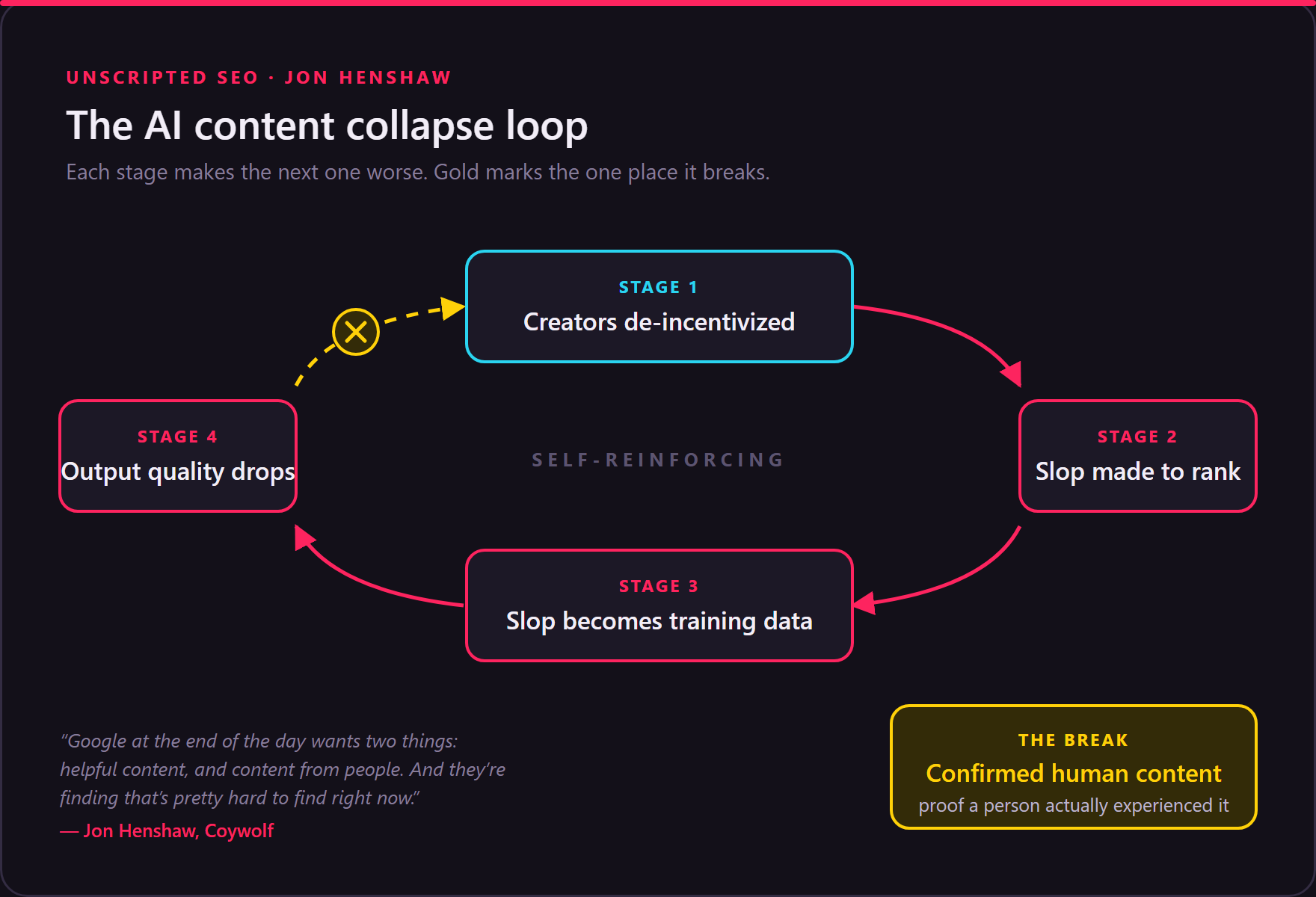
Jon: The content people seek out may not be Google. It might end up being some platform where most of our consumption comes from a verifiable trusted human source — because we’re seeking human connection, and we don’t want anything to do with a thing that has flattened our economy and our livelihood.
From an SEO perspective, I don’t think things really changed with all this stuff, aside from having less visibility. The job is still pretty much the same. You need to do a little more, make sure something’s more buttoned up. And long-term I think there’s going to be a huge cultural pushback toward humanity. I’m an optimist.
Connect with Jon Henshaw
Jon writes at coywolf.com. He’s at jon.henshaw.me, on Mastodon at henshaw.social/@jon, and his notes app is Recollect.
Related conversations: Jason Barnard on entity optimization and AI · Patrick Stox on building in the GEO era · Search Everywhere Optimization · the technical SEO practitioner guide.
On SEO Arcade: Schema markup for AI visibility · Information gain content · E-E-A-T signals building · Why Search Console data is not accurate.
For more like this, explore the Unscripted SEO topical hubs or try the keyword-research tool at SEO Arcade.