🎧 Listen to this episode
Zozimus EVP of Digital Marketing & AI David Wilson — an SEO since the AltaVista days — joins Jeremy Rivera on the Unscripted SEO Podcast to make the case that SEO is now “search everywhere optimization”: driving business results across social, LLMs, and Google, not chasing rankings for their own sake.
🎧 Prefer audio? Listen to the full episode — Search Everywhere Optimization With David Wilson of Zozimus — on the Unscripted SEO Podcast (also on Apple & Spotify).
Unscripted SEO interview with David Wilson
JEREMY RIVERA
Hello, I’m Jeremy Rivera, your Unscripted SEO podcast host. I’m here with David Wilson of his agency Zozimus.
Let’s start with our typical: tell us about yourself, David, and tell us why we should trust you as a digital marketing expert.
DAVID WILSON
Great question. Why should you trust me? I’ve been doing this since pre-Google, back in the AltaVista days.
I’ve been through all of the Google algorithm updates, starting with Florida all the way up to today. I’ve worked with a lot of big-brand companies and small businesses.
So a lot of experience — and I think you can trust me because, at the end of the day, I’m not trying to improve rankings for clients. I’m trying to drive business results. That’s the lens and the focus of everything I try to do.
From Search Engine to Search Everywhere Optimization
JEREMY RIVERA
One thing that’s become clear in the past couple of episodes is my thinking about how SEO and LLM tools interact. Would you agree with the phrase that it isn’t search engine optimization anymore — it’s search everywhere optimization now?
DAVID WILSON
I agree 100% with that. I think I wrote a blog post about it about a month ago, but it shows up in every conversation.
Just some background: I oversee all of our digital marketing effort. So that’s SEO, social, paid, digital analytics, and AI.
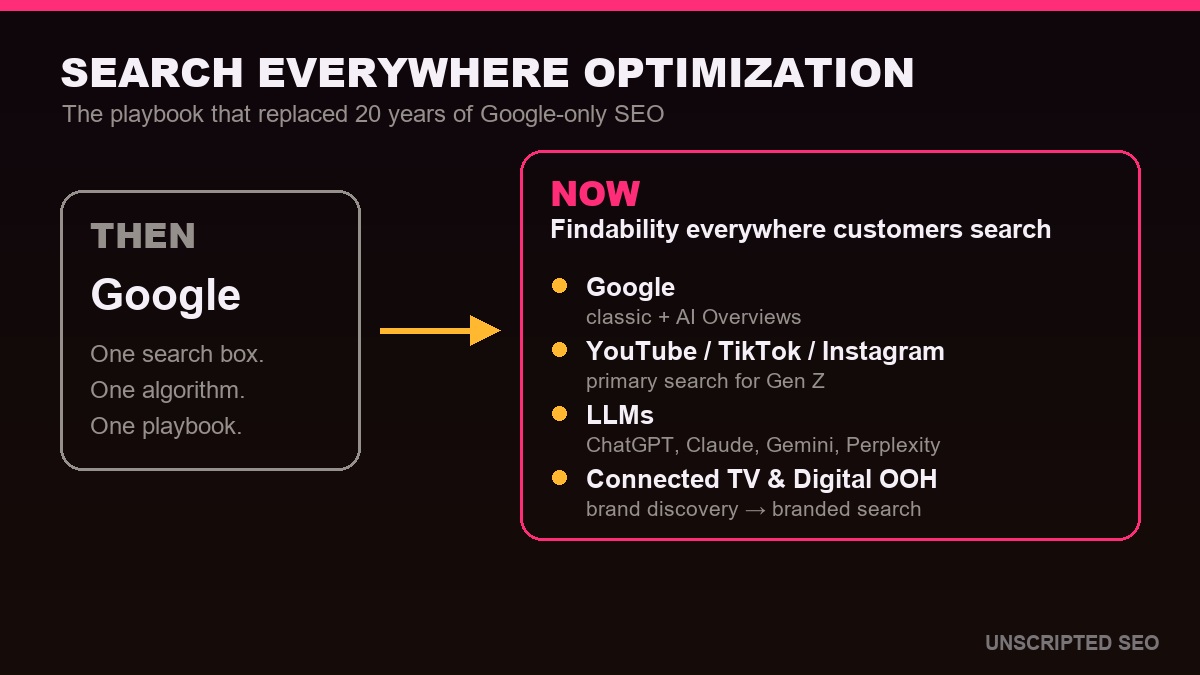
This came up for me as I was talking to clients around social media. You’ve got YouTube and Instagram and TikTok, and hundreds of millions — billions — of people are doing searches on these on a daily and weekly basis.
Now it’s like, these are becoming the primary search channels for a lot of Gen Z and under. So how do you optimize your content and your captions? What are you doing to make your content more findable on the social channels, not just for Google?
And then you lay the LLMs on top of that. So, as you say, search is everywhere. It’s a big change for companies to understand.
It’s not like, ‘I’m just going to show up on Google.’ Now I have to do this everywhere. For them, that’s a difficult thing to wrap their head around, because it’s a different playbook than what everybody’s used for the last twenty years.
A Throwback to the Pre-Google Wild West
JEREMY RIVERA
It’s definitely an evolution, but in some ways — as an AltaVista origin, going back in time — it’s a bit of a throwback to how things were when there was a lot more competition in the original search space.
Google really stepped into a monopolistic status from 2010 to 2020. When anybody thought of search, it was just inherently understood to be Google. But that’s fractured.
We came from a wild, wild west. AltaVista, HotBot, Ask Jeeves — none of them were ascendant over the other. Even when Google came on the scene, it took share pretty quickly, but it took a while to nose out and push out Yahoo. Microsoft before it was a thing. These were different surfaces and different behaviors to market towards.
Is it really that now we’re seeing more mature companies — a broader swath of companies ready to invest in digital? Versus in the late 90s, it was still a tremendous question mark of ‘is this a thing? How much ROI can I get on it?’ And a change in behavior of the C-suite of ‘hey, we need to be digital-first.’
DAVID WILSON
Great question. I think there are two parts. One is, yeah, the C-suite is understanding that this is a fragmented market, and everybody is everywhere. I think the growth of ChatGPT flipped that switch.
But going back to your point about Google from 2010 — that’s sixteen years of the one playbook that everybody’s used. Some of us can go back to pre-Google and reference that, but for marketers under a certain age, all they’ve known is Google.
It’s a really hard spot to move them off, because they’ve built the business on Google — whether that’s organic or paid — and now you’re asking them to do something different. Even though they understand it, it’s still hard for them to do.
JEREMY RIVERA
I saw that reflected in a Reddit thread. Somebody said, ‘okay, I understand what a query fan-out does. What should the tactic be if I just take this list of all these query fan-outs and answer all of them on one page?’
This person took the time to post three long threads of unwaffling: okay, well, the query fan-out is a reflection of how you’re understood in the marketplace, and this is how you should think about a business.
And the reply was, ‘okay, that’s great, and I understand and I appreciate that. But should I just duplicate this list of query fan-out items and explicitly list them on the page?’ And they’re like, ‘okay, let me go over this again.’ We’re so used to being tacticians in a specific vein.
I blame myself in part, because I fell prey to ‘hey, the best way to improve a site audit is to make it a checklist.’ You check this item off on your SEO, and then the game of SEO is just a completion list. And you go through: did you do this? Did you do that? Is page speed under this score? Then fix it this way, with this, this, and this.
What is the keyword density on the page? Those were things that were definite things that clients would ask for. I never went super hard on keyword density, just as a proxy for ‘did we actually say the keyword?’ But that type of checklist mentality is going by the wayside, yeah?
DAVID WILSON
It really is. Clients got used to that, but now you have to give them a little more information behind it — like, why are you recommending this?
The About Page Is Now an AI Asset
DAVID WILSON
One of the things I’ve found with the LLMs is trying to get ChatGPT to understand who you are as a client. And the page they actually go to for that is the About Us page — which is a page that, for SEOs, we’ve ignored for most of the last sixteen years.
Because it was viewed as: there’s not any real SEO value. But there’s now AI value to it. There’s some schema markup, but there are changes to that page now.
So we have to do the explanation to the client: it’s not just a checklist — we want to make these changes, and this is why. And then you show them data. There’s a little more show-and-tell than we’ve had in the past, to explain what we’re trying to get you as the result.
JEREMY RIVERA
That’s in line with my previous conversations with Jason Barnard of Kalicube, all about entity optimization. It came up with Grant Simmons, who’s also an old dog — he came from the AltaVista times. He said: you’ve got to build an entity home, and that’s largely the about page.
I’ve seen it fall off-site, where all of the information about a company is on another site, and you’re like, that’s terrible. Nothing more confusing than an entity that’s fractured over multiple things.
The SEO Tactic That Survived: Internal Linking
JEREMY RIVERA
What’s a specific tactic that’s survived? An SEO tactic you still execute on a regular basis, and it’s pretty much unchanged?
DAVID WILSON
I think internal linking still has an enormous amount of value. And I’m not talking navigation — I mean in-context links to your key pages. That still carries an awful lot of value.
Because at the end of the day, you’re telling Google — and while we’re talking about LLMs and everywhere, you still need to be visible there too — these are the most viable pages on my website, and these are the relevant keywords.
So internal linking, and not using the same keyword all the time where we link to those pages, is a tactic that I find is still working today, and has for the last decade.
JEREMY RIVERA
Is that as simple as linking on longer phrases that contain that query — resisting the impulse of, you’ve got a keyword research tool, so just linking the word ‘keyword research’? Or is it a more specific tactic: do you intentionally take steps to create your diversification, or just try to be more diverse in how you select the context and not limit yourself to a single keyword?
DAVID WILSON
It’s a great question. When we first started, it was just a single keyword — if you were targeting diabetes, any time you mentioned diabetes you’d link back to the diabetes page.
But as the algorithms got more sophisticated, now you’re looking for the related keywords. It’s not just diabetes — now it’s insulin and insulin resistance. Those related keywords give the search engine a little more depth in content, and as a result, that page ranks for a wider variety of keywords.
The SEO Data Stack and GSC “Dark Clicks”
JEREMY RIVERA
Would you agree that right now we have Google Analytics, we have Bing and Clarity, and we have Google Search Console — and then whichever you pick of your rank-tracking / SERP-checking tool? That’s the range of data sources we can look to.
Bing has Copilot query data, so does Microsoft Clarity. Google Search Console is Google search information. And Analytics or Clarity tells you the source and behavior of where people come into your site. Are there any other measurement tools people should add to their stack to better understand search right now?
DAVID WILSON
There are two ways to look at it. You’ve got the core — Search Console, Bing, and Google Analytics. That’s the foundation.
Then it’s what you can build on top — whether you’re using Ahrefs or Semrush or wherever. But the key thing today, because there’s a lot of data, is: how can you use Claude or ChatGPT to pull all of that data in and find things you wouldn’t have noticed before?
That’s where the magic is happening. Ahrefs also has an agent now. You’re taking that core data and pulling things together — and it’s not just ‘a position dropped.’ You can pull in the SERP analysis and say, what happened in the SERPs? Where did this competitor come from? It’s quicker data and a better viewpoint than we’ve had before.
JEREMY RIVERA
I was just meeting with Ben from OpenSEO. They have a Google Search Console MCP built in, and it’s a cheaper alternative — like 10 bucks a month versus SEMrush.
It occurred to me this morning: Google Search Console has what I call dark clicks. If you look at the total number of clicks, then do the math on the table below, it does not match. The named queries never match the total number of clicks. Google is obfuscating that information.
It’s not that big of a problem — except that it is, when it gets extreme. I have one case study where, ironically, the article is ‘Google Search Console data is not accurate,’ which over six months got 54 clicks. They gave me named queries for four of those clicks. So it kind of proved my own article right.
I just used Fable, using Google Search Console and MCP and OpenSEO’s MCP, to triangulate in three different ways. Okay, how can we guess at, and math out, maybe triangulate? So the first was trying different filters with regex to see what comes up. Is it a branded query, maybe? What percentage of those dark queries — what is the initial percentage first?
And it was very high for my site. It’s like 34% of my queries are dark across the whole site. And for that page, obviously, it was five queries out of 54, so like 95% invisible, or dark, queries. So first you apply the regex filters.
But then you can also triangulate. Okay — if I know that this page, through a third-party tool, ranks for this keyword with this much volume and a potential organic click-through rate of this, and on the search console side I don’t see a matching click that fits within that math, then I’ve got a probability of a number of clicks that can surface up there.
You probably could have done this 10 years ago, but it would be very hard to do the math or figure it out. But now that’s like three prompts. You probably don’t even have to use Fable — I just used Fable to ask, as a hypothesis, how can we extract this data and then turn it into a repeatable prompt?
But now that you have that prompt, you can come back and, using the foible of one data source, you can use a different data source plus Claude to disambiguate. Because that’s always been the superpower of SEOs: we’re not looking at a singular data source, and we’re also holding knowledge in our head of the lens through which this data needs to be understood.
So cross-combining these different channels — taking a savvy operator plus Claude plus data sources — you’ve got a recipe for inventive new solutions for old problems.
DAVID WILSON
There’s a lot more information in Google Search Console than people think. The number of people who think you can only export a thousand lines — we’ve been using a Google Sheets plugin, a free tool, that gives us twenty-five thousand lines. That’s a huge difference.
If I’ve got twenty-five thousand lines and you’ve got a thousand — big difference. A year’s worth of data analysis is a pretty big pivot table. For Fable or ChatGPT, it’s not, and we can get there pretty quickly.
The Expected Click-Through-Rate Model
DAVID WILSON
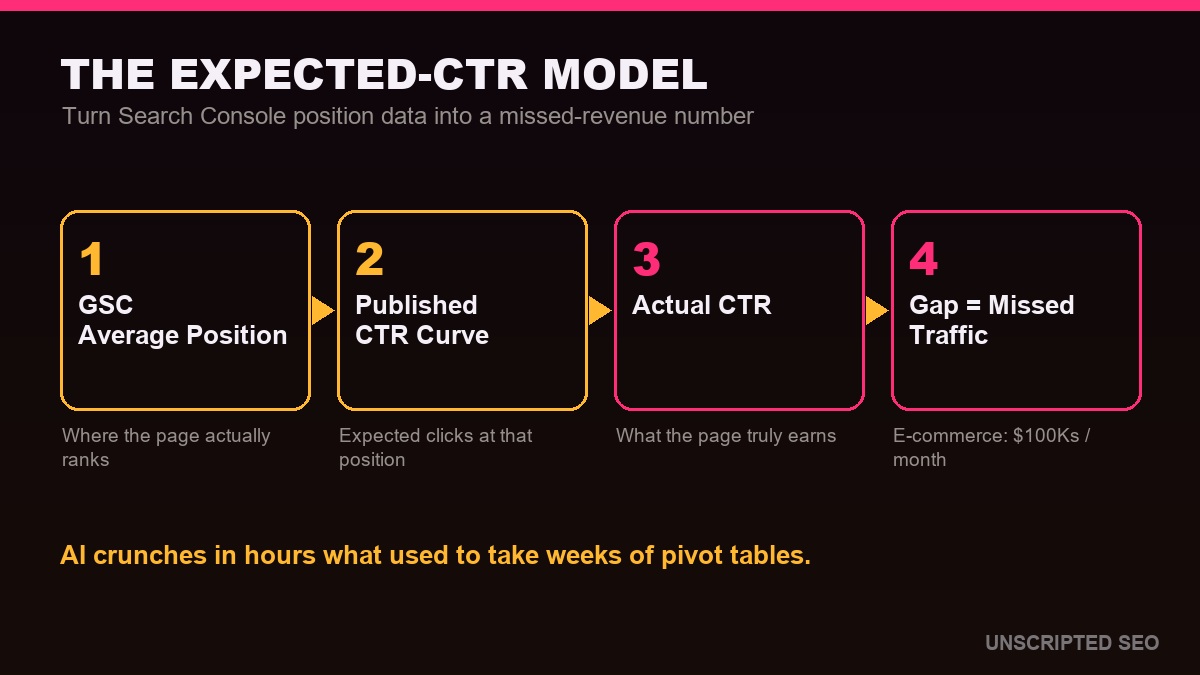
The other thing you touched on that we do: we’ve developed a process around expected click traffic. If you take your Google Search Console average position for a page, and you take the click-through-rate data that’s out there, you can match them together.
You can say, I’m in position four, and I’m expected to get — we’ll make this up — a 9% click-through rate. And I got this many clicks. So my actual click-through rate was this. Am I above it or below it?
We found this really interesting for clients. We can show them: you’re in position two, but you haven’t implemented a new meta description, or that block of text on the front of the page that Google takes now — you’re getting half of the traffic you should be.
And if you’re an e-commerce site, that can be hundreds of thousands of dollars per month that you are missing. The AI tools let us crunch through a lot of that data that was hard to do manually. It would take weeks. Now we can turn it around in hours.
It’s a powerful tool: your click-through rate is four percent and it should be nine. You could double your traffic by making this change. That will get a company to go ahead and do things. Google Search Console with these different tools is still underutilized by SEOs.
I turned David’s expected-click method into a reporting walkthrough on ZapDigits: how to find the page-one rankings that bleed clicks.
JEREMY RIVERA
It’s easier to unblock a creek that’s dammed than to try to get more water into the river. You can get much more outcome, more quickly, for the farmers downstream.
DAVID WILSON
Exactly.
Digital PR Is the New Link Building
JEREMY RIVERA
Are there any broader strategies you’re leaning towards as time goes on? I look at SEO in terms of the strategy layer and the tactical layer — you do tactics to execute strategies. What’s a handful of playbooks you’ve found success with?
DAVID WILSON
There are a couple. One comes back to the search-everywhere conversation. Working with a client in the medical device space, we did a dive into what prompts people were asking the LLMs. Around this particular product, it was cost.
So if I put my SEO hat on: we’re going to create content about this and put it on the website. But then I work with my social media team to develop social content around it and make it found there. It’s not specific just to the SEO on the web page — it’s where else can we get this information everywhere?
The other part: for years we thought about backlinks as the old directories and article websites — but a lot of it was low-quality stuff. Looking at it from the lens of digital outreach, we’re using PR. How can I work with our PR team to get exposure for a client?
If our PR team can get a client in multiple publications in their vertical — local or national — that helps us from an SEO standpoint. I don’t have to hit them over the head and say, can you talk about this keyword? Can we get broader brand exposure? Because that brings everything up.
And related to that: AI is taking away a lot of these top-of-funnel, middle-of-funnel, unbranded searches. It becomes hard to fight that from a paid and organic standpoint — which means people are going to find you from brand.
I think that’s going to become more and more likely over the next couple of years. So if it’s branded traffic, how do they find you? PR plays into that, and social media plays into that, because those are the places outside of search where people can discover you.
And how will people discover you? I think Connected TV plays into SEO, digital out-of-home plays into SEO, because we’re getting exposure on all of these channels and bringing them back to Google to search for us by brand name.
It’s not just keyword-on-page. It’s what’s the PR team doing, and what are we doing on YouTube and YouTube Shorts, and how is that going to get ingested by the LLM? SEO is not just words on a page on a website.
AI Slop Is Programmatic SEO Reborn
JEREMY RIVERA
My friend Michael McDougald at Right Thing Agency just put out something awesome about research into StoryScope — part of how Google detects AI slop. Have you come across any clients who indulged that trigger finger, copied and pasted a bunch of stuff from Claude or set something up programmatic, and just went hog wild on content production, leaning too heavily on AI?
DAVID WILSON
I’ve seen the horror stories — the companies that did ‘we put ten thousand pages up, and look how Google impressions went up,’ and then they dropped the next month because Google did that.
We’ve been lucky in that we haven’t done that, because we’ve never recommended it. We’ve gotten caught occasionally by using the AI tools where the source wasn’t quite right. But AI slop is really easy to get into. We work really hard with clients to not do that.
Because to me, as an SEO, the worst conversation to have with a client is: we did something that just got you thrown out of Google’s index. We never want to have that conversation. So I try really hard to steer clear.
Using AI to generate massive amounts of content, to me, is like going back to programmatic SEO. Before that it was doorway pages. It’s the same sort of tools, and I’ve never really been part of that.
It’s the same reason we lean into genuinely human content — the durable value isn’t volume, it’s the real thing behind it.
Real Marketing vs. Checklist SEO: Building a Moat
JEREMY RIVERA
It almost feels like we’re getting an opportunity to get more value out of other channels. I was working with Pure Air, an air-monitoring company, and we’re doing a park cleanup. It’s one of the few places I’ve found you can get your brand listed on Reddit — you find the community subreddit and say ‘I’m going to do a trash cleanup,’ and they’re all for it. ‘Community cleanup by Pure Air,’ upvote.
Whereas usually, if you do anything explicitly with your brand on Reddit, it’s 50-50 of getting downvoted into oblivion, maybe banned, scolded by the mods. But if you find those opportunities, it’s like looking at the stack of how a company is structured.
Well, you’re contributing a thousand dollars a month to the Make-A-Wish Foundation, but you said that nowhere on your site. Let’s take that thousand dollars that’s making a difference and encourage other businesses to do the same by putting a little publicity behind that philanthropic work.
It’s one of those things — I don’t want to do something philanthropic just to stand out there and do it. But for businesses, the more that businesses co-market with nonprofits… I was talking about this with Andy Choi. He specifically runs a program to help companies not necessarily found new nonprofits, but there are tons of ways to collaborate, and if you’re in a community.
My wife works at a tattoo shop as an apprentice, and her boss is a veteran — it’s hugely important to him. Hey, you should check out and see what the needs of the veteran community in Cookeville are, and find out how you can bolster that. Is it visibility? Can you do a pledge drive? Do they need volunteers, or do they just need cash, or do they need visibility? Because it’s always one of those three with a nonprofit.
By doing that, you create a footprint of links and visibility that — curated from an SEO perspective — gets you so much more bang for your buck than ‘I’m going to pull up Ahrefs, and here’s your four blog posts for the month.’
DAVID WILSON
I agree. It’s real marketing versus just checklist SEO. The four blog posts might work in the short term. But what you said is also hard to replicate, because it takes time and effort.
For that tattoo parlor to go work the community with different veterans groups — that’s great from a business standpoint, and it becomes defensible from an SEO standpoint, because they’ll get links back. It’s hard for another tattoo parlor to replicate that.
So, as you said, it’s not a tactic, it’s a strategy. How can we put our strategy hat on and create a plan that has some sort of a moat around it? Something like that lets you create a moat, because ninety-nine percent of other companies like that are not going to do it — and that gives that company a chance to dominate from a local SEO standpoint.
JEREMY RIVERA
I like the concept of the moat. The commoditization effect of AI tools is pretty extreme in the white-collar workforce. When something can be repeated, you have to find what is unique — the story, your angle or value — to have a differentiator.
DAVID WILSON
It’s never been more important. Years ago I talked to a company working in-house — we showed them: these are the competitors, and they’re producing twice as much content as you. Over two or three years, you’ll never catch up. That company was using content as their moat.
For a lot of businesses it’s: what is the moat I can create from an SEO and digital marketing standpoint that lets me withstand a Google algorithm update, or Claude or ChatGPT doing something, or something in the economy? When you can find that and lean into it, those are the businesses that will do really well over the next couple of years.
Competitor Gap Analysis + the NotebookLM Tactic
JEREMY RIVERA
With Claude and GPT, it’s never been easier to do competitor gap analysis correctly. With the basic tools it was: you have your content and their content, and they’re doing better with these articles. No — you need to find the gap where those articles don’t exist. That’s new market opportunity. What are the intents of people in my audience that are unfulfilled by anybody right now?
DAVID WILSON
Related to that, one of the tactics we’ve been using: we’ll take Gemini, ChatGPT, and Claude and create a prompt around SEO — ‘you’re an SEO analyst, go look at ABC Corp, do research, use all the available tools.’ All three pull something different. We take those three reports and put them in NotebookLM.
And then we say: I’m a competitor of ABC Company — what are their three weak points around SEO that I can take? If it’s a true competitor, I have my action plan. And if I’m ABC Corp doing a 360 on myself, I now know my weakness and where I should focus my time.
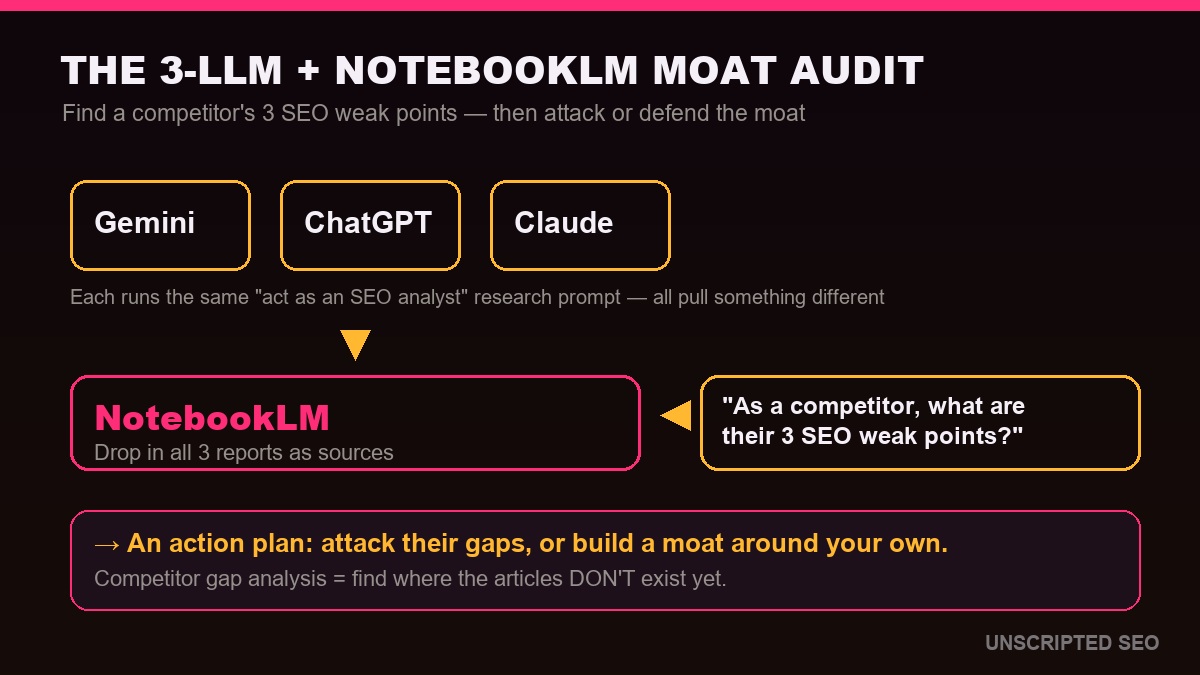
That was difficult to do before, but now you use the LLMs to ask what the strengths and weaknesses are and how you’d attack them — then you lay your own knowledge on top. Now you’ve got a playbook around how to attack a moat or how to build a moat. That’s working really well for us at the moment.
Are Faceless Brands Over?
JEREMY RIVERA
A question from my previous guest, Zach Ellie from finder.com. He was wondering whether the era of faceless brands is over. Are we seeing the rise of CEOs and directors — Elena Verna at Lovable, people from the Anthropic team — being faces, having personas and a public presence, giving more of a human element to brands versus the corporate faceless entities we’ve known? Are we going from faceless to archetypes and people associated as figures with successful brands?
DAVID WILSON
We definitely see that in social — when you can put a face to a brand: this is our team, these are our leaders, and more importantly, this is the behind-the-scenes. ‘We did a local community event, and this is our team out there.’ That works really, really well at a small-business standpoint.
I’m not a hundred percent sure — because I know Dario more than Sam, would that make me buy Claude versus ChatGPT? Or would I have bought Moz back in the day because Rand was there, and am I less likely now because he’s not? I might be. But at least in a crowded marketplace, it lets you identify who they are.
The challenge for brands: as you move from faceless to having a face, you have to stand up for something. For a lot of companies that’s really difficult, because they’re afraid they’ll upset a percentage of their audience who don’t agree. So there’s that risk factor.
JEREMY RIVERA
That’s true, because you’ve got the other side of it: humans are going to human. If you’re focused on selling concrete walls in Florida but you’re nationwide, and your CEO says something that leans one way on the political Richter scale versus another, then you just alienated half of your potential audience in the South, or half of your potential audience in the North.
So I guess it does come with the risk of, the more people that you put out there that are associated with your brand — do you give them, is that partial? Are they just on the code side? And then if they do something controversial, you have the repercussions of that.
So maybe it’s within specific elements and specific arenas — like surfacing people to do the conference circuit or the podcast tours, and get out there to have human-to-human conversations. Or even just leverage the superpower that is, right now, human-to-human conversation, by doing internal interviews and introducing your CEO in a more controlled aspect, or the director of development in a controlled aspect — using that as a marketing vehicle, but not putting them in the driver’s seat of your entire company, because they might drive it into a ditch.
DAVID WILSON
I agree. But there’s also a recruitment part. If I’m looking for a job in marketing, and I see a VP of marketing or a CMO on these podcasts, and they’ve got great ideas, I’m like, I want to go work for that person — versus, if it’s faceless, it’s just company A versus company B, and it might come down to money.
The other one can attract talent if you’re visible across the channels. That’s a part of being visible that businesses don’t think a lot about: how can it help me recruit really good talent?
Resources & Where to Find David
JEREMY RIVERA
As we round out, are there any special projects — presentations, downloadables, or resources at your agency site — you want people to be aware of? I’ll add these to the show notes.
DAVID WILSON
Yeah — we have a series of case studies on zozimus.com around work we’ve done in MedDevice, e-commerce, higher ed, and finance from an SEO standpoint, that are quite good.
JEREMY RIVERA
I appreciate you stopping by and giving your wisdom. For my listeners, I’ve got a ton of new resources up on unscriptedseo.com — a whole hub library of all of my past guests. I’ve had 120 so far, broken up by topic. You can read through David’s recap if you want something specific we talked about. Check it out for more, and David, thanks for stopping by.
DAVID WILSON
Thank you very much, Jeremy. This has been great.
Key Takeaways
→ Search everywhere optimization: findability now spans Google, social platforms (YouTube/Instagram/TikTok) that are Gen Z’s primary search channels, and LLMs — a different playbook than the last twenty Google-only years.
→ The About page has flipped from an SEO afterthought to a core AI asset — the “entity home” ChatGPT reads to understand who a company is — which takes more show-and-tell with clients on the ‘why.’
→ Internal linking is the tactic that survived: in-context links to key pages with diversified anchors and related keywords (not one repeated keyword), so a page ranks for a wider variety of terms.
→ The expected-CTR model turns GSC average position plus a published CTR curve into a missed-traffic number — for e-commerce, often hundreds of thousands of dollars a month — and AI does in hours what took weeks.
→ Digital PR is the new link building: as AI erodes unbranded top/mid-funnel search, branded traffic wins, so PR, social, Connected TV, and digital out-of-home drive brand discovery back to Google.
→ AI slop is programmatic SEO / doorway pages reborn; the durable play is real marketing that builds a defensible moat (community ties, local SEO domination) competitors can’t easily replicate.
About David Wilson
David Wilson is EVP of Digital Marketing & AI at Zozimus, a Boston marketing agency, where he leads SEO, social, paid, analytics, and AI. He’s been doing search since before Google — back in the AltaVista days — and you can find his agency’s case studies (medical device, e-commerce, higher ed, finance) at zozimus.com, or connect on LinkedIn.
Turn this interview into action with the SEO SOP: Find the Traffic You are Leaving on the Table with the Expected-CTR Model — plus a free, no-gate PDF.