🎧 Listen to this episode
📺 Watch the interview
Wedding photographer and freelance SEO Jonathan Schüßler joins Jeremy Rivera on the Unscripted SEO Podcast to break down programmatic local SEO across ~80 German towns, low-volume “money” keywords, and the YouTube → TikTok → blog content flywheel that reached 1.5 million accounts.
🎧 Listen to the full episode: Local & International SEO Through the Lens of Jonathan Schüßler — on the Unscripted SEO Podcast (also on Apple, Spotify & YouTube).
Unscripted SEO interview with Jonathan Schüßler
JEREMY RIVERA
Hello and welcome to the Unscripted SEO Podcast. I’m Jeremy Rivera, your host.
I’m here with Jonathan Schüßler. Why don’t you give yourself an introduction and focus on your bona fides — the experience that should make people trust you when you’re talking about this subject?
JONATHAN SCHÜSSLER
Hi, I’m Jonathan. I come from a background of studying sports and mathematics, and photographed on the side for a long time.
Then I started doing wedding photography about 10 years ago, and over that time I had to promote myself starting out.
Then I switched to agency life about five years ago and got really into the SEO stuff, and nerding about it.
I think I understand the basics of how algorithms work from my study of mathematics.
It’s really interesting trying to figure out how this stuff is evolving and seeing new things come up — sometimes stuff that’s not good for you in the long run, but works as well — and just trying to get a feel for it.
It feels like everyone’s trying to solve this puzzle, and I’ve been into puzzles all my life. So I really, really like SEO right now.
And basically just building trust with your audience was my main thing over the past few years, which resonates with SEO as well, because you’re really trying to gain trust with Google and LLMs now.
JEREMY RIVERA
That’s exactly right. I try to get people on who are in the trenches, who are executing on this, and not just the front man of an organization.
SEO is always different in how it’s viewed or understood based on whether you’re in-house, a freelancer, a fractional CMO or CFO, or even a PPC person. They all have different perspectives on it.
That’s the nature of interviews and conversation: we’re combining our shared experience on a shared topic, and it’s going to come out with something new and weird.
So I like to understand that at the outset — where have those experiences come from?
If you’ve only done in-house for somebody and grew entirely in-house that entire career, or if you’ve been freelance and never been in-house on the opposite side, then you might not have as much clarity about the pressure to convince a boss to execute on budget.
You might be scrapping for $80 a month for an Ahrefs, versus coming in as a consultant where you’ve got your tools as weapons and you can convince the client super easily: oh yeah, we need this and this and this. And the in-house guy is sitting there with Slack going, can I get any of this money to do this stuff?
So SEO is an interesting industry that has developed in the past 25-ish years — that didn’t exist on the face of the planet before, as the internet gained its preeminence in our culture and discovery.
So I’m curious: where are you at now with your career? I understand you’re doing freelance — how has that experience been different from agency life and where you started learning SEO?
From agency life to freelance SEO
JONATHAN SCHÜSSLER
In the agency, we were basically a web-based agency, building new experiences for either existing companies or helping new companies come up in the space.
We didn’t only do SEO — we built the whole brand: the socials, the web design.
That was really tough, because I got to face a lot of, basically, gray old men who either had an existing website from 2004 that looked exactly like Windows XP with no sense of content on it, or other companies barely just starting out.
And they were like, we need to get on Google page one. I’m like: you have no domain, you have no backlinks, you have nothing for us to work with. So we really had to start scrapping from each side.
It was sometimes tough because it was in a smaller city in Germany. We had to do a lot of local SEO, but some of the companies really wanted to go nationwide, and they didn’t really get what’s needed to do that.
They didn’t have a marketing team behind it. They maybe had one person sitting there trying to gain some newsletter followers.
As a freelancer now, I can approach companies myself — I’m not the boss of the agency who goes to someone saying, yeah, we can do all that for you, we can get you on Google page one, and then I have to deliver with a company that’s not prepared to deliver.
Now as a freelancer, I can tell them: this, this, this is what I need. And I can get into a conversation with their boss pretty much, which is way easier than it used to be in the agency.
The agency was very separated. You would always have just your one little project — I’d maybe do the SEO for the website and also do some Instagram content, where their target audience wasn’t on Instagram, but they wanted Instagram because Instagram is new and hip and cool and young, which it already wasn’t at the time anymore.
So it’s been difficult and the switch-up was different. But I’m mainly doing SEO for service-based businesses now, which is much closer to what I do in my own company.
That really helped me focus down on a few certain spots. It’s not that any client who walks through the door is just a fit for what I offer.
JEREMY RIVERA
I’m curious, because I haven’t had the opportunity to do local SEO in an international sense, for another country.
Have you had cross-country local SEO experience — doing something in America or Australia as well as Germany or Britain?
Is there a common line, or is there a big difference between the local SEO game for service-based businesses based on the country you’re in?
Programmatic SEO and the 80-town local strategy
JONATHAN SCHÜSSLER
I haven’t done any cross-international SEO work, but from what I’ve heard from different podcasts, the game is pretty similar in a lot of ways.
I’ve listened to this one Danish guy — I forget his name right now — and also Edward Storm. They’ve talked a lot about different local SEO tactics that I couldn’t quite phrase the rule behind, but that I really acknowledged here.
For me, my other business is mainly wedding photography and videography — I’m a specialist in doing both at the same time as one person.
So I’m kind of local, but at the same time I’m not region-based like a plumber. I can travel two hours to a wedding, that’s no problem. So I have this net of cities.
The first time I heard of programmatic SEO, I was like: this is exactly where my programming background and my marketing knowledge come together.
I moved cities — I moved two and a half hours down south — and I was like, I need to be present in that area without having any backlinks there, without having any newspaper articles about me.
And the area I’m in is very, very competitive, because we have the best wine region, with the nicest venues for weddings around.
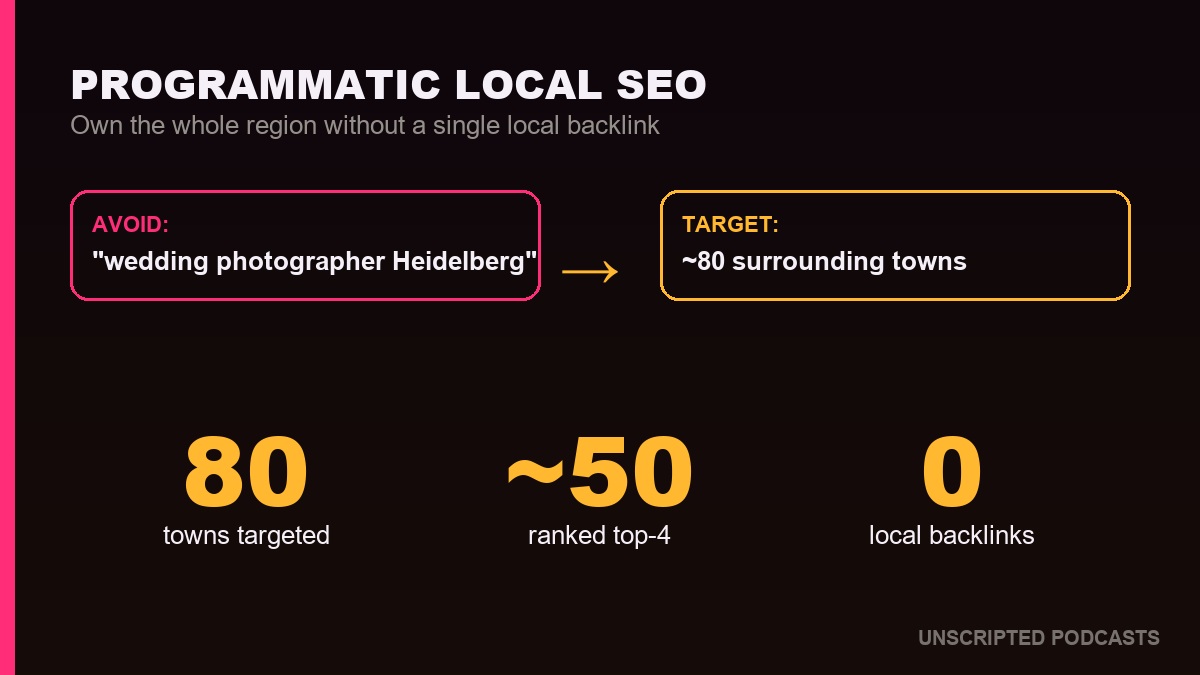
So I couldn’t target “wedding photographer Heidelberg,” because it has a very high difficulty score. I thought, well, we have so many tiny cities around.
So I literally targeted every city within two and a half hours of my surroundings. I have a list of about 80 cities that I’m targeting, and I’m ranking top four for about 50 of them — the ones no one’s targeting, because everyone, even the guys who live there, targets my city.
JEREMY RIVERA
There is that pressure — if you’re getting hired to do SEO in a competitive market, it’s like Nashville. I’m in Cookeville here, an hour away, a completely different market.
Most people who live in the city don’t want to drive to Nashville. But if you’re in this region, they say, yeah, you need to conquer the Nashville Metro.
There are hundreds of literal cities, and you’re right, there’s an inverse pressure: our shop is in Franklin, 15 miles from downtown, but they don’t want to rank in Franklin — they want to rank in Nashville.
I was talking with one of my SEO friends, Michael McDougald of Right Thing Agency. Google used to — and this may be ancient history to you — from 2005 to 2012 have a distinct rule: you can’t have a doorway page that is one region just repeated for a different region, and they cracked down on it.
But it really seems like the inverse is true now: if you do want to rank locally, you need to make multiple different service pages, location pages, and service-and-location-page hybrids to differentiate and even have a chance of generating local search.
Wedding photographer Kronberg: the low-volume, high-value keyword
JONATHAN SCHÜSSLER
I’ve experienced that a tiny bit. There’s definitely a limit where they crack down on you. But for some of the pages, they’re so desperate to find someone to cater to that keyword that they’ll allow it anyway.
One of my favorite keywords — and I’m pretty sure your podcast listeners won’t cross me on this one, I hope — is wedding photographer Kronberg.
Kronberg is the richest area in Germany. It’s a tiny town near Frankfurt, and all the high-finance people live there.
It has this magical castle that’s been used for tons of Bridgerton-level TV shows, which is one of the most prestigious five-star hotels in the world.
No one’s targeting this keyword. It has 10 clicks per month — but those 10 clicks per month, you could live off those 10 clicks in one month.
It’s crazy to me that no one’s targeting this. I know people don’t care because it’s only 10 clicks per month, but — why not target it?
Why target a thousand-click “Heidelberg” if you’re ranking place five and you get maybe 10 or 15 clicks? Why not target the one where all the most expensive stuff is happening, even if there aren’t many clicks?
Don’t sort keywords by volume — sort by where the money is
JEREMY RIVERA
I think that comes down to one of the weaknesses of the SEO industry: over-reliance on data — thinking SEO is popping open SEMrush or Ahrefs, finding the highest-volume term or city, and targeting purely based on volume.
I’ve been in consulting situations where I have to show them: here are the search volumes, but let’s sort it based on where you actually make money the most.
Maybe it’s some of these smaller towns, or a region where it’s a lot cheaper. I’m working with a precast wall company right now — there’s much higher volume in Atlanta, but their main center is in Florida, so the shipping cost is half.
They can deliver locally for half the cost, so they’re winning three times as much business.
So make sure you don’t get shoved into a corner as a consultant of, “hey, can you come do SEO for our site?” No, no, no — I don’t do SEO for your site. I help develop your business’s digital footprint.
Understand your cross-channel picture. Are you trying to drive more conversions through your email? Your email list doesn’t grow by itself — you have to do things, and the best way to do that is with your website: figure out what content you can put out.
Then it becomes a hybrid social-media-slash-organic thing where the content you’re putting out maybe ranks, maybe it doesn’t, but you want to coordinate with the social media person if they exist, and the email management person if they exist — or it’s you.
So what I’m seeing — and you can tell me if this is true — is that the bigger success for freelancers and SEO consultants lies in expressing domain knowledge in SEO, but interacting with, coordinating with, or literally executing non-SEO items as well for the company.
JONATHAN SCHÜSSLER
100%. We know Google is growing to way more than just our title, our H1, our first sentence, and our alt text — they really start pulling everything together.
Especially if you’re doing local SEO, they have this great source for pulling all the data your company gives out together, which is the Google Business Profile.
If you’re linking all your socials there, they’ll start understanding what your business is about — what kind of users are interacting with your business on those social accounts.
Since Instagram allowed their posts to be indexed, I increasingly saw that people who saw me on Instagram also found me on Google.
The same happened with TikTok, because Instagram got pressured — TikTok already did it. They were like, yeah, take our content, get us more people on the site.
Sorry that I’m always talking about my wedding photography now.
JEREMY RIVERA
I love having a case study. It’s fine, I’m not offended.
I consulted for a poop-scooping company, and a lot of my examples for a while were around scooping poop — but it was very actionable. It was funny, because the poopy lessons apply elsewhere.
So use the example that you have. I’m certainly not going to turn up my nose at your photography example when my example is poop-scooping.
The content flywheel: YouTube to TikTok
JONATHAN SCHÜSSLER
About five years ago, I started watching YouTube videos from this Canadian wedding photographer who started doing photo-and-video hybrid.
As a side note, he said: when I was practicing video, I started doing some videos about wedding venues that I visited.
He’s huge — he has like 600,000 on YouTube. He’s been around the block, and he’s kind of old for a wedding photographer, because most of us can’t deal with it at 40 anymore. He’s around 45, 50-ish.
He just said this, and it sparked the idea. I was like: I’m good at video, I could show wedding venues to potential clients.
Because I see a big market of couples who get married not in the same region where they live, and they don’t want to drive four hours every time to visit a venue.
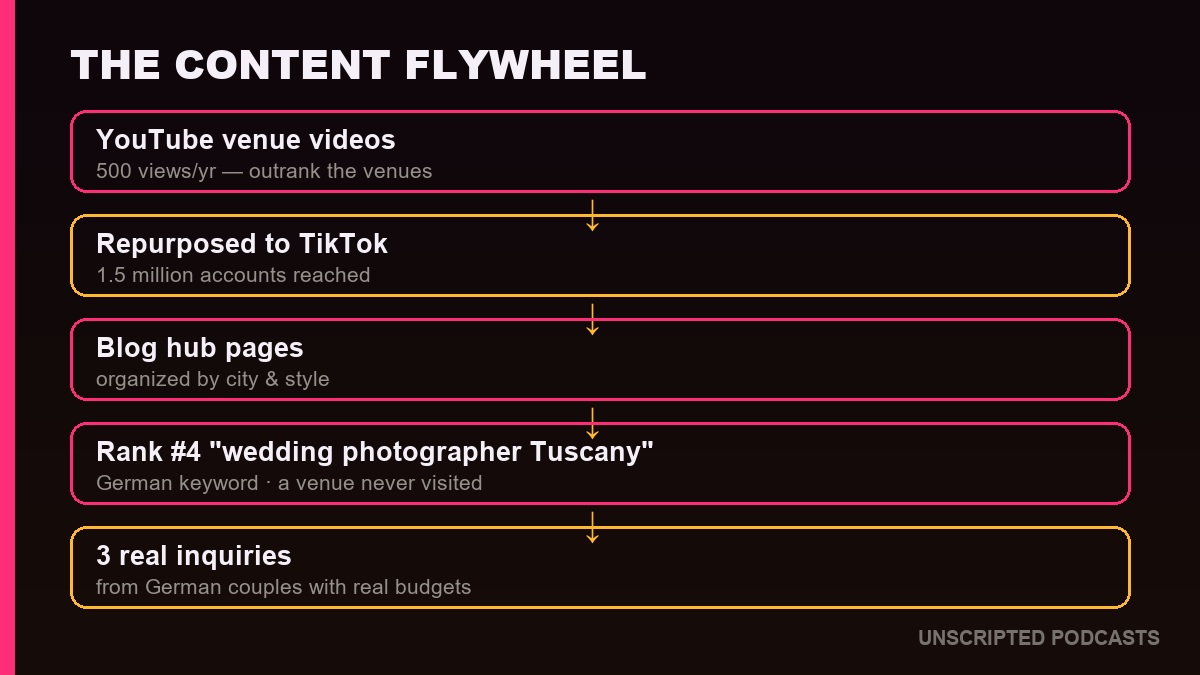
So I recorded those videos, put them on YouTube, and some of them outranked the location itself, because the venues had so little good material about themselves on their own website.
And I was like, this is great — I get 500 views per video per year. They never slow down; they’re never fast, but they never stop.
Then this year I got the idea: might as well try repurposing them on TikTok. Out of nowhere, I got one and a half million views out of those videos.
And I linked those videos to the YouTube videos. So I get 1.5 million people scrolling through my stuff — it’s accounts, not views, sorry, accounts, which is better in my opinion.
And it’s all my target audience: women between 20 and 35. So they click on my YouTube videos, and from my YouTube videos they click on the blog to get a few more impressions.
Then I have hub pages of those blogs organized in different cities and different styles.
International SEO: ranking for a venue he’s never visited
JONATHAN SCHÜSSLER
And those hub pages sometimes now outrank the locations, or at least place two, three, four for some of the most prestigious wedding venues in Europe.
I have this one venue I’ve never been to. I don’t have a video about it. It’s in Tuscany, one of the top 10 venues in Europe, and I’m ranking place four for it.
That links to my wedding photographer Tuscany page. I have about four clicks on it this year, and three inquiries from German couples — because I targeted the German keyword for the Italian place.
If people travel for the wedding, two countries apart, they probably have a decent-budget wedding, right? They wouldn’t do that if they didn’t have the budget. So: four clicks, three inquiries.
One of the couples — I literally saw the email pop up while we were recording. They messaged me two months ago saying, yeah, we really want you, we don’t have the venue yet, there are two we could do. And now they’re coming back, and they found me on TikTok, moved over to YouTube, moved over to my blog, moved over to my wedding photographer Tuscany page.
JEREMY RIVERA
And you said you didn’t have any international SEO experience…
JONATHAN SCHÜSSLER
Sorry, I forgot about that. Yes, I’m doing that for me and my brother — but that’s German, not English. I feel like that could be different.
JEREMY RIVERA
That’s fair. Some people, as monolinguists, kind of forget or get biased when we’re consulting. There’s multi-region, and then there are crossover languages.
Trying to show up in Italian search, or French search, or Greek search for Tuscany is different than being an authority in Germany because you’ve tackled all of these similar venues.
I love that development of thinking about the market, and not just the one single thing. It’s not just, “I’m a photographer in these 50 cities” — but where do you do that photography? How does it tie in?
If you’ve got a mobile photo-booth rental company, you should talk about the venues as much as you talk about your own photo-booth rental option.
SEOs get so locked in on their own specific service pages, and they think, I need to go top-of-funnel, so I’m just going to talk about photography in general, wedding stuff in general.
But there are different categories and types of content to explore and craft that LLMs are going to chew on and cite — and you can get traffic that way.
Even though LLM-based search is just a few percent of the total market, it’s huge on the minds of CEOs.
JONATHAN SCHÜSSLER
I think it might be two to three percent or something.
JEREMY RIVERA
The messaging for the past six months has been “SEO is dead” again. But really, when it comes to the fundamentals, it’s just stupid SEO that’s on the ropes. The fundamentals are still there.
Junk food SEO and the ChatGPT content problem
JEREMY RIVERA
Creative marketing is still there. Understanding the business perspective and tying it into those values is still there.
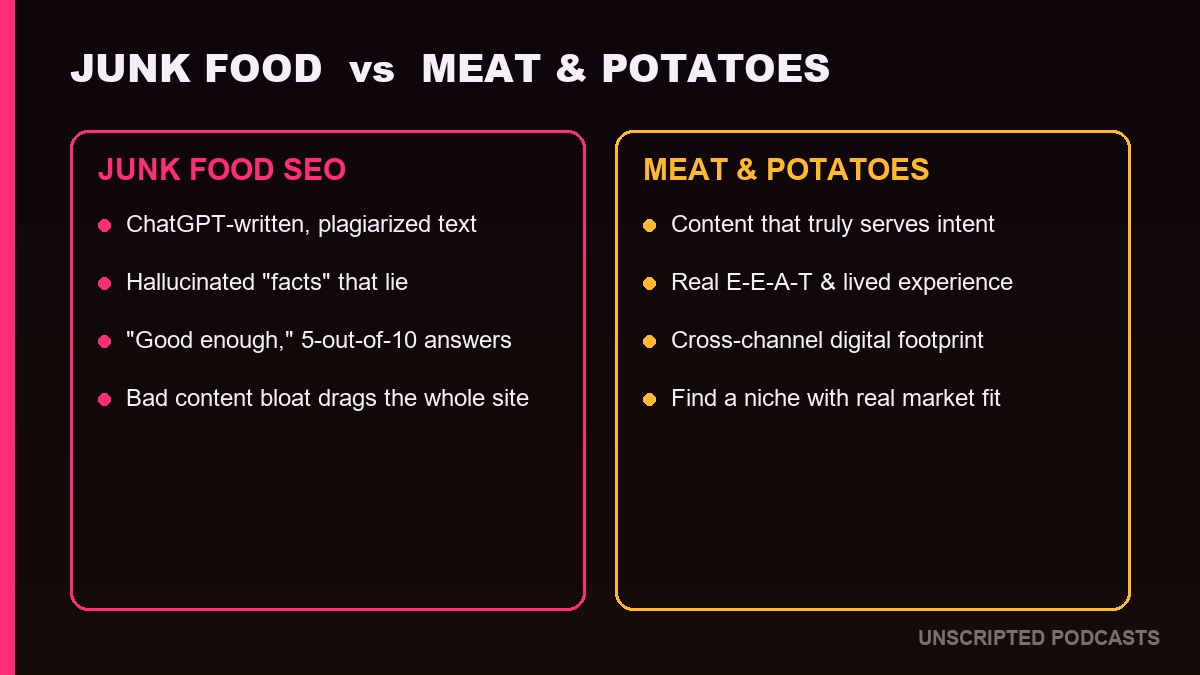
So I’m curious: what’s the fast food right now in SEO? What’s the junk food that’s being sold, versus the meat and potatoes we’ve been talking about? What do you think will be giving us a stomach ache very shortly?
JONATHAN SCHÜSSLER
100%: overusing ChatGPT in your content.
I come across so many people who are like, oh yeah, I can do my own website with Lovable and do all the text with ChatGPT. And it’s just all plagiarized content.
That kind of works sometimes, because it’s a fresh domain — even Google doesn’t have much old data about you, so you’re not getting flagged for reusing your own content — but it’s not great content.
The most important piece right now is getting stuff that actually serves the intent. E-E-A-T has always been important; making great content that serves the intent has always been important.
There’s so much stuff being thrown out where people think it’s good for the intent, but it’s actually a five out of 10, because ChatGPT doesn’t give great answers — it gives good-enough answers. That’s not bad, if it’s not hallucinating, which it did so much.
When I set up the page for all the different venues, that was about a year and a half ago, and it sometimes completely lied the whole way through.
I was like: I’ve been at this venue, you can’t get 300 people in this room, that’s a 40-people venue, what are you talking about? And even when I say “you’re lying,” it thinks for two minutes and still lies. What are you doing?
If you’re spreading misinformation, in the long run it will always bite you, especially for LLMs. If they keep learning, they’ll get better at differentiating what’s actually good information and what’s bad information.
If you’re bloating your site with so much bad information, that’s going to haunt you in the long run — because that’s how I would make the algorithm. If 80% of your website is bad content, I wouldn’t rate the other 20%.
HCU, and why bad content drags your whole site
JEREMY RIVERA
You’re basically describing the knock-on impact of the HCU. Google leveraged LLMs and machine learning to re-drop the Penguin bomb.
There was an age of SEOs where we didn’t have a site-wide penalty option. Panda and Penguin were no longer nuking sites left and right for content or scammy links. But then HCU comes back up.
Part of that was to address overuse of AI. Part of it was to address people overusing programmatic, and part was to address the creep of sites that were literally just getting thrown up, with AdSense thrown on them, that didn’t really add new unique content.
And that’s just accelerated with the popularity of GPT, of Claude, of these tools. They’re like my dad.
You can ask my dad, why did Slobodan Milošević get ousted in Yugoslavia in the ’90s? And he’ll go on a 10-minute tirade about the impact of the Mongol invasion into the region.
It sounds good, but then you dig into it and you’re like: you made half of that up. You’ve connected A to B to C, but really it was kind of like A, but not really.
The problem is the tool itself is based on probability — it’s math. It’s guessing what is most likely the right word that’s going to pass muster, that’s going to kind of be real.
So people are digesting and accepting output from GPT as fact, like a human speaks it. But it’s not a human. It comes from its knowledge base and from third-party citations, and sometimes those citations get mutated as it tries to generate a sentence that makes sense.
You’re right, there’s a huge proclivity for lying. I always process my interviews with Claude afterwards, but there’s an error rate of one in five or one in 10.
I’ll read through it like: we did not talk about that at all. This section of text, back and forth, is completely fictional. I never said that, he never replied that — in fact, we made the opposite points.
And I’m like, okay, I’ve got to restart this. Strictly don’t add new words, just act as a careful editor, back and forth.
I know a lot of shops, a lot of SEOs, and a lot of laymen using this tool are not going to be that careful. If they don’t have a good knowledge base, and didn’t just come off the conversation, they’ll go, yeah, this looks like SEO gibberish, they totally said that.
JONATHAN SCHÜSSLER
My brother, for example, keeps asking. We keep having this conversation where he has a new idea: I’m going to ask ChatGPT, what should I do to improve my SEO, how can I climb in the ranks?
And it gives him answers that I’m like — sometimes, but not really anymore. This could have worked maybe 10 years ago, but it doesn’t anymore.
So it’s really just getting the stuff it heard most about, which is usually the stuff that’s not used anymore.
The diminishing incentive to publish real SEO insight
JEREMY RIVERA
That’s a big problem, because you also have an oblivious eye to the modus operandi: why did this content get created in the first place?
In SEO, there was an incentive from, I’ll say, 2002 to 2012 — a very pure, culture-driven, “hey, we’re figuring this out, I’m publishing as I go, I’m digging in deep, this is what I figured out.”
But after 2012, a really big change came, as Google rewarded less of who was actually doing the publishing in SEO. It moved more toward the SaaS companies who had a big enough budget to keep publishing, and fewer individual blogs, bloggers, SEOs, and hardcore enthusiasts.
They moved off to forums, then to Slack channels — really the best discussions were on Twitter. Twitter went down the tubes.
So now there’s a ghost-in-the-shell effect: the people creating the most content about SEO are the teams of famous SEOs, but it’s not actually written by the SEOs anymore. It became a content-mill production for SEO agencies and SaaS companies.
The quality, the depth, the care, the really niche, weird, bizarre abstracts — it’s not there anymore.
Anything true like that is in the big SEO — not the subreddit, because the subreddit’s spammed out now, but the Slack channel, or a Discord. That’s where the true experimentation is happening and people are really discussing real stuff.
Because if you have a truly powerful thing in SEO that can make you a bunch of money, why are you going to blog about that?
Only if you can harvest it — turn it into enough organic traffic to get clients and make it worthwhile — do you have an incentive to publish it.
That may be specific to SEO, but it applies to other industries as well: insights, industry secrets. Why would they put their industry secrets out there if there’s not enough AdSense money, and with sites getting choked off by HCU now?
What’s the incentive to publish? It’s diminishing — especially as competition comes up from LLMs, and why would anyone search for it when they can just get their answer from the AI Overviews?
JONATHAN SCHÜSSLER
100%. That’s in a lot of different categories, not just SEO. But in SEO we have the problem that if you publish something and it goes viral, there are so many developers who are like, yeah, this is not intended, let’s patch that by tomorrow.
So that’s a huge problem in SEO. It’s a bit less of a problem in other categories.
We started off the internet being like, yeah, we can share everything, and it’s becoming a bit more… gatekeeping is definitely a thing, especially on social media.
I’m not sure if you have the saying as well, but: if you can’t do it, teach it.
JEREMY RIVERA
Yeah, we have that saying, for sure.
JONATHAN SCHÜSSLER
I definitely feel that’s the case in photography as well, and in social media marketing, 100%.
The guys talking on social media about “this is how you get views, this is how you hook people” — they just repeat what they’ve learned somewhere else, and it’s not always working. It’s definitely not working most of the time.
They only get the views because they’re talking about how to get more views. That’s a pretty big topic on social media, because it’s somehow this self-sustaining machine of people thinking, I can do this better.
JEREMY RIVERA
There is that entropy. I believe it was A.J. Kohn who said it’s the enchatification of Google results — changing the phrase “it’s good enough” to “it’s Goog enough.”
JONATHAN SCHÜSSLER
Sorry, I don’t know that vocab.
JEREMY RIVERA
It’s like Google will just accept this level of things. I was mentioning this in another interview — this acceptance of, wow, this AI Overview just told me to pour gasoline on my sandwich.
JONATHAN SCHÜSSLER
That was a great time, when those shitty Reddit posts started surfacing in the AI Overviews. That was so funny.
JEREMY RIVERA
Culturally, in my opinion — for Microsoft in 2010, if they had released something that would have gotten a diver killed because the data was inaccurate about how deep you could go, that would have been a scandal.
It would have been news cycles, it would have damaged them — they wouldn’t have gone to market with what is essentially a live beta test.
We’re living in an age where, for some reason, the appetite for this AI capability is so high — I don’t know whether it’s the C-suite, investors, culture, or programmers — that there’s such an interest in it.
There’s a live beta test happening right now. Every new version we release is a new live, mass-cultural beta test of these programs, and it’s accepted.
The error rate is just accepted. What would be a company-destroying disaster is maybe a few headlines that aren’t great — but who even believes the headlines? They’re AI-generated too.
Finding your niche in the age of AI
JONATHAN SCHÜSSLER
Everything right now is AI. I’ve been to a few entrepreneur summits in the area, and everything is AI, AI, AI. Every company wants to use AI, and everyone is interested in what’s the newest AI. It’s the biggest, most talked-about topic right now, and it’s only getting bigger.
It will definitely slow down at some point, I think. And so many companies starting up are GPT wrappers.
I heard this interview with Altman, and it was like: if you’re building something really cool with GPT-5, but it’s not getting better every time a new version comes out, your company is instantly going to drop at some point, because when the new version comes out it’ll be so much better than the previous one.
The example he used was: if you’re building a tutoring program that with GPT-4 could teach year-one-to-three students, with GPT-5 it might do one to five, with GPT-6 up to ninth grade, and maybe with GPT-7 or 8 you’ll be able to do your full high school degree, tutored by whatever GPT wrapper you’re building.
That’s the kind of company you should be starting to build right now if you’re interested in AI.
But what’s really important — same as in SEO — is you really, really need to find your niche.
Before, it was good to have a niche and branch out a little. But with AI, you need to find, like, the AI to help with doing your bookings as a plumber — something super niched out. Maybe a bit similar to what I said about all the little towns I’m targeting with my pages.
You need to find your niche that has a proper market fit. And if you have that proper market fit, you’ll automatically gain a little traction, and then you need to surround it with a proper repurposed-content structure.
That’s the stream where Google really wants you to branch out and look like a bigger company.
Beforehand, you could have only an active Instagram and it would be fine, because I’m a photographer — and maybe a Pinterest. Those two channels are mainly photo-related, so that’s fine.
But now it feels like: okay, I need some press releases, I need some LinkedIn posts, I need a whole bunch of stuff, because that’s what a bigger company would do.
So Google puts more trust in you if it thinks you’re more like a good, established company — whereas before it would only be the one channel that’s shown.
I feel like comparing yourself to the biggest company in your niche really helps you figure out what you should be doing.
JEREMY RIVERA
Matt Brooks of SEO Tarik and I were talking about this. You need to understand: are you the 800-pound gorilla in your industry, or are there a bunch of 800-pound gorillas and you need to find out how to survive?
There is space, but you still have to make a name for yourself. You need to understand the market you’re playing in, your role in it, and the potential.
So that comes back again to understanding the bigger market view — not just “add an H1, edit the meta title, include internal links.” There are fundamentals, but there’s more value in connecting cross-channel and understanding the bigger market picture.
I love this conversation. Let’s wrap it up: what’s your hottest take right now? What’s your spicy take for the SEO industry? What’s a big win, what’s a big loss, what’s happening?
Hottest take: 30-minute videos as the next E-E-A-T frontier
JONATHAN SCHÜSSLER
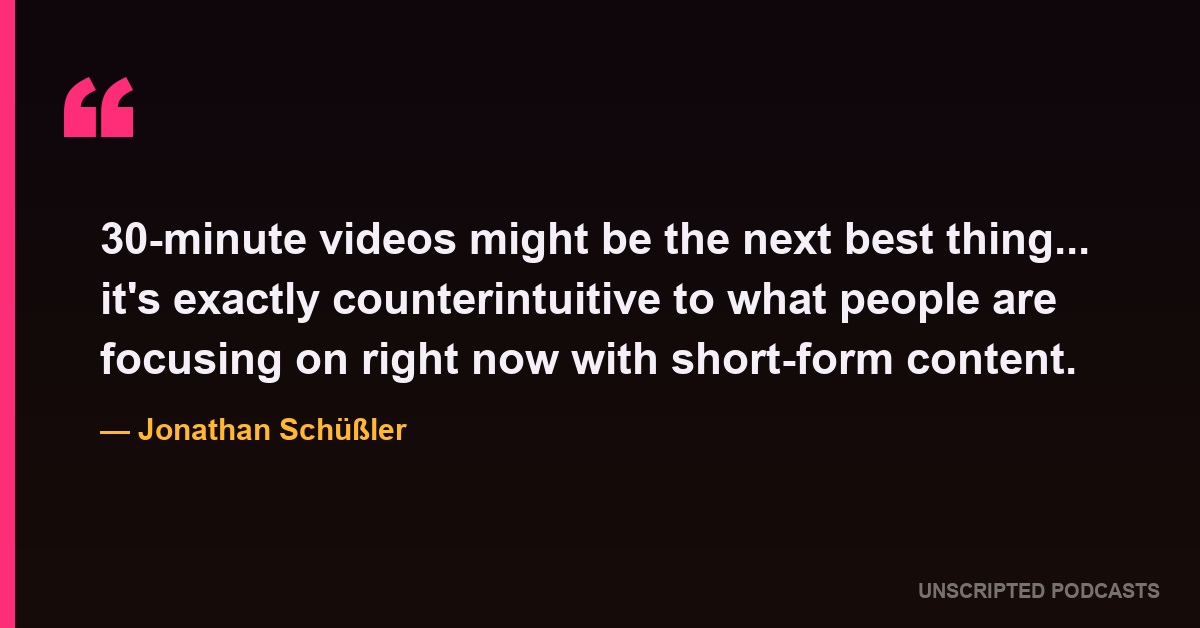
One thing I heard the other day that really caught me off guard — I can’t remember where I heard it — was that 30-minute videos might be the next best thing.
Because as soon as LLMs start tracking the whole transcripts of YouTube videos… right now the only people doing 30-minute videos are huge companies that have the time and money to invest in very long-form content.
And this might get put out as the next most influential E-E-A-T-type content — which is crazy to me, because it’s exactly counterintuitive to what people are focusing on right now with short-form content.
JEREMY RIVERA
I think you’re right, and that’s where my heart is. My brand, SEO Arcade, is focused on podcasts as an SEO service.
Because I realized: this interview, it’s 45, 46 minutes now — that’s 4,000 to 6,000 words of written content.
You can break that easily into three or four very specific niche conversations we’ve dived into. That’s three or four specialty blog posts, with direct quotes between two subject-matter experts that aren’t pulling from LLMs.
And you get the links out of the ecosystem for publishing it on podcasts, publishing it elsewhere, putting it on LinkedIn Pulse.
Lily Ray was complaining the other month: content she takes from her site and posts to LinkedIn Pulse, Google is ranking the LinkedIn Pulse version above the exact same content on her own site. There are some weird distortions going on.
But if you have that subject-matter expertise, it makes sense that a company that can do longer-form content and interviews wins.
There’s Llama or whatever that purports to create podcasts, but you can feel it. I’ve listened to a podcast that was made by it — it’s that weird uncanny-valley experience, like watching CGI from 2003 where you’re like, that’s not how a body moves, that’s not how a conversation works.
It’s a little too chipper, a little too on the nose. There aren’t enough detours. So I totally agree with you.
I respect the rush to the five-second attention span, but you’re right — maybe some of that is just snippets off the bigger thing. Those are bites off the elephant.
JONATHAN SCHÜSSLER
That’s literally what I was going to say, because it offers you so much potential for clipping.
Right now in streaming, clipping is the biggest thing and the most underrated, good-earning job. If you have bigger streamers and you’re clipping them, if you’re a professional clipper, you can make bank.
But you could use this for your company too. If you’re doing a podcast, you have your podcast, you get your blogs out of it, you get your LinkedIn posts out of it, and you get your clips to send everywhere — to shorts. The shorts might rank, your LinkedIn posts might rank as well. Google loves the shorts.
I know my TikToks are ranking really high right now, but I’m re-releasing everything on Shorts this winter. I’ll sit down for two weeks, plan it out, and have all my content re-released on Shorts. It’s great, it’s so fun.
JEREMY RIVERA
Awesome. I appreciate the conversation. Shout out where people can find you — the name of your site, how to pick you up on the freelance side, and a couple of your handles. I’ll include all of it in the show notes, but let people know where they can find you.
JONATHAN SCHÜSSLER
You can find me mainly on Instagram — that’s my main platform. I have Jonathan Schüßler for my wedding photography, and then a Schüßler handle you’ll find in the show notes — it’s tough to spell.
And you’ll find me on LinkedIn. I’m starting to post there right now; I haven’t really used it much. My websites are the same as my Instagram handles.
JEREMY RIVERA
Awesome, thanks so much for your time.
JONATHAN SCHÜSSLER
Thank you so much for having me.
Key Takeaways
→ Target where the money is, not the volume — Jonathan ranks top-4 in ~50 low-competition towns and prizes “wedding photographer Kronberg” (~10 clicks/month) because one booking from Germany’s richest town can carry the year.
→ Programmatic + local SEO let a service business own a whole region without local backlinks: he moved 2.5 hours south into the competitive Heidelberg wine region and built ~80 town and location pages instead of fighting the single high-difficulty city term.
→ Build a content flywheel across channels: YouTube venue videos (500 views/year that outrank the venues) repurposed to TikTok (1.5M accounts reached) feed blog hub pages — even ranking #4 for a Tuscany venue he’s never visited by targeting the German keyword, producing three real inquiries.
→ “Junk food” SEO is over-relying on ChatGPT: plagiarized, hallucinating, good-enough content bloats a site and, in the HCU / Panda / Penguin lineage, drags the whole domain down. If 80% is bad, the other 20% won’t get rated.
→ Google now rewards looking like a bigger company: press releases, LinkedIn, multi-channel presence, and a tied-together Google Business Profile build the trust signals a single Instagram used to.
→ The hottest take: long-form (30-minute) video may become the next E-E-A-T frontier as LLMs ingest full transcripts — the same insight behind treating podcasts as an SEO service, where one 45-minute interview becomes thousands of words plus clip-able assets.
About Jonathan Schüßler
Jonathan Schüßler is a wedding photographer and freelance SEO based in Germany who specializes in programmatic local SEO for service businesses. Find him at jonathanschuessler.com, on Instagram, and on LinkedIn. Jonathan also wrote up his own recap of our conversation.
Turn this interview into action with the SEO SOP: Rank a Service Business Across a Region With Satellite-Town Location Pages — plus a free, no-gate PDF.