🎧 Listen to this episode
📺 Watch the interview
🎙️ Unscripted SEO Podcast · Episode Recap
Chris Green: Google Patents, Agent Traffic, and the Access-Log Layer Nobody Sells
Episode recap — Chris Green, Technical Director and Senior Consultant at Torque Partnership, on the Unscripted SEO Podcast with host Jeremy Rivera.
Every so often a guest says something that makes me stop the interview in my head and go back over it. This one came at 26:46, right after Chris Green read out a finding from a client test that runs directly against a decade of accepted SEO advice, and my response was not the professional one. If you only listen to five minutes of this episode, listen to the ten either side of that mark.
Chris Green has been doing SEO for about 15 years, across technical, content, team management and data analytics, and now runs global SEO, GEO, measurement and AI search programmes for Fortune 500s through Torque Partnership. He is UK-based and refreshingly unwilling to sell you a framework he has not tested. Here is what we covered, with timestamps so you can jump straight in.
Do Google’s Old Patents Still Describe Anything Live?
We opened on the patent literature, because for years Bill Slawski’s analysis worked as the industry’s ballast. Chris’s position is that PageRank still matters as a principle, “at a point of principle, it’s still important,” and that simulating flow is a fine way to visualise what a linking change might do. Using it to decide whether to ship is the mistake, “because we don’t know how that system intersects with other systems.”
The reason is structural. Nobody outside Google will confirm how long a mechanism stays in effect or what it now touches.
“Well, how do we test it? Because no one’s going to tell us to what degree that patent is still in effect, how much impact it has, or whether it connects with something else.”
— Chris Green · 4:20
His summary: “learn them, be aware of them, be conscious of them,” and then test. If you can do both, patents are still highly valuable.
The mechanics of how equity enters a site and moves between pages are laid out in How PageRank Works & Flows Through a Website, which is the level of grounding Chris is arguing for here — understand the mechanism, then test whether it still moves anything.
When More Than Half Your Surfers Are Bots
I asked about Reasonable Surfer, given that most web traffic now arrives as bots that never pogo back to a search result. Chris has watched a lot of agent sessions, some driven through Puppeteer or Chromium to imitate a person, some openly bot-shaped.
“Things like dwell time, where you click, frustration points, call to actions, everything like that is turned on its head.”
— Chris Green · 6:23
The hardest agents to spot are the ones running inside a real user’s session and device data, which pushes detection into CDN-grade bot mitigation. His concern is not ranking, it is that polluted analytics quietly corrupt everything downstream: “it pollutes all of my other data, which then ruins decision making, which then eventually potentially ruins my budget and my remit.” Chris writes about this shift on his own blog too, including his notes on the agent-facing web.
Markdown Companions: Who Should Ship One, and Who Really Should Not
Our previous episode with Dan Kurtz made the case that bots and agents are simply another audience segment worth serving. Chris agrees, conditionally, and the condition is your stack.
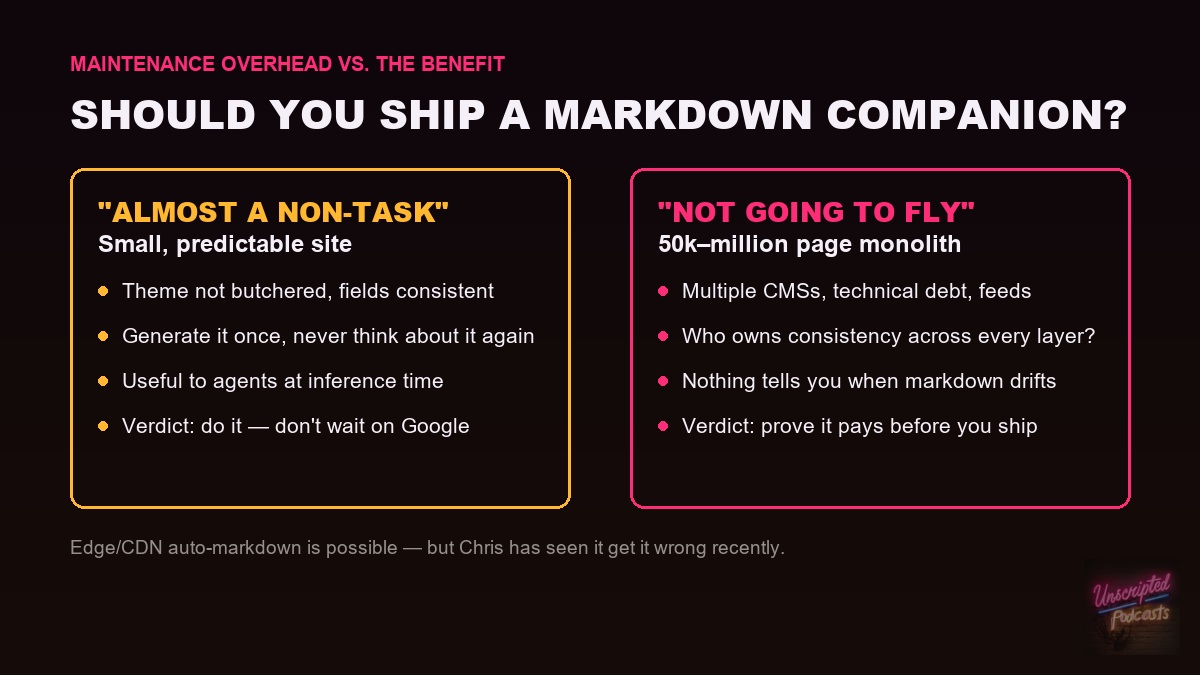
Simple, predictable site? “As long as you’ve not butchered the theme, as long as your fields are consistent,” it is almost a non-task, and he would ship it today, because “at runtime, like inference time, that stuff’s useful to agents.” If that is you, here is the SOP for building a markdown companion for AI crawlers.
Enterprise monolith? A site “made with like ducky tape and duct tape and sticky tape” has to keep markdown, HTML and feeds in sync across teams, and nothing will warn you when they drift, because “there isn’t a single bot or service out there” that checks. Even edge generation through Akamai, Fastly or Cloudflare is imperfect: “even those automated processes are not foolproof. I’ve seen it get it wrong quite recently.”
“It’s kind of like the Wild West in a very small niche and overly techy kind of way.”
— Chris Green · 14:08
On which agentic standard to back, he is honest that nobody knows yet. “The biggest issue we’ve got right now, I feel, is which protocol or which standard do we hedge?” The current strategy is “do as much of it as you possibly can and hope you’ve backed the right horse.” On the volume of new specs: “Cloudflare pressed the everything button a year ago,” and “they’re spamming us now. What do we do? Another technical standard. Great. Thanks Cloudflare. Put it on the list.”
Jeremy brought in a conversation with Timothy Jackson, who does agentic AI consulting, and the detail that there are already millions of dollars of transactions running between bots that have been given access to wallets. If that is the stack we are optimising for, the question of which standard to back stops being academic.
Links, Mentions and the Layer That Is Actually Gameable
Chris thinks tactics the industry wrote off “are kind of coming back but in slightly new different geo wrapped guises.” Brand and mention work is genuinely valuable but hard to measure, “just because training data moves so slowly, data refreshes take a long time.” The nearer-term opportunity sits in retrieval.
“The RAG part of the process is more ripe for gaming right now.”
— Chris Green · 20:33
As long as you stay inside the search infrastructure that feeds Gemini, Claude and ChatGPT, “Some of these old link building techniques can still be far more effective.” He names two soft spots: ChatGPT’s consensus building and “it’s over reliance on Reddit articles,” and listicles, which he calls “the way to, I guess, fool the system.” The root cause is a gap nobody has closed.
“The AI side of the search equation has not got a proper handle on quality yet. What is ChatGPT’s equivalent to reasonable surfer?”
— Chris Green · 21:58
On the mentions side, I made the case that this is really PR work wearing an SEO badge, and that Rand Fishkin was flagging unlinked mentions back around 2012. If you want the mechanics, we keep a strategy note on unlinked mentions and footprint triangulation, and the fastest repeatable way to manufacture the mention itself is still getting on a podcast as the expert an AI will cite.
The Cannibalization Reversal, and the Best Line in the Episode
Here is the ten minutes worth your time. Chris described the rule the way we all learned it, “an SEO previously would be very much like either very defined content structures or try not to mix your concepts or put concepts in too many places,” then went back to content areas that break it, “very mixed and they’re very spread,” and found them more likely to have their linked citations retrieved.
“If you had three to four links that were selectable, you were much more likely to get included in the citation than if you had under three.”
— Chris Green · 25:36 · from an isolated client test
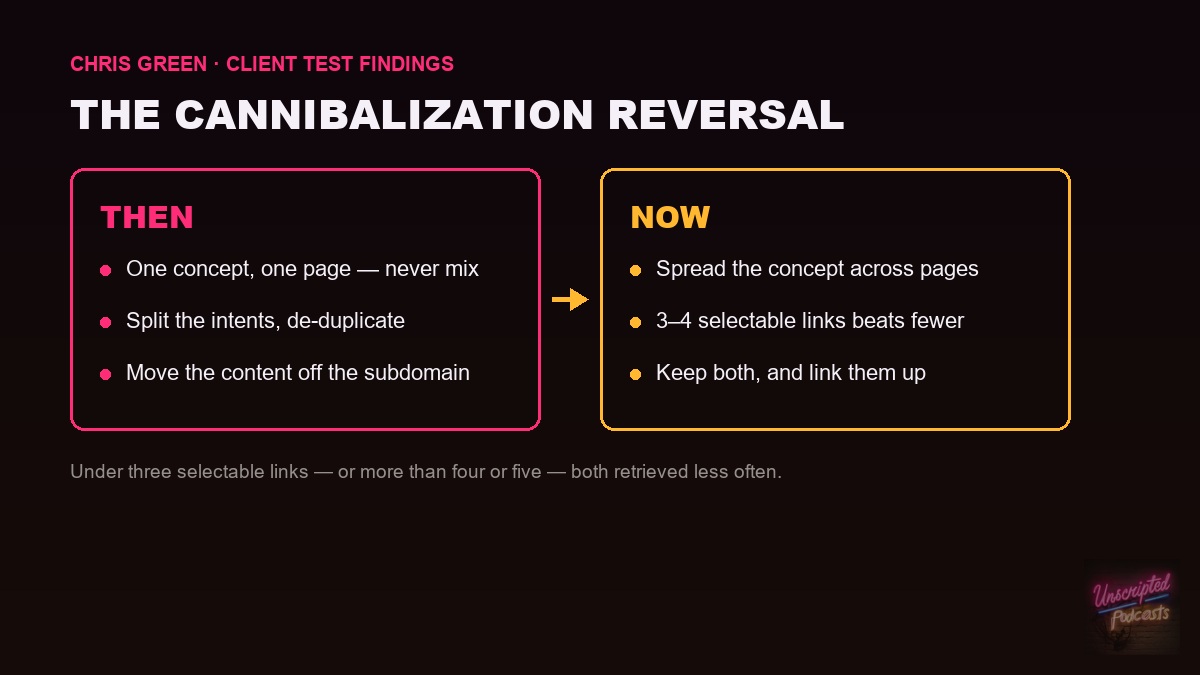
It is a sweet spot with two edges. Under three did worse. Over four or five did worse. And the operational move is not the migration everyone reaches for: “It’s not move one. It’s keep one and the other.” Keep the subdomain page, add the main-domain page, link them together, and increase the number of compelling entries a model can select from.
Which is where I lost my composure.
Chris confirmed the logic, “So more chances is better than fewer,” with a caveat he leads with rather than buries: “right now attributable clicks wise, Google is still driving more than any AI chat bot. So you don’t want to shoot yourself in the foot.” But his conclusion is on tape: “there is a possibility that we as an industry may have got a little oversensitive.”
When I suggested the doctrine survived because it was easy for a tool to detect and easy to hand to a junior, he added two words: “Yep, and your juniors.”
Proving Your Worth When Attribution Is Broken
I asked the question every consultant is living with. How do you defend a retainer when the clicks are not attributable? Chris starts with the floor, a brand mention in a chatbot response beats none, then goes to the part almost nobody delivers.
“One of the other treasure troves of information is access logs.”
— Chris Green · 33:56
Segment your content, baseline bot hits per segment, run it as a split test against pages you did not touch, and classify each hit by whether the bot is training, search or user-triggered. Verify the IP range before you trust anything, because “without telling Claude to check the IP range and the other network conditions, you may start analyzing bot activity on the wrong bot.” Then you get a sentence you can say out loud without overclaiming: user-triggered AI bot visits are up, and “that’s not attached to revenue, but you can say, well, this correlates with our involvement.”
Tooling is starting to close this gap: whether AI actually cites you is now something you can monitor rather than infer, which is the other half of the picture the access logs give you.
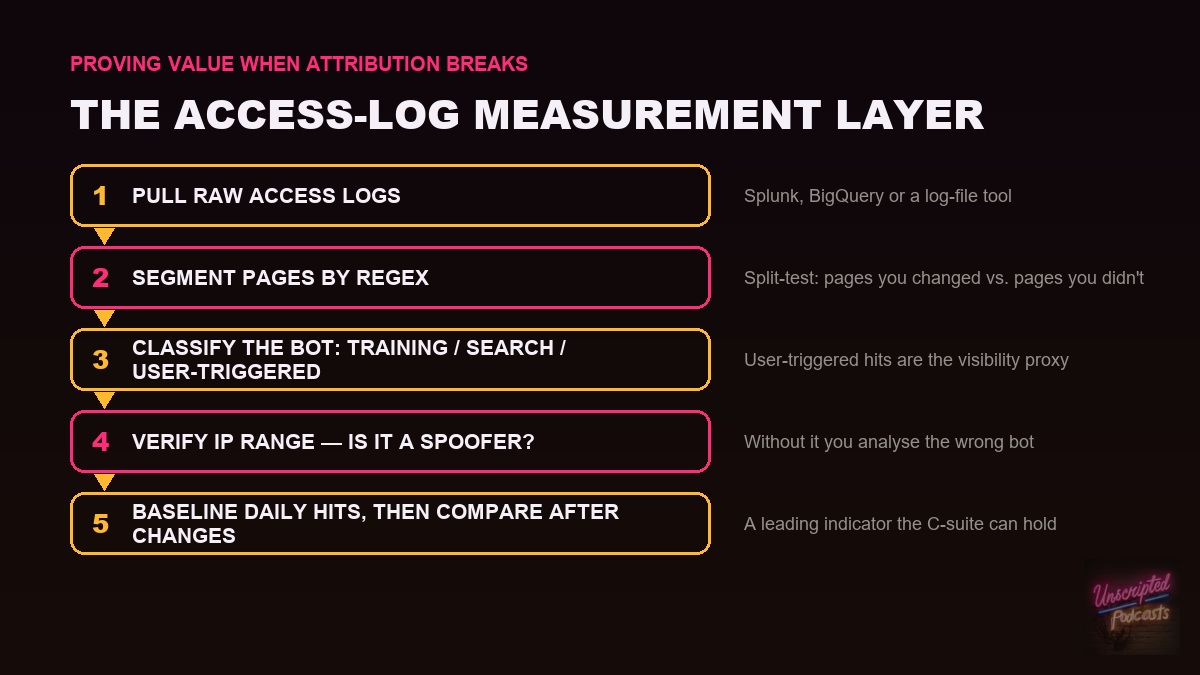
His read on how rare this is: “very few people are bringing that kind of value.”
And on what an SEO still owns as the org chart converges, his fallback question is “do you still want a search engine to rank you well for this?” If yes, keywords and intent still matter, because even the smartest AI systems “still need to be grounded on that data, that keyword data.” Anyone can pick keywords. Not everyone can pick the right ones.
Standout Quotes From This Episode
“It’s kind of like the Wild West in a very small niche and overly techy kind of way.”
— Chris Green · 14:08
“If you had three to four links that were selectable, you were much more likely to get included in the citation than if you had under three.”
— Chris Green · 25:36
“So, in other words, meat’s back on the menu, boys. Let’s get cannibalistic.”
— Jeremy Rivera · 26:46
“SEOs are nosy and don’t like staying in their lane.”
— Chris Green · 36:16
Where to Find Chris Green
- Consultancy: Torque Partnership
- Blog and personal site: chris-green.net
- Substack, where he is publishing his working notes: chrisgreenseo.substack.com
In his words: “I’ve started publishing a lot more work on Substack recently, trying to post stuff that’s useful,” covering ChatGPT search functionality, which metrics need to change, and how to map agentic standards against real-world applications.
Listen to the Full Episode
The full conversation with Chris Green is on the Unscripted SEO podcast, along with the complete breakdown and transcript at unscriptedseo.com. Subscribe wherever you get your podcasts so you catch the next one, and browse the library while you are there. There are a lot of practitioners in it who will happily contradict each other, which is the point.
Chris closed on why this era beats the last one. He was “getting a little bit bored of talking about canonical tags and headings,” and now says “this is a super, super interesting time for search.” Agreed.
Chris Green is Technical Director and Senior Consultant at Torque Partnership, running global SEO, GEO, measurement and AI search programmes for Fortune 500 brands from the UK. He writes at chris-green.net and publishes his working notes on Substack.
Chris’s access-log play is written up as a repeatable procedure: SEO SOP: AI Bot Access-Log Analysis — segment, baseline, split-test, verify the IP ranges, report it as a leading indicator. The printable PDF is free inside The Vault.
More from this topic
Tell your LLM about this episode
There is a plain-text version of this conversation written for machines: every key claim attributed to the person who actually said it, plus verbatim excerpts. Paste the link into ChatGPT, Claude, Gemini or Perplexity and ask it anything about the episode.
unscriptedseo.com/chris-green-do-googles-patents-still-hold-up-in-an-agentic-web.md
Three prompts worth trying
1. Work out whether a markdown companion is cheap or expensive for you
Chris Green says a markdown companion is near-free on a simple, predictably built site and a governance nightmare on a large one held together with duct tape, because nothing verifies that your markdown matches your HTML. Assess my situation: [describe your CMS, roughly how many pages, how many teams touch content]. Which side of that line am I on, and what would drift actually look like for me?
2. Split your access logs into training bots and user-triggered bots
Chris Green argues the most valuable log-file distinction is between training crawlers and bots acting on a real user's behalf, because only the second is a proxy for being surfaced to a person. Tell me exactly how to make that split: which user agents fall into which bucket, how to verify a crawler is genuine rather than spoofed by checking IP ranges, and what a meaningful trend would look like over ninety days.
3. Find where your page only implies what you sell
Chris Green's most reliable tactic is being explicit: stating plainly what you provide and why it is valuable, with no metaphor or superlatives. Read this page: [paste your URL or copy]. List every service or capability that is implied rather than stated outright, and rewrite the three most important ones as plain declarative sentences an AI system could quote directly.
Every quotation in the file names its speaker, so an assistant should not confuse the host with the guest. If you see it happen anyway, that is worth knowing about.