
🎧 Listen to this episode
📺 Watch the interview
🎙️ Unscripted SEO Podcast · Episode Recap
Dan Kurtz on Bots as a Customer Segment, Markdown, and the Agentic Flywheel
Episode recap — Dan Kurtz, Miss Pepper AI, on the Unscripted SEO Podcast with host Jeremy Rivera.
Dan Kurtz is the founder of Miss Pepper AI, and he is the kind of guest who makes an interview run long in the good way. He started in graphic design, bailed after reading Seth Godin’s Linchpin, learned the industry on Black Hat World, ran rank-and-rent, then went and did affiliate work in the hardest verticals he could find before settling into a full-service agency. That history shows up in how he thinks: he has seen every version of this argument before, at a smaller scale, and he is unbothered. This episode is about what happens when the majority of the traffic on the internet stops being human — and Dan’s answer turns out to be something SEOs have already been doing for twenty years. Listen to the full conversation wherever you get your podcasts, or find it with 150-plus other SEO practitioner interviews at unscriptedseo.com.
From Black Hat World to a $5M–$25M ICP
Dan’s origin story is 2006, watching India and the Philippines come online while he was studying graphic design, and deciding to pivot before the pivot was forced on him. Black Hat World was the classroom. Rank-and-rent came first — build the sites, charge for the leads — then a deliberate hard turn into gambling, adult, pharma and poker, which he describes as running both sides of a Spy vs. Spy cartoon. “You’ve got the white coat and the black coat and they’re fighting each other,” learning both and finding the judicious middle. Miss Pepper AI itself grew out of a 2012 software project that took a system-wide-footprint Google penalty, got mothballed, and came back out in 2020. Today the agency’s ICP is businesses between $5 million and $25 million: below that, in his words, they are “probably not ready to play”; above it, out of scope.
The Traffic Mix Nobody Voted For
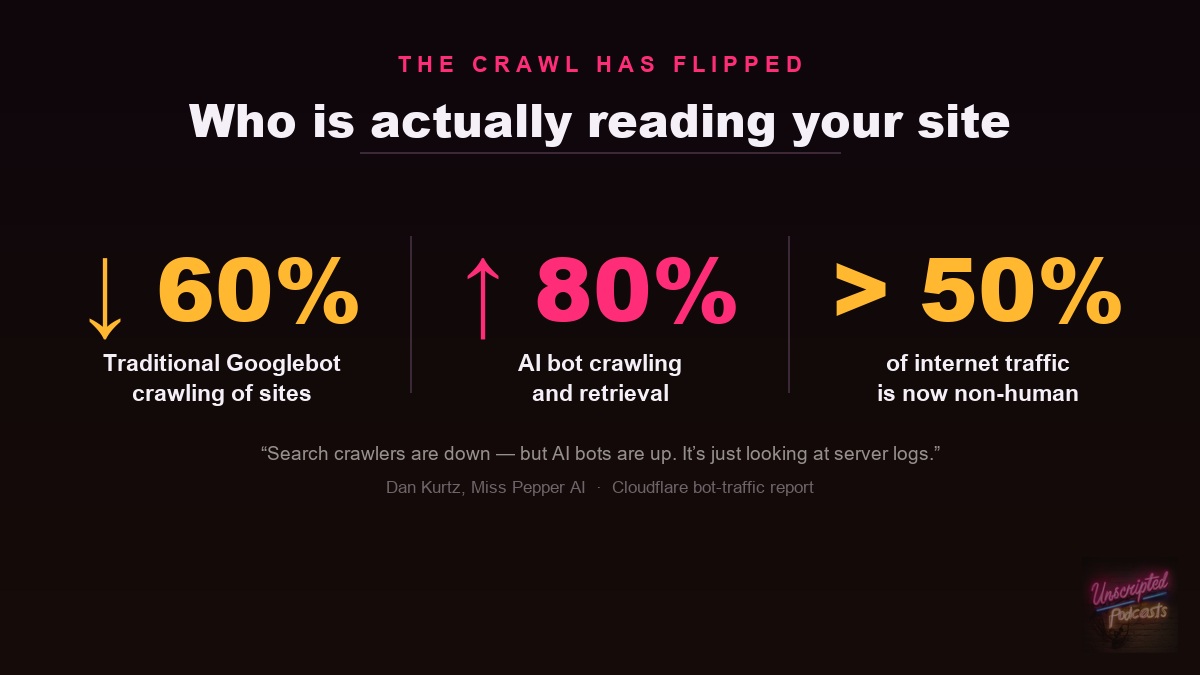
The pivot point of the episode arrives when Jeremy asks whether search goes full AI mode in the next couple of years. Dan’s evidence is his own server logs.
“Like search crawlers are down. Traditional Googlebot’s down, I think something like sixty percent crawling sites, but AI bots are up eighty percent for doing the crawling and retrieval.”
— Dan Kurtz
He pairs that with the Cloudflare report from June that bot traffic on the internet officially surpassed human traffic — “there’s more automations and hooks out on the internet than there are people currently browsing.” His expectation is that AI Mode stops being a tab and becomes the default: “the same search bar that you’ve always known, but it’s going to generate that AI page.” Which is also why he thinks the .com-versus-.ai debate is on borrowed time, even as expired domains, EMDs and authority stacking keep working “to some extent if you know what you’re doing.”
Is AI Slop a Moment or a Condition?
Jeremy raised the question a lot of listeners are living with, name-checking his friend Michael McDougald’s analysis of the AI slop currently showing up in results, and asking whether an AI-centric agency is betting the flood recedes as adoption matures — or whether cheap mass content creation means this is simply the weather now. Dan refused the framing by going backward instead of forward. Keyword stuffing was slop. “Famously there was the Lorem Ipsum test with rhinoplasty Plano,” where people swapped keywords and LSIs into Lorem Ipsum and ranked number one on placeholder text.
“So slop has always been around. It’s just we can create more of it at scale.”
— Dan Kurtz
Because volume is the only new variable, he treats the correction as scheduled rather than hypothetical: Google pushing an update that says “this is scaled content abuse, don’t pay attention to these sites,” with GPT, Claude, Grok and Perplexity following and adding “stop triggers on certain websites based on how they’re getting that data.”
Bots Have a Preferred Content Type
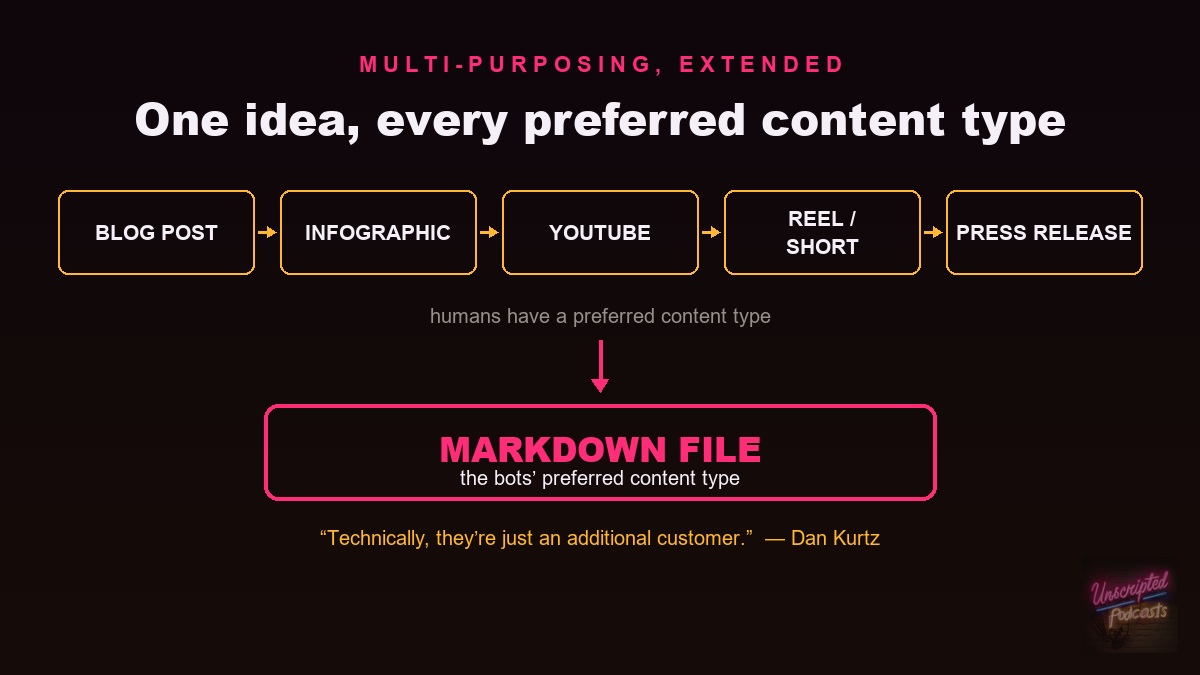
This is the line the episode is named for, and it lands as the resolution to the long-running argument about whether to serve markdown to AI crawlers. Dan’s position is that the industry solved this problem before it existed. “As SEOs and content marketers, we’ve been doing that for decades. We call it multi-purposing.” Blog post to infographic to YouTube video to reel to short to press release — all of it justified by the fact that people learn differently and “have a preferred content type that they’re going to go after.”
“Bots have a preferred content type. Technically, they’re just an additional customer.”
— Dan Kurtz
Jeremy’s contribution to the same idea is what he calls a bot sandwich — human, bot, bot, bot in between — plus the format math: a full HTML page costs a bot roughly three times what markdown costs in load and tokens, and markdown is already organized the way the machine likes it. Dan’s recommendation is to build the file and stop agonizing, because “the worst thing that can happen is they pass it. They fly over it.”
We turned Dan’s strongest play into a repeatable procedure your team can run this week — SEO SOP: Publishing a Machine-Readable Companion File for AI Crawlers. The one-page PDF is free inside The Vault.
The SSL Certificate Trick (Table Saw Rules Apply)
Having published the file, you need the crawlers to come back for it. Dan shared a tip from friends, flagged as “a super secret, secret squirrel kind of thing.”
“If you go ahead on your hosting provider and you reissue a new SSL certificate, it will force all of the AI bots to recrawl your stuff all over again.”
— Dan Kurtz
He is upfront about the limits: he does not know the cadence, he does not know the frequency, and he fully expects somebody to “spam it to death and find out that their website doesn’t take bots anymore.” His safety label — “like anything else, this is a table saw. Watch your fingers and make sure you can still count to ten” — pairs with Jeremy’s salt rule: salt is good, but cover the plate and you get sick.
The 7 a.m. Boot and the AI That Calls Him Out
Asked about his favorite unlocks, Dan described building what he calls an AI-powered operating system inside Claude. Every morning it uses MCP connectors to scrape his accounts, pull client work out of project management and surface calls that came in after hours, then reports the day’s needle movers — with a 3 p.m. update to follow. The clever part is psychological rather than technical: he fed it his DISC assessment and his Myers-Briggs profile, so it knows his avoidance patterns. When he says he will get to something later, it pushes back — “because six out of ten times you’ve tried to do this in the past, that hasn’t happened. So I’m going to put this at the top of your list as a priority for today.”
From there it gets stranger. He feeds the SEO Gets report and the Microsoft Clarity report for a landing page into Claude and lets it iterate the page off engagement data — “so I’m using it to actually do all my A/B testing.” Then, with GoHighLevel’s MCP plus Desktop Commander, Claude Cowork drafts the prompt that GoHighLevel’s own AI executes, standing the variant page up in two or three minutes.
“So now I’ve got my AI talking to other AIs that are deploying websites.”
— Dan Kurtz
Fifty Dollars a Week of Social Intelligence
The exec thought-leadership platform Miss Pepper AI built — where clients are interviewed by an AI over ElevenLabs to construct what Dan calls a second brain, “essentially a MySQL database for a person” — runs on a diet of scraped social data. They pull the top 100 accounts on roughly ten platforms and hook Gemini up to transcribe the videos and “watch the video frame to see how the hook lands.” Every week it re-scrapes what is new from each creator and processes it into a fresh read on where social is heading. Total cost: “like probably fifty bucks a week in AI credits.” His comparison is the whole point — “doing this years ago would have been a team of a hundred people going and looking at a hundred accounts and writing down what they thought.” All of it, plus SEO and appointment setting on a 280-million-record US database, is wired together with APIs into what he calls an ecosystem flywheel: sales talks to SEO, talks to marketing, talks to appointment setting.
Opening Up the Internal Knowledge Base
Jeremy brought in a thread he has been pulling with Matt Brooks of SEOteric — the best plays for unlocking a company’s internal knowledge base, which in B2B is usually where the real expertise is buried. Agent on the site? Email gate? Login only? Dan is experimenting with connectors an LLM can plug into on arrival, turning the page into a real-time query box: “if a bot comes and scrapes — can I, not manipulate, but can I feed it the appropriate data that it’s looking for instead of it going hunting for it?” The goal is that the exchange becomes “just a high five baton pass on the way out, and they just have the data.”
Deliverables Are the Wrong Unit of Work
On the agency model, Dan is direct about what he thinks a productized retainer does to the work.
“Deliverables in SEO means that you’re not paying attention.”
— Dan Kurtz
Quota over attention, he argues — X blog posts, Y guest posts, and a service that “feels very static.” His alternative is to build the AI enablement layer first and put the human on top of it, explicitly to eliminate scope creep rather than headcount, citing the companies that fired ten thousand employees for AI and learned “a six hundred million dollar mistake.” He wants employees using an hour or two of paid time to learn, because the basics of AI navigation are “going to be especially critical here coming up shortly.”
Listen to the Full Episode
Dan expects to publish real client data on what building an agentic flywheel does to a business around Q1 2027 — “everything we can give away without giving away the farm.” Until then, this conversation is the best map of it available. Subscribe to the Unscripted SEO Podcast wherever you listen, and browse the full library of 150-plus interviews with SEO practitioners at unscriptedseo.com. If you want to learn this stuff alongside other marketers, Jeremy’s Unscripted Marketing Skool community is now open.
Dan Kurtz is the founder of Miss Pepper AI, a full-service agency building AI-enabled SEO, appointment setting, creative strategy and executive thought-leadership systems for $5M–$25M businesses. He posts on LinkedIn, and — his words — generally insults the population on Facebook.
More from this topic
Tell your LLM about this episode
There is a plain-text version of this conversation written for machines: every key claim attributed to the person who actually said it, plus verbatim excerpts. Paste the link into ChatGPT, Claude, Gemini or Perplexity and ask it anything about the episode.
unscriptedseo.com/dan-kurtz-bots-as-a-customer-segment-markdown-agentic-flywheel.md
Three prompts worth trying
1. Decide whether a markdown companion is worth it for your site
Dan Kurtz argues bots are just another audience with a preferred content type, and that a markdown companion file is worth publishing because the worst case is bots ignore it. Malte Landwehr disagrees and says a second URL with the same content wastes crawl budget. Weigh both against my situation: [describe your site, its size and CMS]. Which argument applies to me, and what would I actually have to maintain?
2. Audit your own crawl ratio before you change anything
Using Dan Kurtz's framing, help me split my server access logs into two buckets: traditional crawlers such as Googlebot and Bingbot, and AI crawlers such as GPTBot, ClaudeBot, PerplexityBot and Google-Extended. Tell me exactly what to grep for, how to compute the ratio, and what a meaningful change in that ratio would look like.
3. Find the deliverables in your own retainer that are hiding inattention
Dan Kurtz says deliverables in SEO mean you are not paying attention, because you end up hitting a quota rather than moving a number. Here is my current scope of work: [paste it]. Which line items are quota-shaped rather than outcome-shaped, and what would each one look like if it were rewritten to track something the owner can feel?
Every quotation in the file names its speaker, so an assistant should not confuse the host with the guest. If you see it happen anyway, that is worth knowing about.