
Bradley Benner has been doing this since 2010, when he was an electrical contractor trying to make his own phone ring. Today he runs Semantic Mastery (coaching), Tree Care HQ (local SEO for tree-service contractors only) and Semantic Links, the white-label off-page service that is now his highest-revenue business. He came on Unscripted SEO to talk about links, and spent most of the conversation dismantling the way the industry measures them.
This is a companion piece to the full episode recap, Bradley Benner on relevance, entity associations and the future of link building. It pulls one thread: why the metric everybody reports is the wrong one.
Relevance Is The Only Link Metric That Survived
Semantic Links launched in January 2022, after months and months of testing through 2021. What came out of that testing was blunt, and he says it should have been fully obvious way sooner:
“It’s not some stupid third party metric like DA or DR or trust flow or anything else that matters about whether a link is valuable or not. What matters is whether it’s relevant.”
His reasoning is about what is now doing the reading. “We’re in the AI era where language models run everything. Behind everything is a language model now,” he said — so everything runs on what those models understand about language. Relevance. Database relations. Vector search. A score invented to approximate PageRank is not what the system operates on.
He is not absolutist. If you want to use DA, DR or Trust Flow “as kind of a secondary metric after determining that a potential link source is relevant to what it’s going to be linking to, then fine.” The sequence is the argument: relevance qualifies, the metric breaks ties.
What genuinely angers him is the agencies still selling the old version. As a white-label provider he sees other people’s work constantly, and it drives him, in his words, up a wall: they are “selling SEO services to unsuspecting local businesses, taking their hard-earned money… doing stuff that has been outdated for years.” His verdict: “I think it’s unethical.”
Kristiyan Yankov of Above Apex reached a near-identical position from the SaaS side — five to ten evaluation metrics rather than domain rating alone. His episode on SaaS link building in the AI era is the companion listen.
The H1 Is For The Human, The Title Is For The Bots
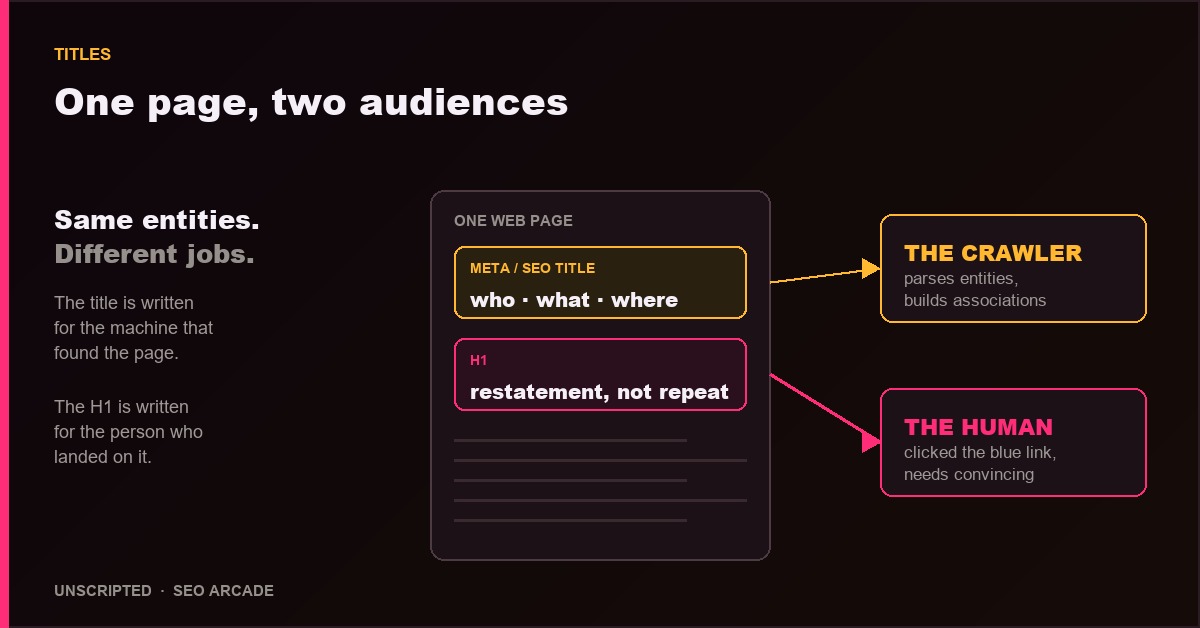
The on-page half of the conversation produced the cleanest framework of the episode. Bradley teaches six main optimisation elements — URL, titles, headings, subheadings, media and internal links — with titles being the one element that splits in two. The meta or SEO title and the H1 are not the same field doing the same job.
The SEO title should be written as a strict semantic triple: “This is who we are, this is what we do, this is where we do it.” That is an entity association statement, structured so a machine can parse the three entities without ambiguity.
The H1 does something else entirely:
“The SEO title, the meta title is for the bots, the models. But the H1 is for the human visitor.”
And critically, the H1 is a restatement rather than a duplicate. “You restate them using entity variants, but more of a compelling kind of like advertising copy line copywriting type headline. Like it’s more for the humans… I say restatement, not repeat.” The person landing on the page came from a blue link that matched their query. What they see first has to convince them, not re-index them.
Forcing The Models To Recognise Your Associations
Underneath all of it sits a redefinition of the job itself:
“Our jobs as SEOs now is not about pushing metrics. It should be about creating associations, strengthening those associations, and helping, forcing the models and the algorithms to recognize those associations. That’s our job.”
The associations are between three things: who the brand is, what products or services it provides, and which locations or areas it serves. Everything else is instrumentation.
That drives an anchor-text policy most agencies would find conservative. Almost 90% of the tier-one links Semantic Links places are brand anchors, or what Bradley calls compound anchors — brand plus a product or service term, brand plus a location, or brand plus service plus location. Jeremy supplied the on-air example, a tree company’s name followed by the service it sells.
The relevance then compounds in three layers: the link sits in relevant content; that content is published on a site whose overall topical themes are relevant; and the backlink profile already pointing at that referring domain is itself relevant.
Jeremy pushed on the mechanism — LLMs are not using links the way Google uses them for PageRank. Bradley agreed and reframed it: links are how the bots and models crawl and navigate the web, and the question a model effectively asks is whether a link navigates to or from a relevant source. “If there’s a mismatch there, then what is the purpose of that link?” Which is why a brand anchor inside relevant content does double duty — the mention satisfies the model, the link satisfies the backlink profile. More on how that thinking is spreading in our hub on brand and entity visibility.
Why Press Releases Work Again
From associations, the conversation moved to citations, which Bradley defines precisely: a published brand mention plus at least one data point from NAPW — name, address, phone number, website. Structured citations are the strict directory format. Unstructured citations are the same brand-plus-data-point appearing anywhere else: press releases, branded assets, brand mentions in blog posts.
His claim about that second category is the strongest in the episode: those “all can act as unstructured citations. And that’s what influences LLM or AI search visibility right now, more than anything.” You should still optimise on-page, he stressed. But if the question is what moves fastest, the answer is third-party mentions — high authority, highly relevant, or hyper-local, depending on the query. Press releases sit at the intersection of two of those:
“Press releases work really, really good for helping to improve AI search visibility because you get brand references on high authority media and news style like freshness factor type properties that the LLMs like to cite.”
Jeremy agreed that freshness is one of the primary factors he is currently seeing in LLM results. Both are describing what they observe rather than a published finding — but they observed it independently.
What Benner Would Do With A New Site Today
An honest caveat: he never got asked. Jeremy had booked a limited window, another interview was starting, and he cut the conversation short mid-thread and invited Bradley back. So this is not Bradley’s answer — it is what his framework implies, assembled from his own words.
Start with the semantic triple. Write the SEO title as who, what, where, and the H1 as a restatement of those entities in copy a human responds to. Fill the paragraphs between the structural elements with material that converts, not material that repeats the heading.
Then buy relevance rather than authority. Point brand and compound anchors at the site, place them inside content genuinely about the subject, and check the referring domain’s backlink profile before you commit. Use DA or DR last, only to choose between prospects that already passed. And get mentioned — unstructured citations are, on his current read, the fastest lever available.
What Bradley likes about all of this is that it is not a trick. Language sitting at the front of every search surface has, he thinks, forced the industry back toward traditional marketing and copywriting. He was never proud of the spammy things he did as an SEO — “but it worked, so I did it.” The current version asks for structure for the machines and honest persuasion for the people, and he is visibly happier selling it.
More conversations like this one in our hub on link building and digital authority.