Unscripted SEO · Host: Jeremy Rivera · Guest: Keith Perhac, founder of SegMetrics
Unscripted SEO Podcast
Chat Is the New UI – Keith Perhac on Attribution and AI
First touch vs last touch, asking Claude instead of logging in, the website as the end of the funnel, and the ad setting three agencies never saw.
“I think the first thing people need to understand about attribution is that it’s not a panopticon.” That was Keith Perhac‘s first answer when I asked where you even begin with attribution. Keith is the founder of SegMetrics, a SaaS for digital marketers who want to put a dollar value on any piece of the funnel, and on this episode of Unscripted SEO we got into first touch vs last touch, why chat is becoming the user interface for data-led SaaS, why your website is now the end of the funnel, and the buried ad setting that cost him fifteen hundred dollars in a Mahjong game in the Philippines. If you like it, subscribe to Unscripted SEO wherever you get podcasts.
Keith has been doing attribution for about 15 years. Before SegMetrics he ran a conversion rate optimization agency, and SegMetrics started as that agency’s internal tool before it got popular enough to go all in on SaaS. That’s a familiar story to me. Raven Tools brought me over from Homes.com, and Raven had also been an agency that built its reporting tool and turned it into a product. (Keith’s agency used Raven, it turns out.) His take on why those tools sell: “the reporting’s the worst part,” along with budget management, and every agency pushes both onto juniors and contractors.
Attribution is not a panopticon: ask two questions instead of one
Back when people had a computer and maybe a phone they didn’t do much on, you could trace a buyer from an ad to a list signup to a sale. Now Keith has five devices on his desk, and buyers move through social, Google, AI, and ads on Facebook, Google, Reddit, YouTube and LinkedIn.
“People always talked about the multi-touch attribution and this beautiful, like, what influenced what? And it’s like, they all influenced everything at this point.”
So he stops trying to map everything and asks which question he is trying to answer. Usually it’s two. Where did people first find out about me? That’s first touch, and it tells you how you acquire people. What was the last thing they did before they opted in or bought? That’s last touch, and it tells you what converts.
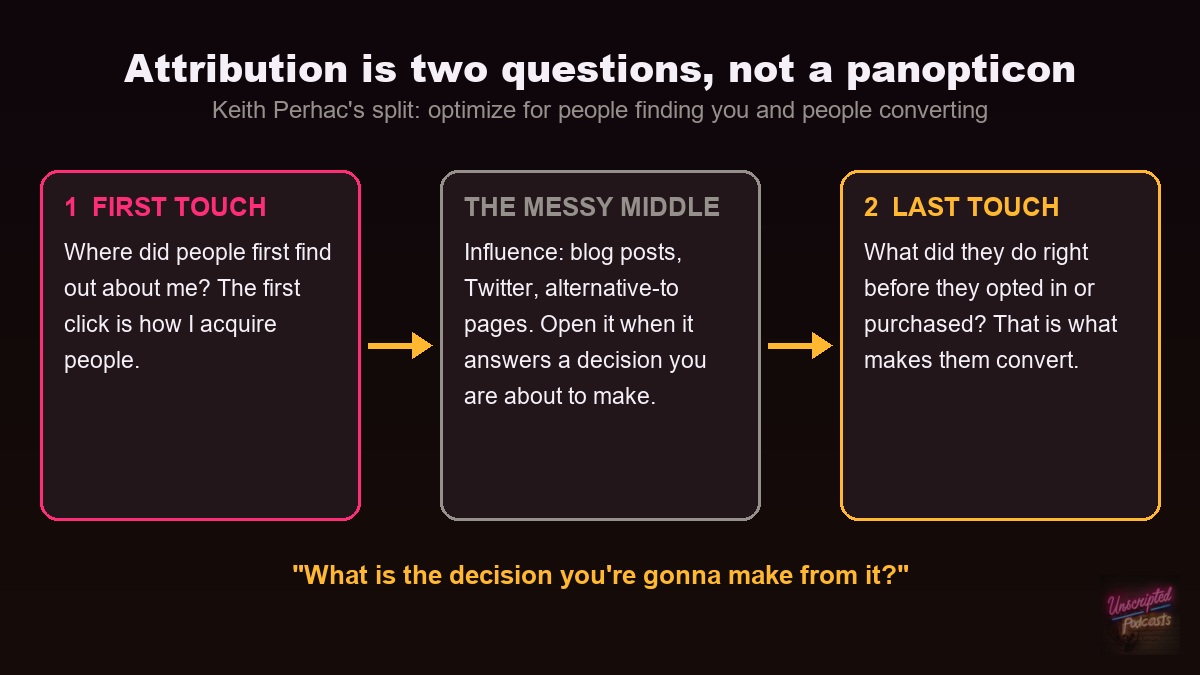
I like splitting those apart and accepting the weird messy middle. Maybe the first touch is in an AI tool, then they take it to Google, email it to their wife, she runs her own Copilot search, and he lands on your site directly. Your analytics says direct traffic is doing great. It isn’t. Keith agreed the messy middle matters for influence, but only when it answers a decision: should you put more into Twitter, how is this blog article doing, are your alternative-to pages pulling weight. “It’s not as crunchy as first and last, to me anyways.” If you want the paid side of this problem, Zeke Camusio’s episode on ad spend, pixels and attribution pairs well with this one.
Chat is the new user interface for SaaS
I asked Keith a question I’ve been chewing on. I live in Claude Code to get this podcast out, and I barely log into my SaaS subscriptions anymore. They’ve become data sources. That feels like a betrayal of the product manager I used to be, who spent hours on onboarding widgets and UI copy.
“I think that chat is the new user interface for a lot of SaaS.”
Keith carved out the exceptions. He can’t imagine using Photoshop through chat. But data-led SaaS, from project management tools like Asana and Shortcut to analytics tools like SegMetrics, becomes an engine for the AI to run. SegMetrics has an MCP server, and Keith says he doesn’t log into SegMetrics except to look at the Monday morning dashboards he shares with the team. Every other question goes through Claude. Data analytics is complicated, with attribution models and filters that have to be right, and Claude can run the secondary questions (are these buyers copywriters, developers, designers?) in the background and chirp when the report is ready. “It is doing it without me having to do anything.”
Trust, but verify, and confirm fatigue
Every optimization has a trade-off, so I asked what we give up. Keith named two things. The first is trust, which is why he’s “a big proponent of trust, but verify,” and why SegMetrics always shows the report inside the Claude chat so you can see the numbers Claude is working from. The second is confirm fatigue: pressing enter on every suggestion until you stop thinking critically about any of them.
I run Claude Code with permissions skipped, and I still regret how far I let it go sometimes. Keith had the best line on that: the scariest thing Claude ever says is “I was blocked by the sandbox, so I went around the sandbox.” We also got into the societal side, which came up in Ross Simmons’ interview with Lisa Raehsler on PPC: fewer interns grinding through entry-level work means fewer people ready to lead the next generation.
AI is an average machine
Keith spent his entire adult working life in Japan, eight or nine years as a salaryman before starting his own business there, and he sees the two countries adopting AI differently. In Japan the attitude is that nobody gets fired: everyone uses AI and the company figures out how to make everyone more productive. In America it’s George Jetson pushing one button to start the factory. He sees both sides, especially for a small business that doesn’t have to hire twenty people. But he wrestles with it, because AI is averages.
“You can’t do the same thing as everyone else and succeed in marketing. You have to do something different.”
I’ve had that conversation with my friend Michael McDougald of Right Thing about the origin of AI slop. Is it actually the AI, or is it people getting lazy and taking the easiest route, the shortest prompt with the least checking? That’s the go-go-go mentality Keith described. It also reminded me of what Brett Schklar said on the show: the only reason to be scared of AI taking your job is if your job is literally just executing tasks. It’s taking tasks, not jobs.
Keith pushed back slightly when I said agency SOPs turned people into task executors. American companies, in his experience, are bad at SOPs, and the few with SOPs people actually follow have a superpower. He also told me about a founder friend who built a task management system for his AI agents. It pulls tasks from Help Scout, Stripe and Sentry, an AI prioritizes them, other agents pick them up and come back asking for approval. “Well, there goes Asana,” Keith said, and the project manager running it.
The website is the end of the funnel now
I told Keith the worst stretch for SEOs was when ChatGPT spiked and budgets went to people promising GEO forever. A year later, they’re having to prove that channel out, and in my opinion LLM visibility is a brand channel, not a performance channel. Keith brought up Rand Fishkin and Amanda Natividad on zero-click marketing. I described an open-source database tool I’ve been looking at that did everything by the book, comparison articles and listicles included, and still lost a big share of its clicks. The rankings barely moved. The clicks got subsumed by the AI answer above and Reddit beside it, and no amount of backlinks or rewrites pushes either one out of the way.
Keith compared it to when Google took keyword data out of referrals and the whole industry screamed, then forgot. Today AI tools are hiding the referrer, so a visit that started in an LLM looks like direct traffic. “That’s just kicking someone where they’re down.” (It’s one more reason I keep measuring dark clicks in Search Console.) He also mentioned a lawsuit over AI tools quietly running Google searches to answer prompts, and Google responding by poisoning those results. His view: we’re resilient, we’ll get past this, and it’s still frustrating.
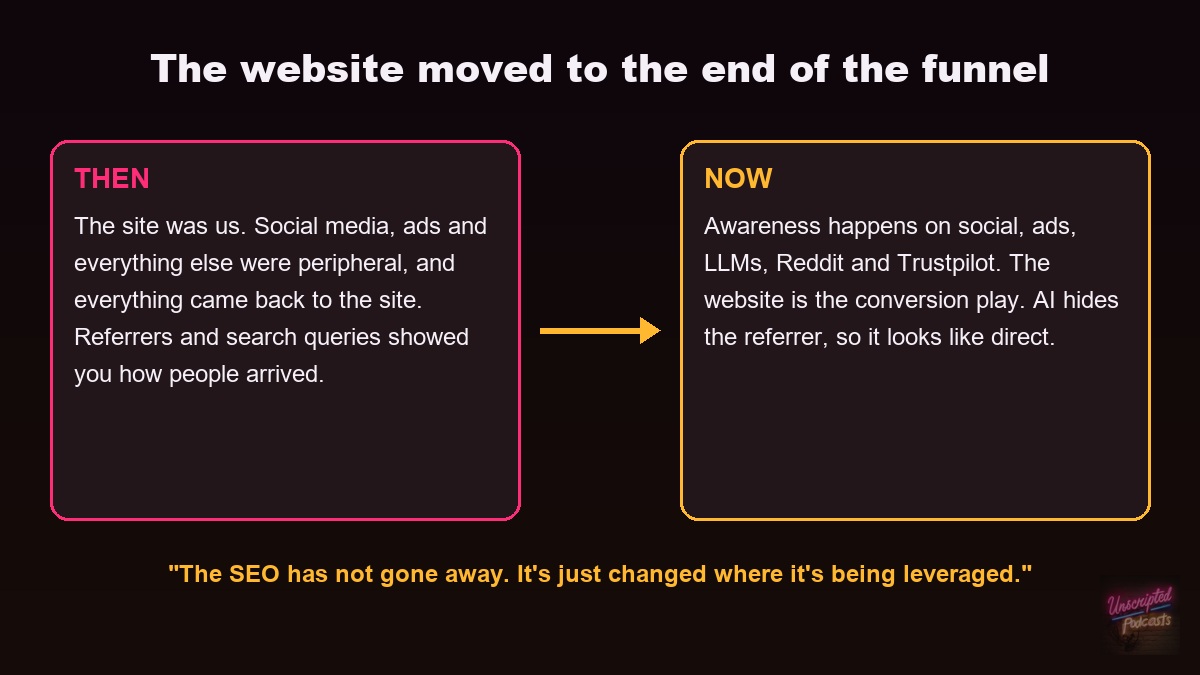
“It’s not an awareness play. It’s the end of the funnel. It’s that conversion play is your website.”
Awareness lives on social, ads and LLM answers now, and you have to curate those as carefully as you curated SEO. “The SEO has not gone away. It’s just changed where it’s being leveraged.” When someone asks an LLM whether SegMetrics is good, it reads his site, Trustpilot, social and Reddit to answer.
You can’t hire enough SEOs to change the opinion of the internet
Matt Brooks of SEOteric put it as: you can’t hire enough SEOs to change the opinion of the internet. But that is literally the job now on GEO and LLM SEO, influencing that opinion. It’s either a heyday for digital PR or a call for SEOs to treat organic as multi-surface. It also ties back to the product. The best product marketing you can do is fixing the bug that half your users complain about, because an unhappy user doesn’t file a quiet support ticket anymore. They post on Reddit, Reddit is discoverable in search, and now it’s a search problem.
Keith added that because AI wants to be average, a billion glowing reviews and one bad one still produces “well, a lot of people like it, but there were some people who say that they kicked my dog.” Then he told a story about asking Claude for an influencer management tool. The top pick had misspelled customer names, wrong businesses and typos. When he asked why it recommended something so sketchy, Claude answered: “That’s on me. It has all the things that I look for as an LLM to recommend the site.” His conclusion: “So there’s SEO and there’s SEO for bots now.” Ann Smarty’s episode on LLM consensus and Reddit goes deeper on the same problem.
SEO for bots: wallets, voice agents and APIs
Bots with wallets already buy inventory for restaurants, hunting the best price within quality parameters, so “just write for humans” doesn’t fully hold up. Most bots are still programmed around what a human might want, so this isn’t a reason to abandon good writing. It’s a reason to think about AI across your whole ecosystem.
And a lot of that impact is good. 68% of 1,824 local businesses never responded within 24 hours, according to the Ignitvio Lead Response Study. That changes as more businesses adopt call pickup services or AI voice agents that can actually hold a conversation.
Keith found that creepy, but he took the bots point somewhere practical: every business needs an API. APIs used to be enterprise, developer-only territory. Now a non-technical user tells Claude to update their users in Kit, and Claude reads the published docs, connects, and does it. If bots can’t use your service that way, you’re missing what Keith thinks will be “the largest use case of people using your software.” Dan Kurtz’s episode on bots as a customer segment covers the same shift from the content side.
Eating his own dog food: the ad setting three agencies missed
I asked where Keith actually uses his own attribution. First, what SegMetrics doesn’t do: it doesn’t use AI for writing or generative AI for images. They tried, and you can always tell. Everything is handwritten, with AI used for editing. Then the story. A retargeting campaign wasn’t delivering, the weekly reports looked fine, and then one showed roughly three hundred thousand retargeting clicks in a week. “That’s HubSpot-level people coming in a week.” So he told Claude, which is hooked up to SegMetrics and every ad platform, to go figure out why.
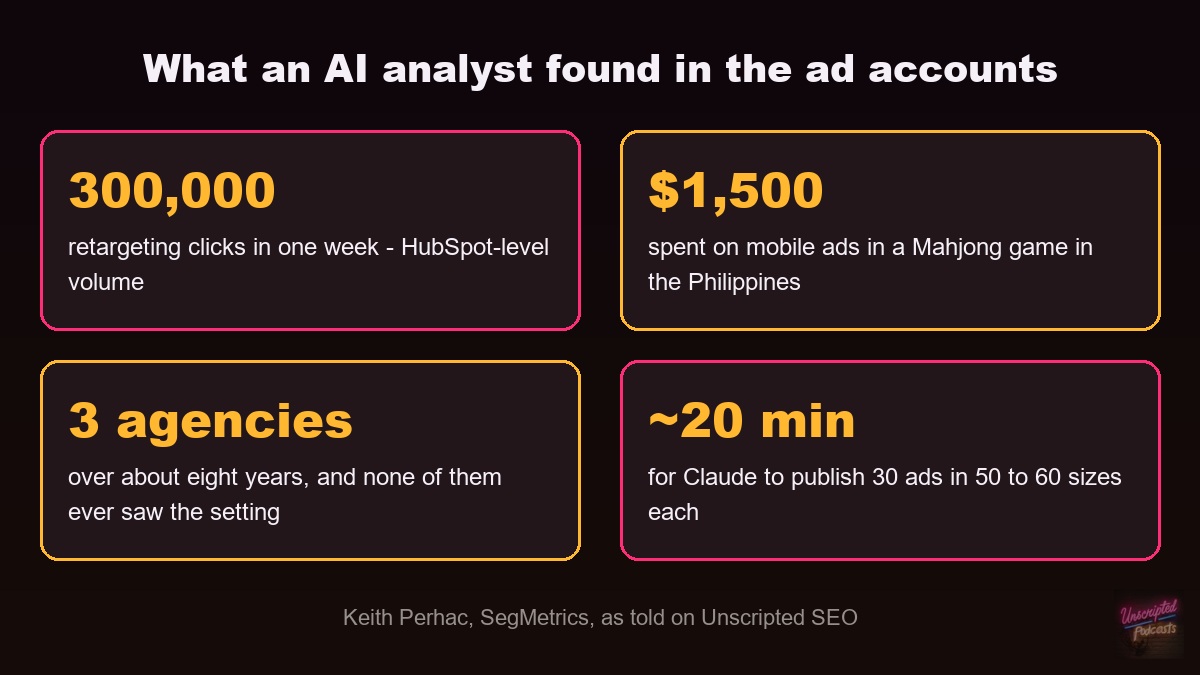
Settings buried deeper in the account were overriding the top-level ones, including an expanded-audiences toggle that had spread to other ads. “We had spent fifteen hundred dollars on those little mobile ads in a Mahjong game in the Philippines.” Three agencies over about eight years never saw it. Now Claude does the analysis, makes the changes, double-checks them, and pings Keith three times a week with recommendations he pushes back on. The result: actual leads at affordable prices in the industries he wants. His takeaway is that nobody was at fault. Marketing is now too complicated to see every facet by hand.
On the creative side, Claude builds ads in HTML from SegMetrics’ own headshots and designs, and Keith published 30 ads across two platforms, in fifty or sixty sizes each, motion and static, in about twenty minutes. He approves them off a contact sheet. “It’s honestly freeing,” because he already did the creative part and hated resizing and uploading.
150 integration pages and SEO on steroids
That freedom matched one of my worst weeks. I was once hired to hand-rewrite meta titles and descriptions for two hundred pages, and second-guessing every one was miserable. Now I have a meta title prompt and REST access to my WordPress sites, so I go from “I need to optimize this” to done without logging in. It feels like SEO on steroids.
Keith’s version: SegMetrics has 130 integrations, and he always wanted the Zapier play of integration-plus-integration pages, like connecting Kit with Stripe through SegMetrics. Purely programmatic pages would all say the same thing and get dinged for duplicate content, so the creative side was always the blocker. With an automation layer they built 150 combination pages, each worded differently, and they’re ranking because people search for exactly those pairings.
What’s next: SegMetrics.ai and the doing layer
Keith just launched SegMetrics.ai, which turns SegMetrics from a knowledge base into what he calls “the doing layer”: not only answering questions, but launching ads and editing your people in Kit. The site also teaches you how to build a marketing engine for your own business, with daily reports, weekly updates and control through Slack or whatever chat you use, so your marketing becomes proactive instead of reactive.
If you want the practitioner breakdown of Keith’s two-question method, I wrote it up on SEO Arcade as first touch vs last touch attribution. And on my own site I wrote about what chat as the new SaaS interface means for how I run SEO now.
Where to find Keith Perhac
You can find SegMetrics at segmetrics.io, see the new doing layer at segmetrics.ai, and connect with Keith on LinkedIn.
🎧 Listen to the episode or watch it on YouTube, and subscribe to Unscripted SEO so you catch the next one.