
Matt Goren has a simple test for whether AI search is a fad. He sat out NFTs. But when Google, “the biggest company on earth, is losing money because of it, then it’s real and it’s here to stay.” Matt founded RunOctopus after taking his own e-commerce store from zero search clicks in February to 7,800 in 28 days, and on Unscripted SEO he walked me through how AI engines decide which business to recommend. His answer favors the expert, not the biggest brand.
🎧 Listen to this episode
📺 Watch the interview
Listen to the full conversation on the Unscripted SEO Interview Podcast. Here’s what we covered.
Search went from “doctor near me” to a full conversation
Matt doesn’t start with algorithms. He starts with how people talk to their phones: “So now we’re talking to our technology and we’re we’re getting a response back and then we’re responding again.” His example of the shift:
“We have gone from a doctor near me to I’m 47 years old with with I’ve had two meniscus tears. I have gone to the doctor many times. Can you help me find a doctor within 30 miles of Daytona Beach?”
Before anyone asks him how the AI finds businesses, Matt wants owners to treat this as a chance to rethink how they describe what they do, because “your business isn’t just one thing.” Ask yourself what you’d search for if you were the one trying to find your business.
I came in with my own read. The golden age of SEO, roughly 2010 to 2020, when editing some meta titles, writing a few blog posts and grabbing a few backlinks got you most of the way, is long past. I don’t think this is an extinction event. It’s another moment where SEO has to adapt to how people actually find businesses.
Long, precise questions are winnable because of how retrieval works
I asked Matt about Ben Wills’ work at OppAlerts, where Ben used vector embeddings to study which factors line up with visibility in AI answers. You can read the OppAlerts research on what correlates with AI search visibility yourself. As I described it on the show, Ben found that links from pages whose embeddings match yours came close to the line between correlation and causation, with unbranded anchor links, co-occurring mentions and branded links all correlating too.
Matt was skeptical of anyone reverse-engineering the engines from outside. The engines don’t publish their embedding models, and “there’s no human on earth that can do enough tests to really find out anything.” He works from the standard retrieval architecture the engines describe in general terms instead.
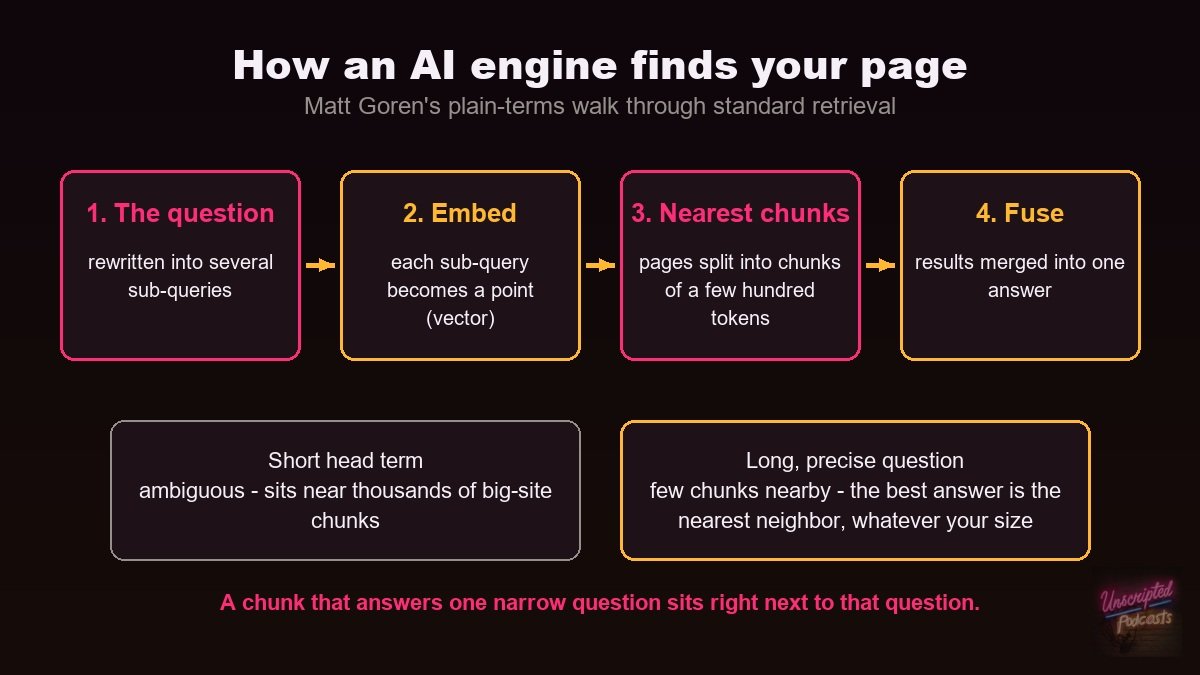
The plain version: your page gets split into chunks of a few hundred tokens, each chunk becomes a point in space, and the question becomes a point too. The system returns the passages nearest the question. One user question can also be rewritten into several subqueries, each retrieved separately, with the results fused into one answer.
“So a chunk that answers one narrow question can sit sharp right next to that question. And a generic paragraph embeds near the center of its whole category.”
That’s why he thinks long questions are where a smaller business wins. A short head term is ambiguous and sits near thousands of big-site chunks. “A long, precise question has few chunks nearby. So if yours is the best one, you’re the nearest neighbor, so to speak, whatever your size may be.” I pointed out this isn’t brand new. Google put focus on passage ranking around 2018, and RAG systems chunk pages the same way.
A mention from someone with nothing to gain
Matt agrees links still help, “because they’re a kind of vouching,” and vouching is what the machine is looking for. He cited Ahrefs’ study of 75,000 brands, which by his read found that how often a brand is simply mentioned across the web tracked AI visibility about three times more strongly than backlinks. His summary: a link is “really like a vote,” and what counts is “a mention in the right place by someone with nothing to gain.” That, he said, is why Reddit has gotten so powerful.
I had an anecdote that fits. A new client compared six SaaS products that were in the same weight class on backlinks and in organic Google results, yet two of them were far more popular in LLM answers. Those two were rated between four and a half and almost five on G2 and similar review sites. The others sat in the solid three range. LLMs also seem to remember negative reviews, and because the model tries to be fair, it will go find a negative to include.
Daniel Hebert, the founder of Oleno, pointed out to me that there’s now a decision layer between the searcher and the ten blue links. I see it as a second bite at the apple. You still need to show up in Google, and now you can also influence the sources that help the AI decide.
Encyclopedia-level content and the subject, situation, question formula
“So I don’t think that five hundred word articles, even nine hundred words or a thousand word articles are enough anymore. I think that authority and encyclopedia level content is completely necessary now”
Matt’s proof is his own store, All Angles Creatures, which sold feeder insects to reptile owners. He exited the business in April and kept adding content. By his count, the site went from zero clicks in February to 7,800 clicks in the last 28 days.
The formula is “the subject, the situation, and the question type, and then a real honest page for every cell worth answering.” A product is for a species. That species can be at a life stage or in a different setup. Then come the questions: how many, how often, this versus that, is it legal in my state. That grid takes you from no content to several thousand pieces, and every one of them has to be great and navigable by technology.
So he’s blunt about shortcuts: “really just going to [ChatGPT] or Claude and getting an article and putting it up is just not going to cut it.”
His analogy is a bad knee. If you ask a friend for a knee doctor and he’s never been to one but heard of somebody, that recommendation just got weaker. AI recommends the way people do. Ask ChatGPT for the best coffee shop in any city, Matt said, “And Starbucks is never going to be recommended. It’s always going to be a actual local business.” He says the same holds for pizza and air conditioning.
Ten questions for a concrete wall installer in Pensacola
If you aren’t using his tool, Matt says to “start out with just ten questions that you think people would be going to [ChatGPT] and asking” where you’d want to be the answer. Then find the variations.
He asked me for a business to riff on, and I gave him concrete walls in Pensacola, Florida, the kind of work Permacast Walls does. The old-school target is “concrete walls in Pensacola, Florida.” Matt went straight to the weather, since Pensacola takes a lot of storms: can you install concrete walls after a hurricane, how long should you wait, what do they cost in Pensacola, and what changes in winter, summer and fall. Then project size, and who’s a good contractor for a big one. “I don’t know much about concrete walls, but I’m already, we’re already at like 10 pieces already.”
Each of those pages has to say something specific about Pensacola, not swap three words. RunOctopus’s AI maps out the next 600 questions a site needs to answer over the next few months, and Matt says every page it writes is unique even when the titles differ by a word.
Don’t give up on the queries Google anonymizes
I told Matt about my study of anonymized queries in Google Search Console: on average, 64% of the clicks Search Console reported came with no query attached. John Mueller of Google confirmed it to me. If a query doesn’t reach dozens of searches a month, it gets anonymized. Google spent two decades training people to type head terms. LLMs reward the long, personal question instead, which means a lot of the demand you’re serving is invisible in your reports.
Matt doesn’t see that as a reason to stress. He wants those queries. Picture 300 phrases averaging 70 searches a month. Every one of them may be anonymized, and together they’re 21,000 chances to be found. A lot of people gave up on SEO when Google made that harder to see. If a phrase like “concrete walls Pensacola” gets fifty searches a month but a tool shows zero, the usual reaction is to skip it.
“Let’s say it’s fifty times a month but it shows zero, it’s like, well we shouldn’t work on it. No, you should.”
You can check where you stand by hand, too. Matt suggests taking your queries to ChatGPT or Claude and asking them directly.
How to get recommended by AI search: Matt Goren’s free scan and Search Playbook
Matt’s takeaway for business owners is about timing. New marketing channels don’t come around often, and “right now is an opportunity to take a very big blue ocean that is not being seized by everybody just yet.”
“Your customers, before they come to you, are having a conversation with technology before they get to you.”
Matt is at runoctopus.com and on LinkedIn. RunOctopus offers a free website scan that gives you a breakdown of your site and an early plan, whether you work with them or on your own. “Ours is quite different. Ours is quite advanced.” His Search Playbook has over 1,200 pieces on this work, and he wrote a free book, Who the AI Picks, which he calls research-based and very technical.
I wrote two more takes on this episode. For agencies, swap the keyword list for a question map on SEO Arcade turns Matt’s method into a client deliverable. For small business owners, read why ChatGPT never recommends Starbucks on my personal site.
Subscribe to the Unscripted SEO Interview Podcast wherever you listen, so the next conversation lands in your feed.
This episode is supported by our sponsors, including Assertio, which writes content that ranks in Google and gets cited by AI search, and Blawgy, which publishes the content AI search tools cite. OppAlerts and Oleno, both mentioned above, also sponsor the show.
Sponsor disclosure: OppAlerts, Oleno, Assertio and Blawgy are paid sponsors of the Unscripted podcast network. Links to them are marked as sponsored.