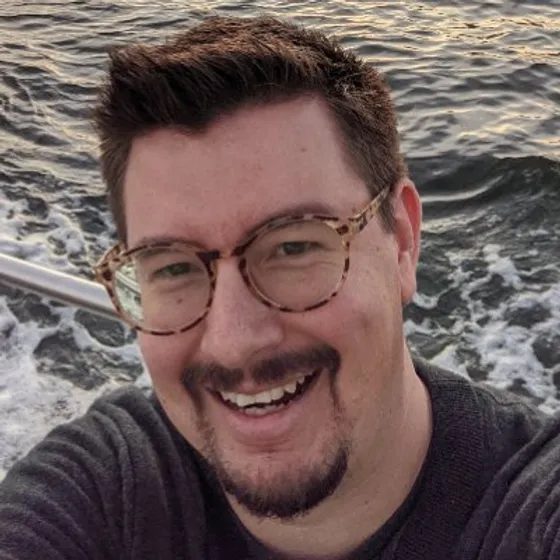
Ethan Felizzari-Castillo doesn’t think films really compete with each other. What he sees, as a director, producer and the founder of New York’s CK Productions, is films competing for a week of attention. On this episode of the Unscripted SEO Interview Podcast, recorded in January 2025, Ethan walks through how an independent film gets press with no studio behind it, why release dates are a search problem, and why a theater run is the least important part of a movie’s life.
This was one of my favorite conversations on the show, because I’d never talked SEO with someone working inside entertainment.
You can listen to the full episode with Ethan on Castos.
🎧 Listen to this episode
📺 Watch the interview
A production company started in high school
Ethan started acting in local theater as a kid and opened CK Productions in 2013. “The same company I opened when I was a junior in high school is the same company I work for today in my late 20s.” It’s now a multimedia production company working in film, theater and music, with a marketing branch, CK Marketing, for independent films and recording artists.
Everything they take on stays independent, and he runs it the way his family runs their small businesses across New York. “It’s very similar to how any other small business would run.” You start with little money, you “use what you do have to your strength,” and you make up the rest with paid media later.
Get the artist speaking, even when nobody knows their name
Ethan’s first question on any campaign is what the press outreach will be:
“How can we get as much press as possible, but specifically press where the artist or the creative or the person we are trying to promote, how can we get them speaking?”
Interviews come first because people decide whether to give a film their time and money by relating to the people behind it. The catch is that the trades with the most pull, The Hollywood Reporter, Deadline, Variety, Rolling Stone, want the biggest names, not the small story.
He worked on Beyond Utopia, a documentary about North Korean defectors that, he said, had already won at Sundance when he came on. The subject was a pastor running what Ethan described as an underground railroad for defectors. “No one’s ever heard of this, this literal modern day hero. How do you now build this guy up?” His answer is time, effort, creativity, and figuring out how Google is going to recognize the person.
Films don’t compete with films, they compete for a week of space
I asked whether other films are the competition. Ethan said mostly no. People who went to see Mufasa aren’t necessarily the people who went to see Nosferatu. Genre splits the audience before any marketing does. “It’s really less competition on movie to movie and more competition on us versus the audience member.”
Where films do collide is timing. A small business plans growth over months. A film often gets two weeks:
“Your best chance to catch an audience member, especially now that no one is buying movies that far in advance anymore, is like the week of. So then that week of your competition becomes, it’s less about the movie and more about the space that you’re able to get for that movie.”
He had a film come out on January 10. That’s a hard date for an independent release, because “it’s the very last week that awards movies are doing their mandatory runs to get nominated for Oscars.” If a Bob Dylan biopic starring Timothée Chalamet is getting every interview and every placement that week, your film’s odds of traction drop, whether or not you share an audience.
Still, he doesn’t root against the big releases. People going to the movies at all is good for every film.
A theater run is a luxury, and the real life comes after
Ethan’s view of theatrical release would surprise a lot of first-time filmmakers:
“A theater is a luxury. It is an amazing luxury to get place in a theater.”
With fewer theaters and screens going to studio films, a small film may get one weekend. That’s exciting for investors and producers, but “the real life nowadays for a film comes after that movie has that theatrical release.”
After release there are two audiences: the people who’ll leave the couch, and the people who’ll wait for it on Hulu. Neither is wrong. The second group is where Ethan sees independent films surviving now:
“I think right now social influencers are what keeps independent movies specifically alive. A good social influencer campaign can make or break a movie.”
An influencer reaches the cinephile in the middle of the country who only has an AMC or a Regal nearby, and tells them the small film is worth their time and where it’s streaming. He contrasts that with the organic cult revival of The Rocky Horror Picture Show, a box office bomb that became part of the culture. He’s heard of studios engineering a comeback like that but has never been part of one.
Eventually, he said, you let go: “The movie itself is an entity, but the movie itself has to at some point, you have to let it just go and you have to move on to the next project.”
AI search is still the old-fashioned way, for now
When I asked whether AI search tools change his approach, Ethan said not yet. “Right now I view it as more of the same of, you know, still the old fashioned way of populating things.” He remembers Google’s AI answers getting everything wrong at launch and then getting sharp.
What interests him more is access. “Entertainment is something that has been controlled by major studios for so long,” and tools that make marketing accessible “for the little guy or for the little film” could become a real strategy for independent production companies.
Indie film marketing lessons from the Unscripted SEO Podcast
If you market anything with a short window, a launch, an event or a film, Ethan’s playbook comes down to a few moves:
- Get the people behind it talking. Interviews beat announcements.
- Plan the release week as a fight for space, and check what else is taking the coverage that week.
- Treat the theater, or the launch, as the start. The long life comes from streaming and word of mouth.
- Use influencers to reach the audience your press never touched.
At recording, Ethan was preparing to shoot his debut feature as director, Backyard Desert, in spring 2025, aiming for festivals after that. Find him on Instagram, where he posts most, follow CK Marketing on Instagram, and find CK Productions and CK Marketing at ckproductionsnewyork.com.
I wrote two more takes on this episode. For agencies, entity SEO for indie films on SEO Arcade covers how Ethan checks the SERP for a film title and measures campaigns by phase. For anyone chasing their own knowledge panel, read how to get a knowledge panel without a publicist on my personal site. Earlier guests went deep on the same topic, including Jason Barnard on entity optimization and AI.
Subscribe to the Unscripted SEO Interview Podcast wherever you listen, so the next conversation lands in your feed.
This episode is supported by our sponsors: Assertio, which writes content at the claim level so AI answers have something to quote; Blawgy, which publishes SEO blog content for agencies under the agency’s own brand; GSC Wizard, whose Google Search Console MCP hands ChatGPT and Claude finished numbers instead of raw rows; and Fastbooks, which handles invoices and bookkeeping for freelancers and small business owners.
Sponsor disclosure: Assertio, Blawgy, GSC Wizard and Fastbooks are paid sponsors of the Unscripted podcast network. Links to them are marked as sponsored. Ethan Felizzari-Castillo has no connection to them.