
This one is a first. Martin McGarry told me at the top of the recording that this was “probably the first real podcast I’ve ever done,” and I believe him, because he describes himself as a reclusive SEO: conferences, the community forums, otherwise head down doing the work. Twenty years of some kind of SEO, ten of them professional, and the early years spent, in his words, in the “murky world of building WordPress websites and trying to hack links and just rank whatever I could.” He went clean about a decade ago and now consults for small UK businesses, some US healthcare clients and a lot of iGaming.
🎧 Listen to this episode
I started this show to find the people with their heads down rather than the ones on stage, and Martin is exactly that. Listen first, then read on for the parts you’ll want to quote.
Watch on YouTube: https://www.youtube.com/watch?v=X4s7o82vq3I
Listen on Castos: https://the-unscripted-seo-interview-podcast.castos.com/episodes/martin-mcgarry-on-black-hat-balance-wordpress-exploits-and-perspective-as-currency-in-ai-search
Twenty years of SEO, ten of them clean
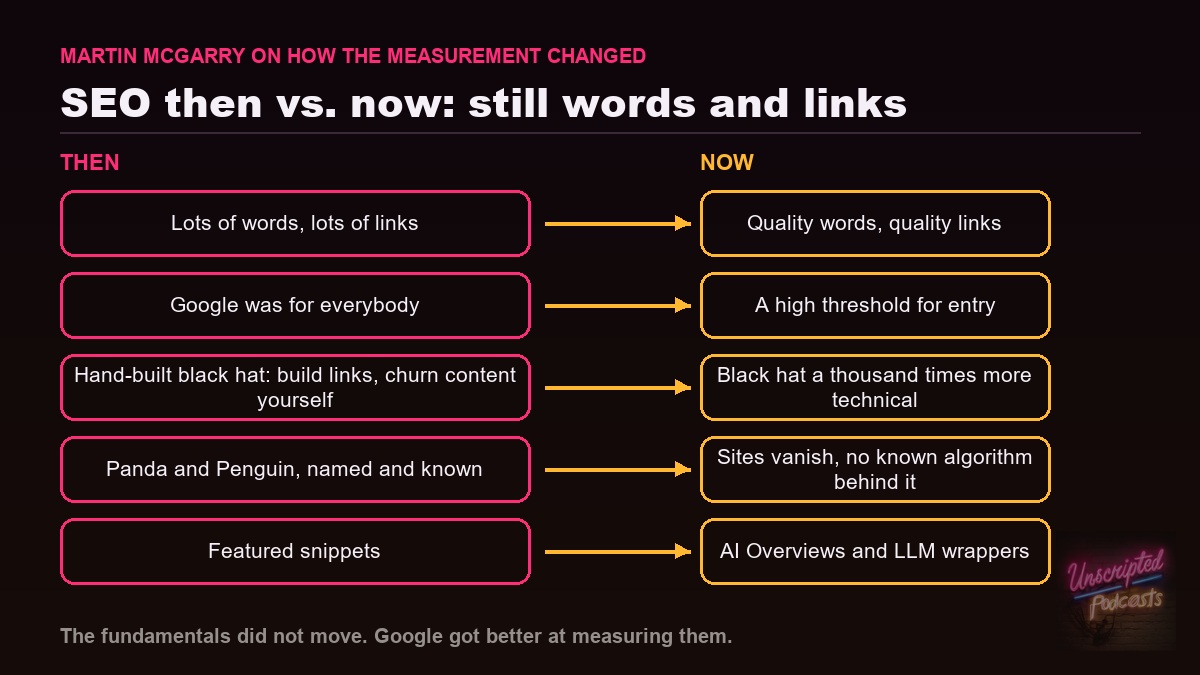
Martin’s career splits down the middle. The black hat years taught him what he calls quick technical black hat, back when it wasn’t automated and you built the links and churned the content yourself. He’s watched the update cycle move from named Panda and Penguin releases to websites just disappearing with no knowledge of what algorithm did the work. The capability available today, he says, is a thousand times more technical than it was.
The clean decade is small-business consulting, with iGaming as the niche that made him loud. “If you see me on LinkedIn or any of the forums, I’m probably whining about black hat SEO. That’s my current bugbear.”
The cool trends in WordPress tend to lead to exploits
I opened with a 20-year grievance: comment spam in 2006, comment spam in 2016, and 200,000 spam comments in a client’s filter in 2026. Martin’s answer was that Disable Comments (originally Globally Disable Comments) was always the first plugin he installed. He doesn’t use WordPress for his own site anymore because of the automated taxonomies, categories and tags a technical SEO has to switch off, but every client runs it and it’s great for automation through the RSS feed and the API.
“The flexibility of WordPress is also its curse,” he says. Someone told him it’s the most secure and most insecure platform in the world at the same time, because any hack gets shared globally and patched globally.
You’ll recognise his intake pattern if you’ve worked with local clients. Singing acts, tradespeople, and “most of the time they come to you with an exploit of some kind, and it’s a plugin, obviously.” The one that still makes him wince is RevSlider: rotating homepage banners nobody watched that became full PowerPoint presentations nobody saw, with a “mega security flaw.” Carousels around 2010, RevSlider after, then parallax and the single-page site. Hence the rule in the header.
“A profile of a website that looked helpful”
Martin had listened to earlier episodes on the Helpful Content Update, and he brought the pattern that the sites which vanished were WordPress sites on the same not-quite-custom themes the industry had called simple to scale. His read:
“The helpful content update was not about finding helpful content. It was about finding a profile of a website that looked helpful. It wasn’t about the content on the site. It was about the entity graph or the knowledge graph. Would you trust that platform? Would you ask that person or that company for help?”
If that framing is new to you, Olesia Korobka’s episode on knowledge graphs and brand fortresses is the companion listen. Danny Sullivan said afterwards the wording was probably incorrect, and by then everybody was asking why their helpful content wasn’t being acknowledged. Martin’s bigger theory is that Google needed to axe a fair bit of the index and used the entity graph to choose who stayed. Everybody could be a creator, and Google didn’t want that competition.
He isn’t saying words stopped mattering. Google “still calls words on pages.” The content prospectors just thought a single platform full of words was enough, and it was, once. “Google used to be for everybody. And that was the great thing about it… It’s a really strict discipline now and the threshold for entry has been put up by Google.”
“I just want balance back”
That line came after I described a door-manufacturer client whose whole top 10 was getting sludged by a competitor buying 20 domains a month, and it’s the heart of why Martin rants. He isn’t asking Google for purity. A lot of SEO contravenes the guidelines and he wants the levers to keep working: “We do want levers that we can pull as SEOs.” What he won’t accept is a top 20 of churn-and-burn sites, because his clients need to stick around. “That would be gone tomorrow, and then there’s a different top 20.”
“I just want balance back. I want to be able to pull levers and for them to work, not to pull levers and end up on page three.”
In iGaming the deluge, he says, comes from “offshore illegal companies.” A reputable pharmaceutical brand competing with offshore illegal drug suppliers would see that cleared straight away. iGaming has been left, handled algorithmically by a Google that doesn’t grasp country-by-country regulation. “It’s surprising that it’s been left this long.” It rhymes with what Timothy Malmros described on this show: drop domains, canonical tricks, and a Google that only reacts once the spam is already ranking. He doesn’t mind black hats on social media saying they’re the ones making regular money. “It’s a bit of yin and yang.” But: “At the moment, it’s not balanced at all. It’s swamped.”
Telegram sellers, expired domains and ten more sites waiting to load
Here’s the mechanism, and it’s the segment I’d send to anyone who’s watched a clean site fall off page one for no reason.
Telegram link sellers have scaled an old trick, adding links to brands with their own anchor advertising their services, to hundreds of thousands of sites and millions of links. It works, and expired domains work, because of what Martin calls the grace period: Google needs things in the SERPs to understand whether users want them, and it can’t judge a page it hasn’t seen ranking.
- A spam page ranks for two or three days.
- It gets tanked almost instantly, but there’s another ten waiting to be loaded.
- The spam links make Google reassess the organic listings that were already there. Martin has seen sites disappear with no reason to, dug into the details, and found Telegram sellers diluting anchor text and destroying the link profile.
- “You’ve got 20 sites that are under a temporary link penalty; your expired domain just slots in instantly.”
“We get one spam update a year that we know of.” We recorded inside the March core update window, and he was hoping for an announcement.
My counter for the door manufacturer was a hygiene program: an aggressive disavow, checked every week. They launched ten more sites, we disavowed them. Rankings that had tanked climbed back and the anchor profile cleaned up. If you take one habit from this episode, take that one.
Perspective, the raw API and the RSS feed nobody is optimising yet
Ask Martin what a company selling precast walls or sunrooms should do for AI search and he answers with perspective. AI can dig out the facts (size, scale, colour, the technical specs) straight away. What it can’t do is hold an opinion.
“You have a perspective on the product that you sell. And your opinion and your perspective is going to be your currency in the future.”
His customer example: everyone assumes a flip-flop is summer clothing. “Who buys a flip-flop for the rain?” People in tropical countries. He calls that “not a unique selling point, but it’s a unique angle,” and you only find it down in the granular use cases and buying personas. “AI can’t reproduce perspective or opinion.” (My version, which you’ll hear on the tape: every human has an opinion, and ChatGPT is the world’s biggest yes man.)
His top tip for anyone learning SEO right now is to hit the API. Open Visual Studio, access the OpenAI or Gemini API from your terminal, and ask a raw question. “What you get back is junk.” That’s how you learn something in the background is augmenting the chat results (RAG, and OpenAI has been caught Googling), and it’s why he’s sure SEO isn’t dead: “these LLMs are having to go out and get extra information from somewhere.” Learn how that fetch happens and you learn where your site needs to be positioned.
And the idea he thinks nobody else has said yet: forget llms.txt, optimise your RSS feed and your API. If part of SEO goes server-side, that’s where the conversation moves. “Maybe I’m the first to go down that route. There’ll be a whole raft of courses on it by next week on LinkedIn.”
Where to find Martin
Google “search assistance” and he comes up in the UK. He jumped from Twitter/X to Bluesky in the exodus, he’s always on LinkedIn, and the SEO Community Slack is where he’s “constantly on there whining about black hat.” He describes himself as “your granular content SEO… still a lover of the keyword, even though everyone says you shouldn’t be optimizing for keywords.”
- Website: Search Assistance
- LinkedIn: Martin McGarry
- Bluesky: @searchassistance.co.uk
Watch: https://www.youtube.com/watch?v=X4s7o82vq3I · Listen: https://the-unscripted-seo-interview-podcast.castos.com/episodes/martin-mcgarry-on-black-hat-balance-wordpress-exploits-and-perspective-as-currency-in-ai-search · Subscribe to the Unscripted SEO Interview Podcast wherever you get your podcasts so the next head-down practitioner lands in your feed.