Unscripted SEO · Host: Jeremy Rivera · Guest: Mike Martin, founder of GBPly
Unscripted SEO Podcast
The GBP Loop – Mike Martin on Google Business Profiles
Verification, mirroring, citations you can edit, independent practitioner profiles, Ask Maps and why GBP work has no end date.
Mike Martin was a locksmith, out on the road breaking into houses and cars, until paid ads got too expensive and he started building his own websites. At one point he ran about 3,000 of them. This year he let 2,500 domains go, because the sites kept ranking and the leads kept falling. Now he runs GBPly, software that helps agencies manage Google Business Profiles, and his whole method fits in one line: fill the profile, mirror it, then pictures, posts and praise, every month, forever. We covered verification, citations, independent practitioner profiles, Google’s new Ask Maps and why Gemini gets Google’s own documentation wrong. Listen to the full episode, then subscribe to Unscripted SEO so you catch the next one.
Verify last, not first
I asked Mike about verification, since so many people I talk to are getting pushed into video verification. His answer surprised me: he doesn’t start with verification at all. Google takes information from user input, from the business owner and from “verified sources across the web, like your website citations and things like that.” So you set up the website first, then the citations, and you make them match exactly. Then you make the profile match both. Then you verify.
Mike calls this profile completeness slash mirroring, and he says the old NAP rule is now too small. “Your working hours, your categories, your services, your prices, everything needs to now match, not just the NAP information, because AI has made it super simple to crawl.”
The other mistake he sees, even from experts: a service area business showing its address. That’s “against Google’s terms of service if you’re a service area business,” and it’s spelled out in Google’s guidelines for representing your business. If you show an address, you need a commercial premises customers visit and signage on it, and video verification from home becomes close to impossible. A plumber set up as a service area business has it easy. Walk outside, show the van with the signwriting, the tools, the invoice book in the front and a utility bill. Done.
Distance, relevance and prominence
I’ve seen service area businesses get nowhere on Maps, then rent a small office near the centroid of the city, put up signage, verify it and take off. Mike agreed you’re allowed to open an office, as long as it’s staffed. “But the key is it’s distance, relevance and prominence. Those are your three factors.” Sit right in the heart of a place and you’ll rank in a tight square around it, as long as you’re relevant.
Mike aims a lot wider than that. His team runs map grids up to a 25 mile radius and tries to be number one in every point. The only way you get there, he says, is consistency.
The GBP loop: profile completeness, pictures, posts and praise
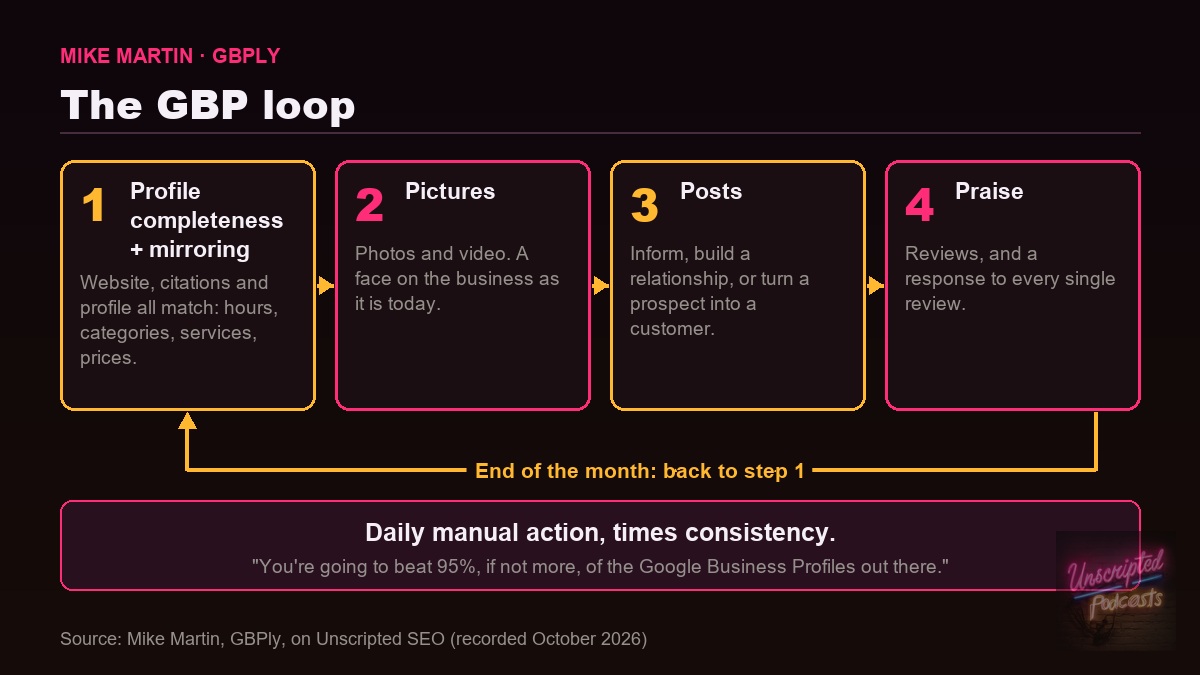
Here’s the system Mike built GBPly around. “It rhymes with the Ps.”
- Profile completeness and mirroring. Fill in the profile, make it mirror the website, then go to every citation you have and fix anything that’s off.
- Pictures. Photos and video. “Images don’t affect ranking, but what images do is they put a face on the business, and a face on the business as it is today.”
- Posts. A post does one of three things: gives information, builds a relationship or turns a prospect into a customer. Keyword-stuffed posts “don’t even get indexed.”
- Praise. Reviews, plus a response to every single review.
At the end of the month you go back to step one and do it again. Mike’s framing is that Google Business Profile moved from a static listing to something closer to a social profile, so it follows social rules. “With a Google Business Profile, it’s daily manual action.” All the technical SEO, keywords and internal linking still live on your website.
Stay on that hamster wheel, he says, and “you’re going to beat 95%, if not more, of the Google Business Profiles out there, because nobody’s staying consistent.” Every profile he has personally optimized saw a big visibility jump within 12 weeks, and his own ranks number one across a 50 mile radius. It once ranked in France, from the south coast of the UK.
The GBPly link is a referral link; I may earn a commission.
Citations: Dana White versus Bob Smith
I asked Mike about data aggregators, and we had to stop and define the term, because we were using it for two different things. What I mean is the handful of business data hubs (Localeze, Foursquare and the like) that collect business information from registrations, chambers of commerce and other sources, then package and distribute it to hundreds of directories. You can knock out a good chunk of citation work by hitting those first. BrightLocal connects to them. SEO Arcade’s guide to building local citations covers the rest of the process.
What Mike means is the mass citation tools that sell you a hundred listings for a couple hundred dollars, half of them sketchy. He avoids those, and his analogy stuck with me. Bob Smith sits at home, three or four people visit him and he has no other connections. Dana White, the UFC promoter, is connected to everyone. You want Dana White citations. “I personally, for a local business, would prefer to have 10 verified, manually created citations on proper places than 100 just genuinely OK ones.”
The reason is control. Mike says Google’s documentation now says it can notify you that someone suggested a change to your profile, and if you don’t respond, apply it within four days when verifiable sources on the web back it up. So if someone gets control of your citations and changes the phone number on 20 of them, they can suggest the same change to your profile. Miss the notice and it goes live. That’s why he wants 10 to 15 citations you can actually edit.
Independent practitioner profiles
When I asked about edge cases, Mike asked if I knew what an independent practitioner profile was. I said it’s the doctor at a health clinic who claims their own profile at the practice address, and he said I was “one of the first SEOs that’s ever been able to answer that pretty much bang on.”
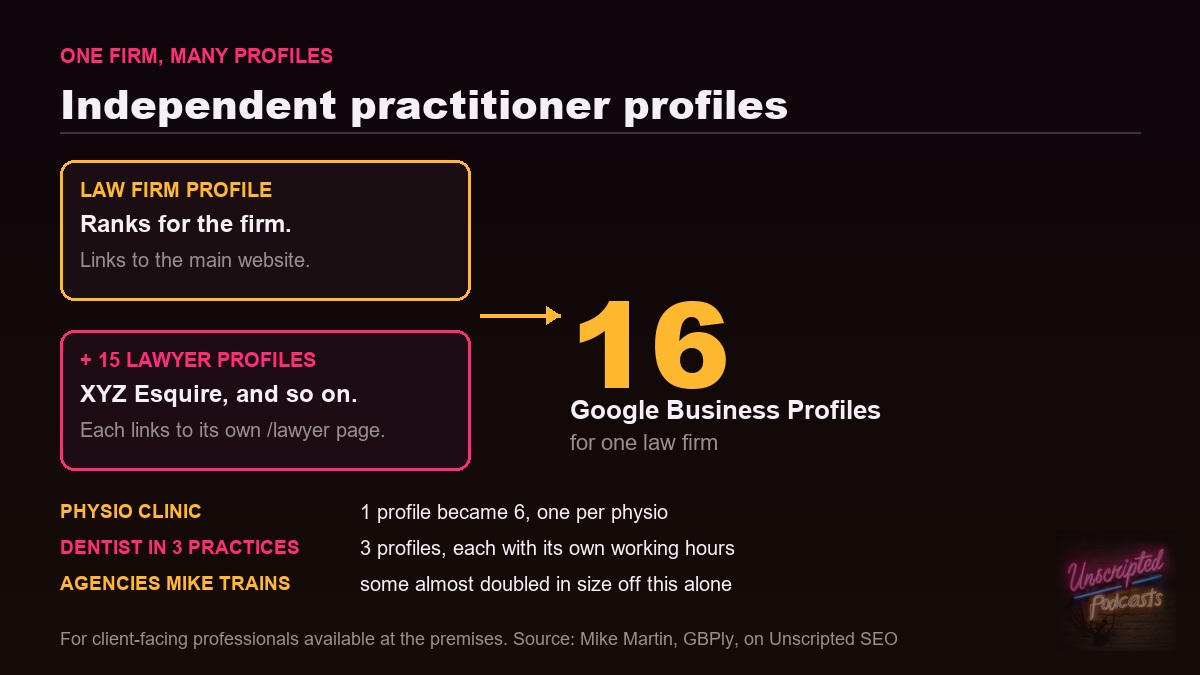
Google allows them for client-facing professionals who are available at the premises during working hours, and it names lawyers, dentists and doctors. Mike’s examples:
- A physio clinic with five physios now runs six profiles: one for the clinic and one for each physio.
- A US law firm with 15 lawyers could run 16 profiles. The firm’s profile links to the homepage, and each lawyer’s links to their own page, like /lawyer-one.
- A dentist who works in three practices across the week can have three profiles, each with its own hours.
Mike says “some of our agencies have almost doubled in size just off the back of setting up independent practitioner profiles for experts.” If you work with clinics, Isaac Justesen’s episode on clinic profiles is worth hearing next to this one.
Want to run this for a client? I turned it into a step-by-step SOP: how to set up independent practitioner profiles, with Google’s eligibility rules and a free one-page PDF.
Mirroring matters more than the link profile
I asked how much a website’s links count toward its profile’s rankings. Mike thinks of it as the website as an entity, not as a link profile. The SEO belongs on the website, and a well-built, data-driven site will lift the profile with it. But mirroring comes first.
“Google’s the hottest girl at the party. And if your website and your Google profile don’t match, then all of a sudden you’re in a position where Google is just going to walk away.” His summary: “one business, one entity, and everything needs to match.”
Google Books, IMDb and a 24-hour AI overview
Mike hasn’t touched Bing. His view of AI search right now: run the same search twice in an LLM and you get two different answers. “We’re living in a world of a giant split test and still the LLMs are trying to figure out what they’re doing.”
He still ran an experiment. After watching James Dooley and Charles Floate on making AI overviews “pop,” he put some of his eight to ten Amazon books on Google Books and set up an IMDb profile. Within 24 hours, the AI overview for “Mike Martin SEO” filled in with his background, where he started and the businesses he runs. He hadn’t seen anything move that fast since around 2011. His caution: AI search came out in 2024, and 10,000 hours is 40 hours a week for five years. “So there’s no experts yet.”
Twiddlers and the HouseFresh lesson
I went on a rant here, so I’ll own it. SEO is the only consultancy I can think of where the thing you’re measured on is built to hide whether your change worked. Google calls them twiddlers: your rankings jump, drop and come back so impatient black hats can’t tell what happened. Mike pictured “little evil engineers at Google sat laughing their heads off.”
Then I told the story of Gisele Navarro and HouseFresh. They did everything Google said it wanted, tearing down air purifiers and testing them properly, and the helpful content update still cut their traffic to a sliver. Six months after Google invited publishers to talk to its engineers, their rankings came back with no change on their end. My takeaway, and I’ll keep saying it: it’s not enough to just create good content. When one channel of your income depends on a black box, you’re exposed.
From 3,000 websites to Google Business Profiles
Mike’s history explains his method. Early on he used Pay As You Go SIM cards to get 19 free Google websites, ranked them all number one and woke up one day with none. So he went black hat. He scraped Yellow Pages for expired domains, bought up to 100 a day and built city pages on them with his Magic Page plugin, then stacked them into PBN “triangles” pointing at money sites. “I don’t build money sites. Money sites build themselves based off my strategy.”
At the peak he had about 3,000 sites. They all kept ranking, and the leads kept dropping. With a network that big, he could see the trend before anyone else, so a few years ago he took “a full 180” into Google Business Profiles. He let 2,500 domains go this year and has 2,600 more set to expire next year. He also passed along something he heard secondhand from a video: lawyers at an event saying 70% of their leads now come from their Google Business Profile and AI overviews.
Ask Maps and the blacked-out shop
Mike called Ask Maps the biggest upgrade to Google Maps in 10 years. You can ask Maps for a vegetarian restaurant open within five miles, or a hotel with disabled access, and it answers from profile data. That’s another reason profile completeness matters, and another reason Google doesn’t want service area businesses showing an address someone might drive to.
His picture of how Google reads activity: if the shop across the street has blacked-out windows but a queue out the door every day, you assume it’s busy. “If it sees lots of activity from a business and then nothing, it just assumes you’re no longer a busy business anymore and drops you through the rankings.”
Opening a second location
I asked about a client of mine that makes precast concrete walls in Florida and is weighing a Houston branch. Mike’s answer: every location’s profile is independent. You don’t push the same images to both. And if you can run the new market as a service area business, you don’t need a storefront or signage, just a staffed location.
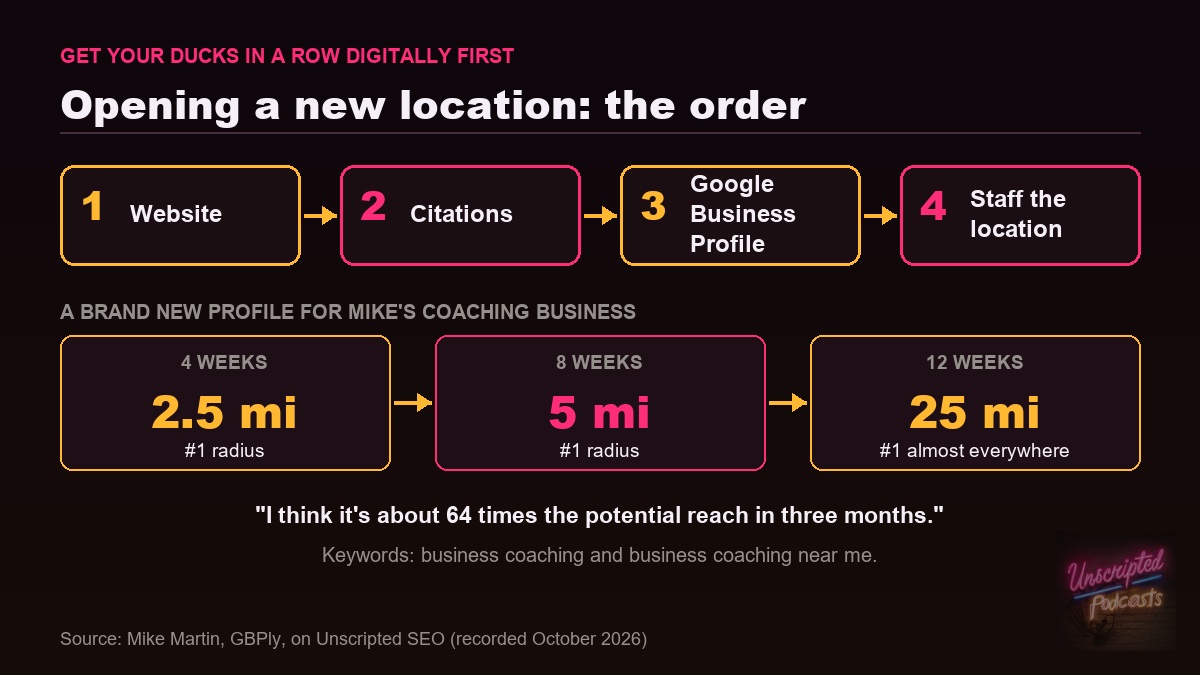
If it’s a storefront, his order is website, citations, profile, then staff. Verification “can be a pain in the backside” and you get little feedback when it fails, so get your ducks in a row digitally before you hire. “The quickest route to leads without paid ads is a Google Business Profile.” His proof is his own coaching business: a brand-new profile hit number one in a 2.5 mile radius in four weeks, five miles in eight and 25 miles in 12, for “business coaching” and “business coaching near me.” He also says he has “never seen a legitimate Google Business Profile drop” the way websites do.
AI-written posts: a human approves every one
I asked whether writing GBP posts with Claude would get read as AI slop. GBPly lets you draft posts with AI, but “it has to be checked, edited and approved by a human being” before anything publishes. Mike says stay away from AI-generated images, since Google asks for real pictures of the business. A post’s job is the relationship, not the ranking.
Then he went after em dashes (“no real person ever uses them”) and I had to confess I used dashes long before AI did. He has a name for the way I write, short lines and lots of space: “presentation worthy content.” His own prompt rule is simpler: “write it like a 10 year old could understand it.”
Claude Code, WordPress and dark clicks
Mike told me he once had five full-time writers and five developers. None of them work for him now. “You need AI operators now.”
I’ll be honest, I feel like I’m using steroids, and I know there’ll be a cost later. Right before we recorded, I had Claude Code audit my wife’s tattoo shop site for ADA problems over the REST API, and it fixed them while we talked. I got there after interviewing Mason McCumber and talking with Matt Brooks of SEOteric, who showed me that a WordPress application password lets Claude Code handle almost any change on a WordPress site.
I also shared my dark clicks study. Across 38 sites and about 4 million clicks in Search Console, the average site had 64% of its clicks come with no query attached (42% when you pool all the clicks together). John Mueller replied that the clicks are counted on the page, only the query is hidden, and the privacy threshold isn’t going away: a query with fewer than about a dozen searches doesn’t show up in the table. I’m going to test that with a group of volunteers. If it holds, a huge share of searches are too unique to count, and keyword search volume as we’ve understood it is a broken model.
Mike thinks keywords will go away entirely. We used to search “plumber Manchester.” Now people talk to their computers. He also had a warning: his team can’t use Gemini for Google Business Profile questions, because it gets Google’s own documentation wrong and then doubles down. Claude and the newest ChatGPT models do much better for them.
Where to find Mike Martin
Find Mike’s books and software at mikemartin.uk, his videos on his YouTube channel and connect with him on LinkedIn. GBPly has a free Google Maps rank tracker with 10 scans a month, built for agencies but used by plenty of businesses. You can try GBPly here (referral link; I may earn a commission).
Want more practitioner conversations like this? Subscribe to Unscripted SEO, read my notes at Jeremy Rivera SEO, and find the tools at SEO Arcade.