🎧 Listen to the episode:
Every so often an interview resets a mental model. This was one of them. Federico Fancinelli, founder of the AI-search visibility platform GeoSonar, has spent two years running a GEO research lab — and what he found upends the hopeful story most of us have been telling about generative search.
The counterintuitive finding: small brands don’t have the edge
Federico expected GEO to be a great equalizer — a “generational opportunity” for small brands, the way early Google was. The research said the opposite.
“The main difference between SEO and GEO is that it’s not ranking blue links, it’s not ranking pages — it’s ranking entities. And bigger companies are entities by definition. They don’t need to prove it. They organically have more citations, more backlinks — all the things that help you rank in AI search, they already have.”
In classic SEO you could rank a single page and punch above your weight. In GEO, your whole entity is measured against other entities — and that’s a much harder fight for a newcomer.
The three pillars: infrastructure, narrative, authority
So how do you build an entity the machines recognize? GeoSonar’s research points to three layers working together — and it’s laid out plainly in their SEO-to-GEO technical guide.
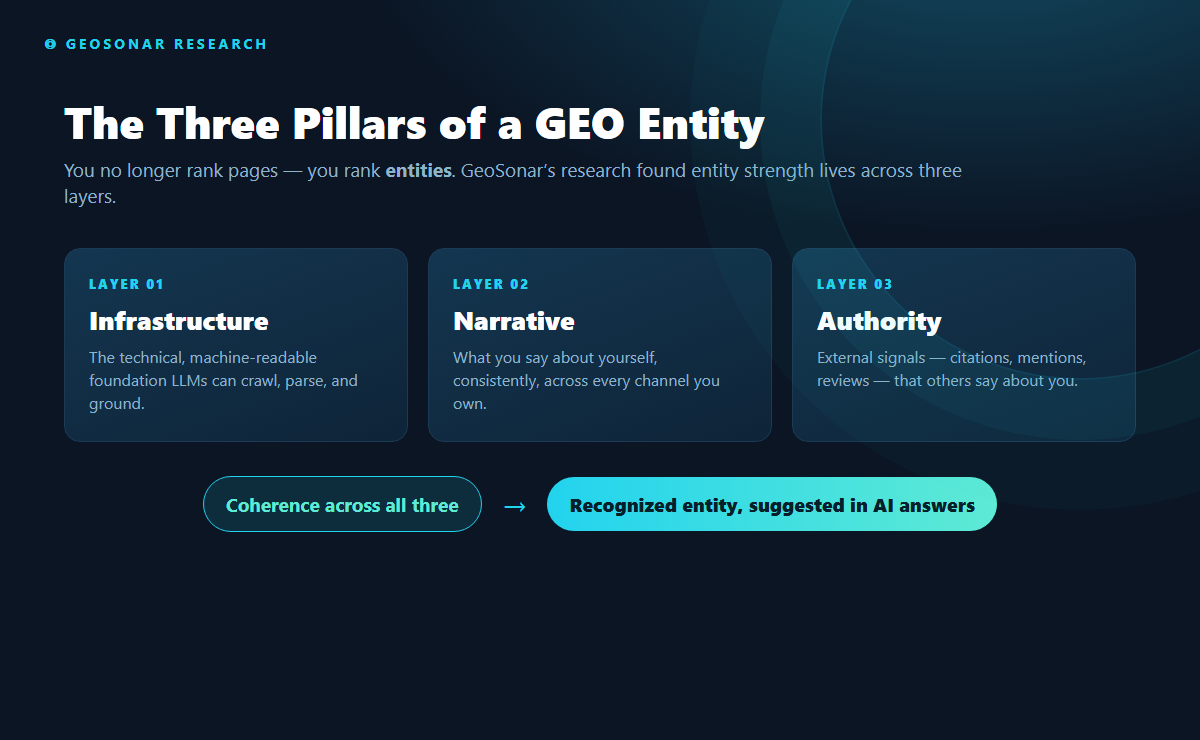
It’s not just external mentions, Federico stressed. It’s the combination of external signals and what you say about yourself on your own channels, all forming the LLM’s grounding about who you are.
Coherence is the whole game
If there was one word that kept surfacing, it was coherence.
“If what you say on your website is different from what you say on your LinkedIn, or those differ from what your reviews say, there is a discrepancy — and this penalizes your brand heavily. Coherence is one of the keys in entity forming.”
Be coherent across every channel that matters for your business, and you have a real shot at being the suggested brand — even against giants. (Federico is worth a follow on LinkedIn for more of this.)
From 1,000 prompts to 10 strategic ones
Here’s the practitioner gold. The same prompt can return a different answer up to 80% of the time. GeoSonar’s answer wasn’t more volume — it was strategy.
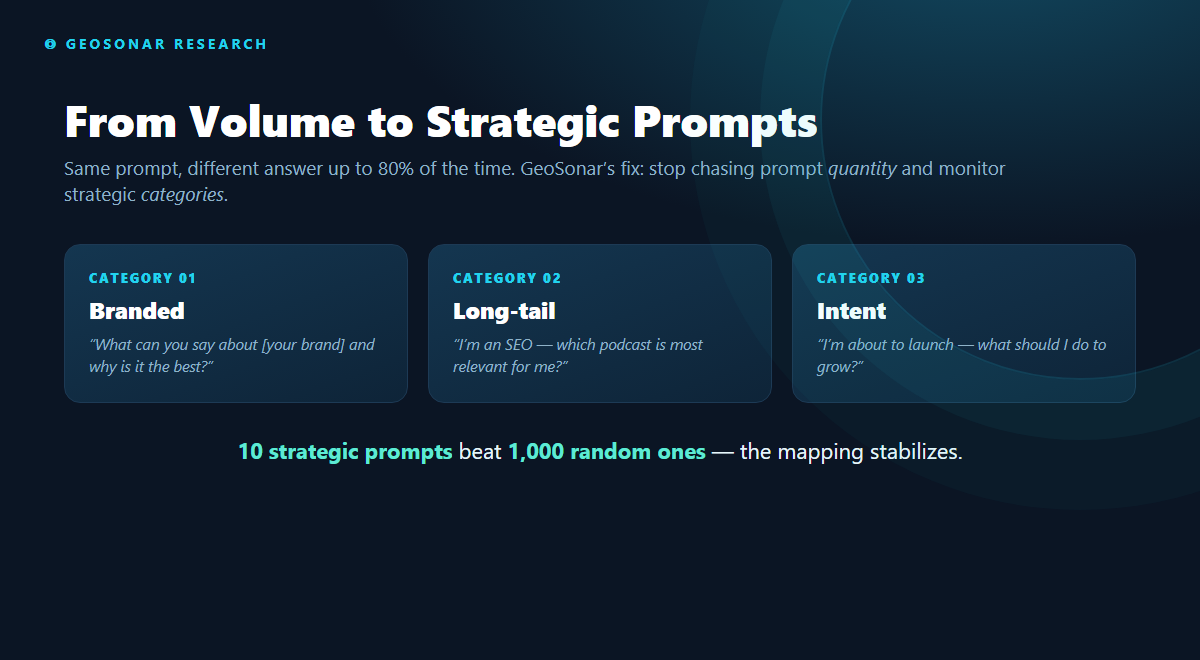
“We went from quantity to strategic quality of prompts … You can monitor ten prompts — two branded, some long-tail, some intent-based. If you map the strategic category, the number of prompts becomes irrelevant. It almost balances itself.”
I compared it to the Heisenberg uncertainty principle — the act of observing changes the result — and Federico ran with it. Which set up the wildest part of the conversation…
“Prompt poisoning” is real — and they filmed it
While building a tool to watch how AI bots crawl a site, GeoSonar accidentally influenced the models:
“By only making prompts in a specific way on brand-new websites, we accelerated the warm-up and the formation of the groundings the LLMs then use as a source about that brand. We have a mathematical proof, and videos of it happening in real time.”
The catch: it works on new, unrecognized brands — not ones already mapped into the AI’s grounding. A genuine early-mover window, with obvious black-hat temptations attached.
Every LLM is a different beast
One optimization does not rank you everywhere. Federico broke down the Google stack alone — AI Overviews and Gemini overlap, while Google AI Mode is “a much different beast” that blends traditional results with Gemini — and then ChatGPT, Perplexity, and Claude reason differently again.
“So many of our clients are present in ChatGPT but not in Claude or Gemini. Optimizing for one LLM does not grant you the same ranking in the others.”
It’s the same fragmentation my friend Matt Brooks at SEO Teric and I keep circling — the “AI overview” is not one thing.
Why you can’t trust Google’s GEO advice
Federico’s sharpest take: follow the money.
“Imagine Google as a bank manager. They would never tell you where the cameras are positioned so you can rob their vault. Why would people trust what Google says about how to rank on Google?”
His verdict is narrative control — whoever controls the narrative controls the behavior. I offered an allegory that stuck: SEOs are courtiers in a royal court, whispering to whichever sovereign holds power. The room used to be Google alone; now it’s ChatGPT, Anthropic, Copilot, Perplexity. And link building is simply getting the queen to say something about you to the king — earning the recognition and referrals that make your patron look worthy.
Agentic commerce: speak the machine’s language
On robots-with-wallets buying goods for their users, GeoSonar’s e-commerce research is blunt:
“If your website speaks the language of the machines, they prefer you — not because your products are better, but before that. Less language barrier. It’s like an empty highway, more likely to be driven.”
Which is why MCP is now table stakes. When I signed up for OpenSEO, my first question wasn’t about features — it was “is there an MCP?” (there is, and it cross-connects to Google Search Console). Federico agrees it’s non-negotiable for any SaaS today — see how he’s built it into GeoSonar’s features.
Reputation is the new ranking
Because you’re ranking an entity, mistakes cost more than they used to.
The LLMs, Federico says, hold a grudge — a pattern Darren Shaw of White Spark has flagged too. A second bad review about the same issue stains the whole reputation. As Patrick Stox told me last week, the real fix is often to change the product, not the page. You can’t hire enough SEOs to out-write a hundred honest customers. I’m living this on Project Kilby — cross-referencing what our website says against what the press releases and journalists actually reported, then correcting the record across the ecosystem.
SEO lives inside GEO
I floated my updated mental model: SEO isn’t overlapping GEO on a Venn diagram — SEO sits inside GEO. Everything we do as SEOs is included, and then there’s more. Federico: “Precisely. Spot on.”
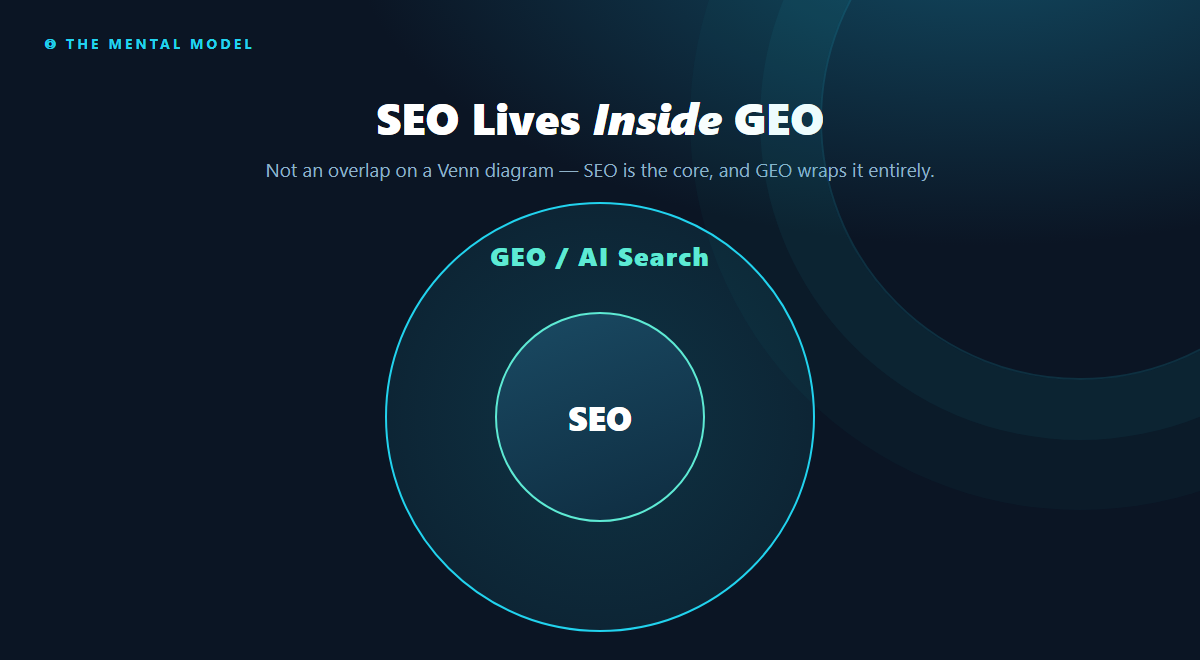
“What changed is not the name, it’s not the discipline — it’s the channel. It was all before only the website. Right now it’s the ecosystem.”
Go deeper
Explore GeoSonar (features · book a demo · GEO Academy), connect with Federico on LinkedIn and GeoSonar, and if you want the tactical layer, I’m mining conversations like this into the SEO Tactic Library.
Heard on the Unscripted SEO Podcast, hosted by Jeremy Rivera.