Unscripted SEO · Host: Jeremy Rivera · Guest: Laura Iancu, founder of Searchpedia
Laura Iancu showed up jet-lagged, two weeks back from an SEO trip to China, and still sharper than most people I talk to after a full night’s sleep. She runs Searchpedia, a one-woman consultancy she started in January after years in-house for big brands, and she calls herself a search activist. We covered why AI search attribution is still murky, why synthetic AI visibility data doesn’t match what Google and Microsoft report now, where AI-generated content ends and AI slop starts, and why every quick win in AI search is a wave that’s going to crash. Listen to the full episode, then subscribe to Unscripted SEO so you catch the next one.
One more drip of attribution in a sea of dark clicks
I opened by asking what her AI search experiments look like, since attribution is so murky that some people now argue for a PR-style approach. We’d gotten multimodal data in Search Console the day before, and I called it “one more drip of attribution in a sea of dark clicks.” Laura agreed it’s murky. The data we’re getting is a small sample, and “no one’s hurrying to test on really big websites.” She came back from two weeks away to a core update and a new report in Search Console. Google gave SEOs an AI impressions report a few months ago, she said, “but it’s not what we really wanted.”
That’s where I jumped in with a tip for anyone listening. If Google Tag Manager isn’t carrying Microsoft Clarity for you, get at it. Clarity shows a lot more bots than Google does, and a lot of that “direct” traffic is bots. I measured how far the two drift apart in a Search Console vs Clarity check across 4 sites, and Gert Mellak made the case on this show that plenty of Search Console impressions are bots too.
Synthetic AI visibility data didn’t hold up
Laura’s pushback was about budget. She doesn’t agree with “wasting your budget on the newest, shiniest SEO tool extension” to get synthetic data, when free tools and a well-written prompt get you most of the way. She isn’t anti-tool. She uses them all the time, and she takes them with a pinch of salt because she compares the data.
A big client paid for Ahrefs Brand Radar, so she had synthetic AI visibility data from October and November last year, months before Clarity, Bing or Google released anything. She compared it with what she sees now. “And it’s very different.”
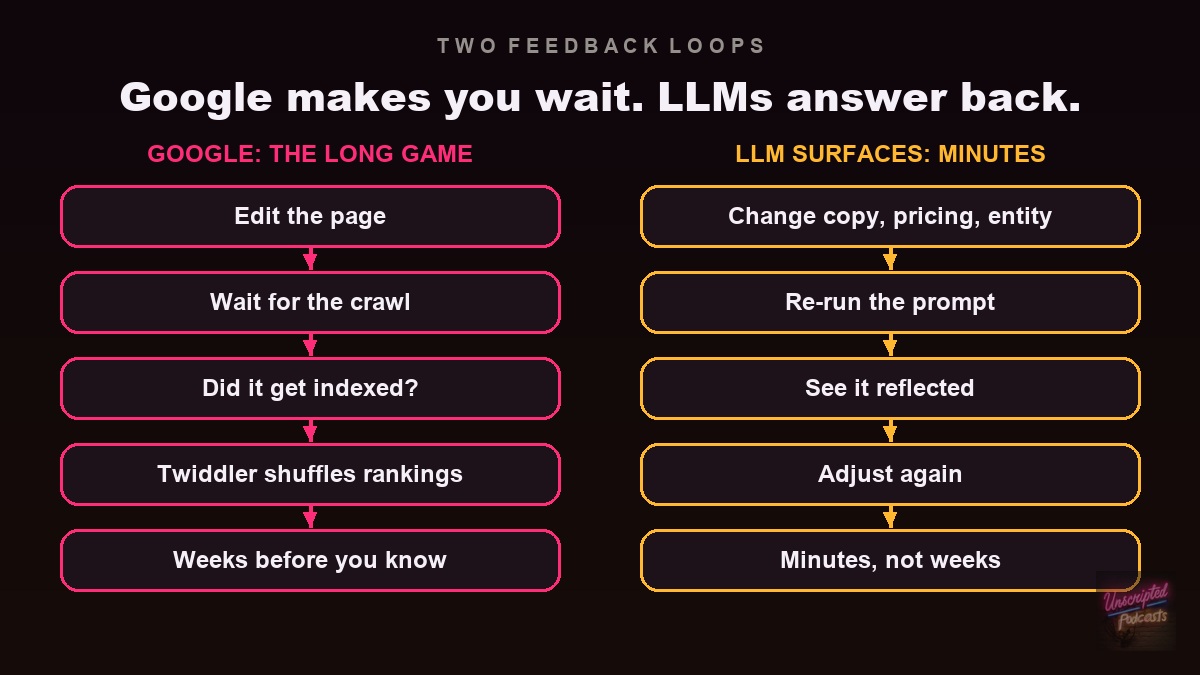
LLMs respond in minutes, Google makes you wait
This is the part that struck me mid-conversation. I’ve changed branding information and clarified pricing on client sites, then run new prompts within minutes and watched the answer change. Google trained SEOs to expect twiddlers, delays and ranking swings designed to discourage you. We’ve been kept like mushrooms, fed BS in the dark. LLMs don’t seem to hold an old cached version of your brand the same way. That makes this a window where you can be more responsive and adaptive, and it’s more dangerous too.
Quick wins are a wave that’s going to crash
Laura said I’d hit the nail on the head with the danger. SEOs got excited because they could see listicle changes land “the next hour.” People are abusing that, and “the more likely Google is going to penalize it.” She quoted John Mueller’s line that GEO and AEO are just good SEO, then added: “And it is good SEO, but that doesn’t mean it’s less complicated.” Jeremy Moser said something close to that on this show in It Was Always Just Good SEO.
She watched Lily Ray give nearly the same talk in London and then in Shenzhen, and she saw how easy it was to meddle with an influential-SEOs list inside LLMs. She was tempted, and then passed. “That’s child’s play.”
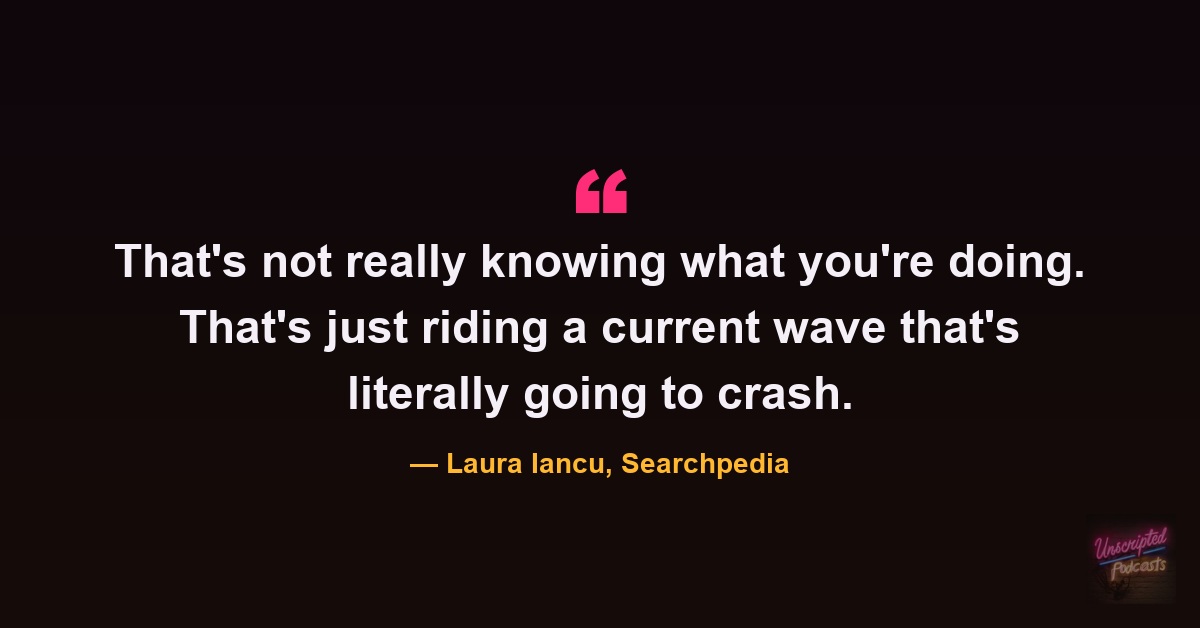
“That’s not really knowing what you’re doing. That’s just riding a current wave that’s literally going to crash.”
Her alternative is slower. She tests on her own clients when she can, leans on people she trusts like Aleyda Solis, and tells a client straight when she doesn’t know yet. Something that worked for an expert “doesn’t mean it’s going to work for my clients.”
LLM optimization expertise is still ankle deep
I borrowed a line from Matt Brooks of SEOteric: SEOs are in exactly the right seat to get asked what’s going on with AI search tools. That’s a blessing and a curse. The depth of real knowledge about optimizing for LLMs feels ankle deep, with a new model every other month. If somebody calls themselves an LLM optimization expert without four asterisks and a disclaimer page, I can’t trust them. Laura’s answer: “No, go home.”
She thinks it runs deeper than that. GEO is a whole new discipline, whether SEO traditionalists like it or not.
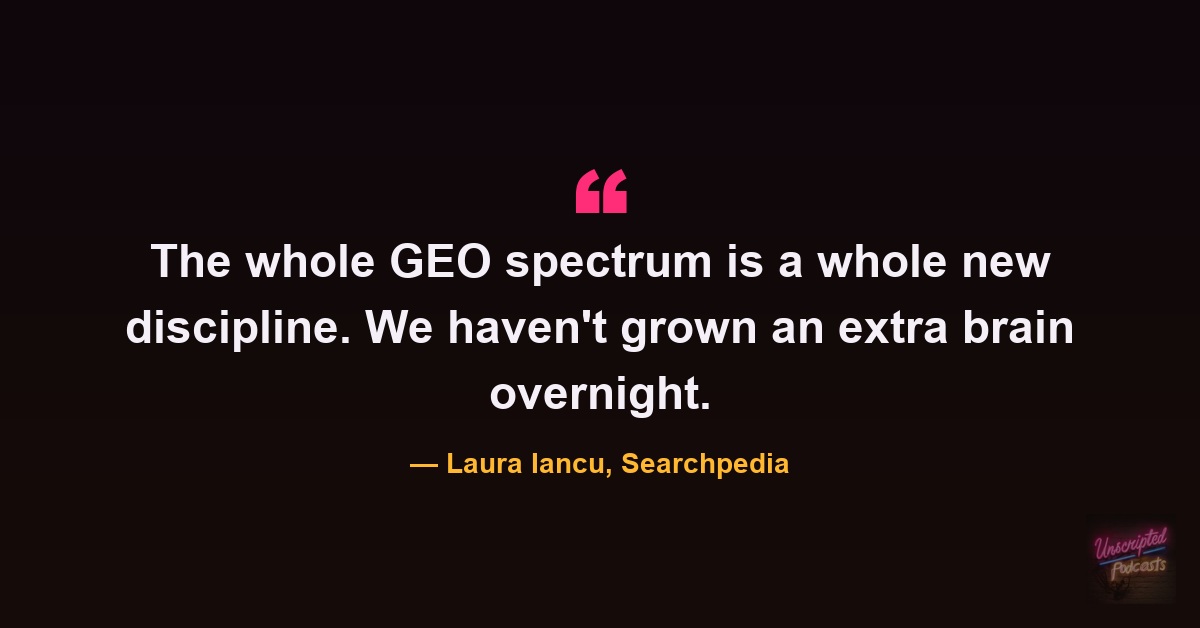
“But at the same time, we haven’t grown an extra brain overnight.”
She spent two weeks at an SEO conference, away from her laptop, and still felt behind when she got back. “So I can’t even imagine how it is for someone who’s just starting now.”
Searchpedia is one search activist, by referral only
“Searchpedia is me. Just me.” Laura worked in-house for big brands and spent a lot of time answering hard questions from C-suites, which she says prepared her for difficult clients. Every client she’s had came through a referral. “I never pitched.” She passes on projects built around black hat quick wins. “I like to build sustainably and I like to build ethically.”
Some prospects don’t need her beyond a technical audit and some information architecture, and she tells them so. The new version of that conversation is a client asking how their brand got into ChatGPT. She’d feel like “a bit of a scammer” promising that a tactic will still work months from now.
Surface the detail your client never wrote down
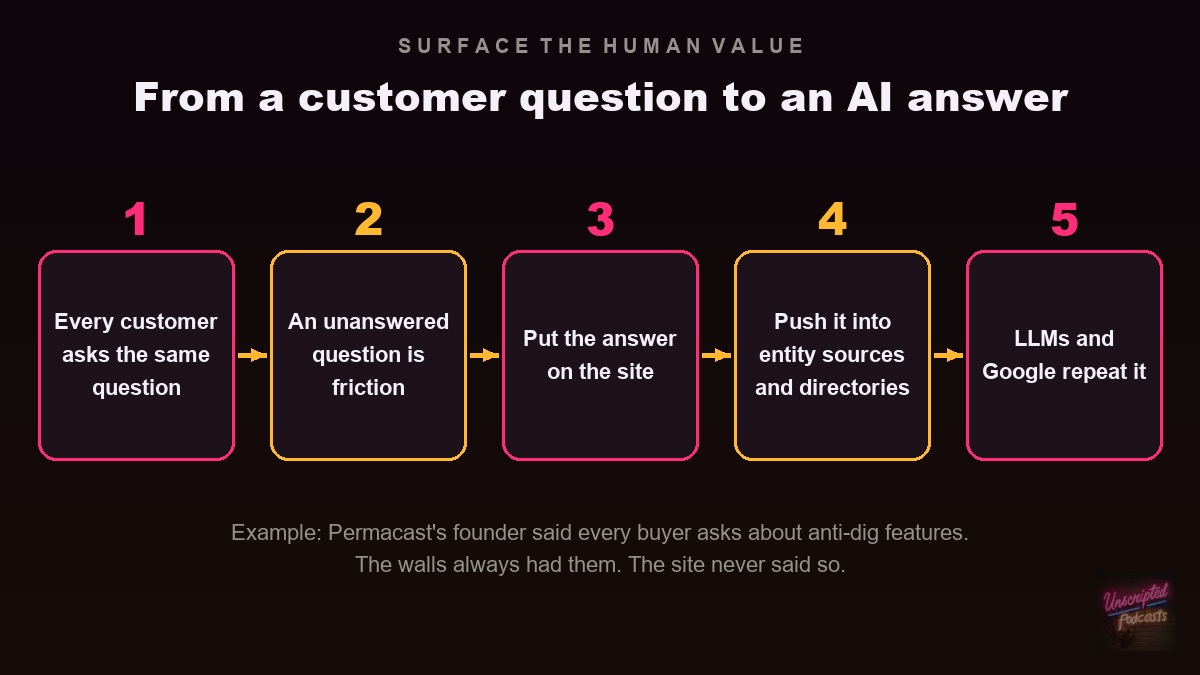
Here’s where I think our job is heading. LLMs are just math, and they’re bad at mixing metaphors. The human conversation is where the value surfaces. When I interviewed the founder of Permacast Walls, he mentioned that every customer asks whether someone can dig under the wall. The anti-dig design is built into the structure, so nobody had thought to say it on the site. If every one of your clients asks about a detail, that’s friction, and it belongs on the page.
Sometimes it isn’t the website at all. It’s entity work, and that’s not as sexy as it sounds. I’ve covered it with Jason Barnard and Alejandro Meyerhans, and Jon Henshaw saw it at Vimeo, where getting data into IMDb had big implications because Google uses it for time markers.
AI-generated content is not the same thing as AI slop
Laura doesn’t agree with the amount of AI content out there, and she knows plenty of fully generated sites are ranking. She recalled Mark Williams-Cook of AlsoAsked putting the share of AI-generated People Also Ask answers at over 70%. Her line is about value, not origin.
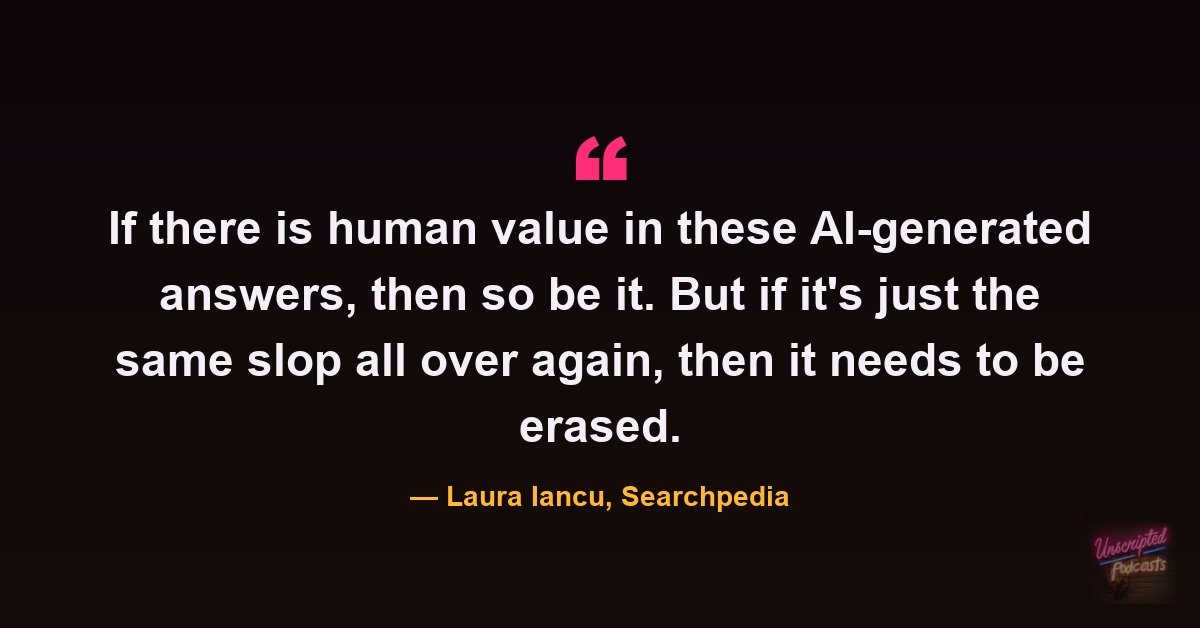
“If there is human value in these AI-generated answers, then so be it. But if it’s just the same slop all over again, that doesn’t add anything to the topic itself, then it needs to be erased.”
She uses AI. Everyone does. What she won’t do is abdicate her brain to it, because somebody still has to know the brand, its audience and the moment a buyer is in.
Back on LinkedIn after two weeks off, she found four of five posts in her feed were AI generated and said nothing. She asked if I’d started using the AI slop button. I haven’t. I find it ironic that a platform whose composer offers to finish your sentences with AI also lets readers call it AI slop. Laura drew the line on intent. Ten commenters under one of her posts left the same comment with the same metaphor.
“All they wanted to do is to be visible. That’s it.”
Publishers, Discover and feeding the beast
I closed by asking what’s got her stumped outside of AI. The answer was publishers. She’s working with a news client and digging into Google Discover for the first time. I’ve consulted for NerdWallet and the Dave Ramsey organization, and I’ve seen the Discover spike and the waterfall right after it. You have to feed the beast, and an archive of old opinion pieces rarely holds any value. Her go-to sources are Clara Soteras’s The Audience Club, Barry Adams and Lily Ray. If you’re a Discover guru, DM me.
Catch Laura at Search ‘n Stuff in Antalya from October 1 to 4, and at BrightonSEO, where she’s giving a talk on October 8 and joining a panel on October 9. Follow her on LinkedIn, Bluesky and TikTok, where she’s posting about her AI research, and see her work at Searchpedia. Then subscribe to Unscripted SEO.