
Evan Boyer accepted what he says is the first apology he’s ever heard from an SEO. I gave it to him on Unscripted SEO, for the way my industry treated PR from about 2010 to 2020, when we wrote off press releases as a pile of nofollowed links we didn’t want. Evan is the founder and CEO of Leaders PR in Raleigh, North Carolina, and he’s spent almost 15 years in PR agencies. His case for SEOs is short: expertise is something you have, but credibility is something other people have to give you, and PR is how you earn it. With AI answers deciding who gets recommended, that second part is the part you can’t fake.
🎧 Listen to this episode
📺 Watch the interview
Listen to the full conversation on the Unscripted SEO Interview Podcast or watch it on YouTube. Here’s what we covered.
PR is telling your story to someone with no reason to repeat it
I opened by asking Evan what PR even is now, in the age of AI. His definition hasn’t changed with the technology:
“PR is asking somebody or telling somebody your story who has no reason to tell it to anybody else, no reason to validate it or vouch for you.”
The job, as he put it, is telling that story in a way that makes them want to. Then he tied it straight to the framework SEOs argue about most, E-E-A-T:
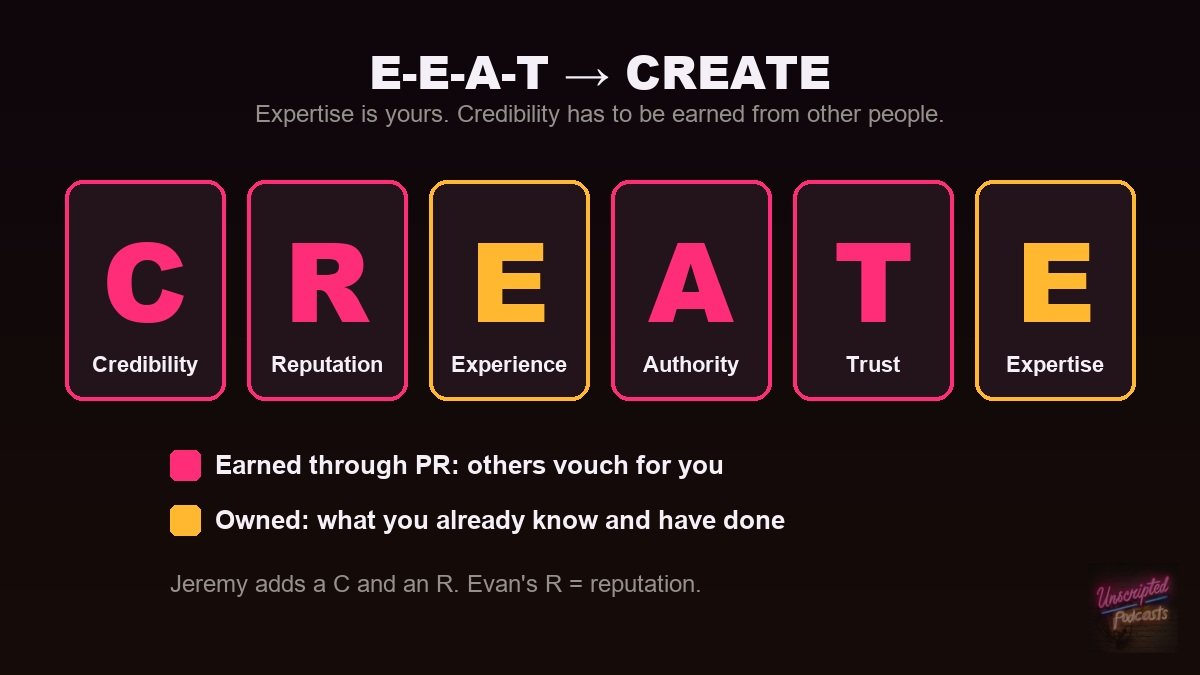
“And I think credibility and expertise are different. In expertise, you have the first two E’s, but you don’t necessarily have the authority and the trust. And so what PR is meant to do is to do that outreach and that storytelling to get others to see you as an authority and trust you.”
So I tried to improve Google’s acronym on the spot. Add a C for credibility and an R, and E-E-A-T becomes CREATE. I guessed the R was relationship. Evan’s mind went to reputation, and I think he’s right.
Google broke the agreement, so SEOs need PR again
Here’s why my apology came with an explanation. For a decade, Google’s deal was simple: build great content and a good site, and it would send you enough traffic that you could pay people to write and build links. I once ranked a client I never met, through an agency contact I never met either. Traffic turned into leads, leads into sales, sales into revenue. It worked “until Google broke the agreement.”
Now there are AI Overviews, ChatGPT and a dozen other surfaces, and the buyer researches in Claude, emails their spouse who uses ChatGPT, and remembers a TikTok from last week. I can’t trace a through line from keyword to revenue anymore. You probably can’t either.
Evan has never sold PR on attribution. “It’s not about proving attribution for me,” he said. What he points to instead is the link between trust building and the numbers SEOs watch: web traffic, conversions and, in B2B, the sales cycle. He put it in two parts: “It’s not attribution,” but “there is correlation there.” His goal is plain: “we want to shorten sales cycles.”
He also told a story every in-house marketer will recognize. He laid out his audience research for a marketing manager, and she said she couldn’t spend that much time on work that wasn’t producing leads: “I don’t have time to do that as the digital marketing manager.” That’s the gap an experienced PR person fills quickly.
Use your nerds: SaaS brands need faces behind the logo
When I asked what a SaaS company should want from PR, Evan pushed back on pitching “brand, brand, brand”:
“I think we’ve seen now individuals’ personalities are outpacing organizations and their ability to attract attention and gain trust.”
The obvious answer is the CEO or founder. The less obvious one comes from his time at Red Hat, where a marketing leader kept repeating one phrase: “Use your nerds.” The subject matter experts below the C-suite “often have the most knowledge,” and they carry the depth a story needs. As Evan said, “people trust people, like humans want to learn from other humans.” Train those people on the message first, then put them in front of a journalist, a town hall or your blog.
Pitch the news hook, then stack the mentions
I brought up Assertio, one of the SaaS companies I’ve interviewed (you can hear my conversation with Lum Kamishi), and its point that journalists think differently than ChatGPT. Should you write one thing to get cited by AI and another to get picked up by a reporter? Evan thinks those two jobs “probably aren’t as far apart” as people assume.
He doesn’t pitch features. He pitches what the journalist’s audience cares about:
“Influencing the influencer so that they can bring their audience along in the story. So really getting a great understanding of audience first.”
Then comes timing. Newsworthiness “has to do a lot with timeliness,” he said. “Why are we telling the story to you right now? Can I find a news hook?” He’d sent pitches that week tied to the Jensen Huang story because it was all over the news.
Next I asked about Ben Wills’ research at OppAlerts. Ben, who I interviewed about one-word prompt testing in LLMs, ran correlation research showing that backlinks and mentions line up strongly with visibility in AI tools, and that unlinked mentions play almost as big a role as links. For a PR person who spent the 2010s hearing “can we get a link on this?”, that’s good news. Evan said “it is a relief. I’m not gonna lie.” His advice: “if you can stack up those mentions over a period of time,” preferably around the same subject, that adds up to more than one hard-won backlink.
Earn first, then own: the content play SEO and PR teams miss
Most SEO teams already run a content machine. I asked Evan whether a steady stream of posts, written in-house or with software like Blawgy, helps his work. It does, but he’d rather start earlier, working with the agency or marketing team on market position, narrative and key message structure, because that’s what decides the content strategy in the first place.
Then he described the play he says gets overlooked when owned and earned teams sit down together:
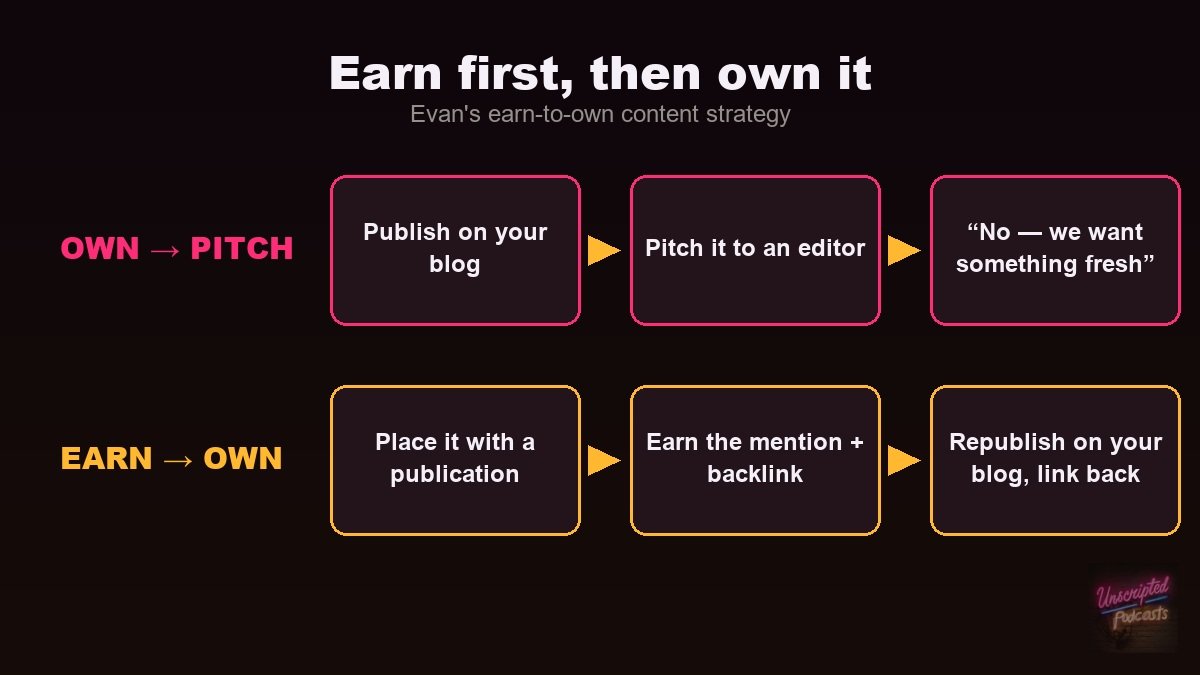
“And it’s a earn to own strategy.”
If you publish a great post on your blog and then ask PR to pitch it, “most of the time the answer is gonna be no, because that publication wants something fresh that’s original to them.” Flip the order. Place the article with a publication first, which in many cases earns you a backlink. Then republish it on your own blog, verbatim or as a snippet depending on the agreement, and point readers back to the publisher for the full piece. “We want to share the love with our publishers,” he said.
Find the white space, whether you have 20 competitors or one small town
This next one was a question from our sponsor WhiteLobby, who do AI visibility for competitive industries: in crowded industries, how do you get a client mentioned when 20 competitors are pitching the same reporters?
Evan’s answer is to look for “a white space.” If 20 competitors already get coverage on your key message, that message probably isn’t enough of a differentiator to build a content strategy on. Sometimes there’s more meat on the bone. Sometimes you go back to the reporter who quoted competitor X and competitor Y and say:
“But there’s actually an angle that you didn’t consider, and it’s this.”
You can back that angle with research or by putting an executive in front of them. This is also where he works best with SEO teams: they analyze a publication’s coverage, spot the topic it isn’t covering, and he connects that gap to the content strategy.
For a local or service-area business, the targets change but the thinking doesn’t. Instead of national trends, “it’s what’s happening inside of the community,” such as an event coming up that relates to what you do. Offer the local outlet something that helps its readers. “It’s less product promotion, feature benefit promotion,” and more of a value add, so readers connect the help back to your company and start following you.
Every placement started as cold outreach, so stop treating PR as a faucet
I asked what Evan wishes people would ask about PR. The question he gets is “who do you know?”, as if a relationship with an editor guarantees a story. He’d rather be asked how he builds those relationships, because a PR friend reminded him:
“just about every single person that we’ve ever gotten piece of coverage with was cold outreach at one point.”
Whether it came from an introduction, an event or an email found on Muck Rack, it started cold. So learn each reporter’s beat, who they quote and when they’re busy. When Evan served a Big Four client, nobody bothered its experts during tax season, so the team got content done in Q4. The effort that relationship building takes, he said, is “really underrated.”
That’s why I shared how PR usually comes up with my clients. One was making concrete walls in Florida and breaking ground in a new market in Houston, and wanted a press release for it. The other was a founder who had done something stupid. Evan’s view is that both are short-term and single-focus. The client relationships that work last years, and reputation only builds one way:
“the only way really to do that is to make a consistent effort over the long term.”
It’s not “turn the faucet on when those things happen and then turn it back off.” Keep earning coverage, so that when somebody searches for you, the signal is clear and they trust you faster.
PR for SEO with Leaders PR: messaging, delivery training, then the plan
Evan founded Leaders PR in August 2025, after a career that ran from boutique shops to a global agency serving clients like JP Morgan Chase, Ernst & Young and Anheuser-Busch. He left because “I saw a real lack of process and procedure in bringing a PR agency into the equation.” Media training was always sold as a side project, three weeks before a trade show. His mostly B2B clients in tech, construction, finance, real estate, manufacturing and logistics get a fixed order instead: “the messaging first and then the delivery training and then building the plan.”
Find Evan on LinkedIn, follow Leaders PR on Instagram, or start at leaderspr.com, where the PR readiness quiz tells you whether you’re ready to bring PR in. He’s based in Raleigh and speaks around the Southeast.
I wrote two more takes on this episode. For agencies, how SEO and PR teams should work together on SEO Arcade turns Evan’s process into a working agreement. For business owners, why I owe PR people an apology is the personal version on my own site. For another view on earned media, hear Chris Panteli on digital PR as the zero-risk link.
Small business owner? The Unscripted Small Business recap of this episode covers local PR, community events and how reputation gets built between the grand opening and the crisis.
Subscribe to the Unscripted SEO Interview Podcast wherever you listen, so the next conversation lands in your feed.
This episode is supported by our sponsors, including Fastbooks, which handles invoices and bookkeeping for freelancers and small business owners; GSC Wizard, which turns Google Search Console data into finished numbers; and Semantic Links, Bradley Benner’s link building service. Assertio, OppAlerts, Blawgy and WhiteLobby, all mentioned above, also sponsor the show.
Sponsor disclosure: Assertio, OppAlerts, Blawgy, WhiteLobby, Fastbooks, GSC Wizard and Semantic Links are paid sponsors of the Unscripted podcasts. Links to them are marked as sponsored.