
🎙️ Unscripted SEO Podcast · Hosted by Mark A Preston
Merging Business ROI into SEO with Jeremy Rivera
Founding host Mark A Preston interviews Jeremy Rivera — two years before Jeremy took over the show — on turning a keyword list into a revenue forecast.
📺 Watch the interview
Some guests have been in SEO long enough to have caused a few of the arguments the industry is still having. Jeremy Rivera is one of them. He started in 2007, and by the time we recorded this in October 2023 he had done sixteen years of it: real estate hosting support, homes.com, Raven Tools twice, agency work, freelance consulting, and a role at CopyPress building their SEO tooling. Alongside that he was building his own SaaS, SEO Arcade, to answer the question most SEOs dodge: what is this campaign actually worth?
That question runs through the whole conversation, and it is the thing I bang on about constantly, because in most cases there is a massive disconnection between what SEOs are doing and the business impact.
From support tickets to the world’s largest link farm
Jeremy’s route in was accidental. He was a support tech at a real estate website hosting company, fielding calls from Realtors who wanted their logo moved an inch and who then asked how to rank on Google. To answer them he started reading Bill Slawski and Mark Traphagen, and started a blog called Foot and Mouth Disease. It ranked page one for content writing advice. His own company’s marketing team found out, spun up a pile of blogs, and pushed him off page one out of spite. So he made it a competition: whoever ranked number one got an ALF bobblehead on their desk. He took the bobblehead in six months and became supervisor of that department six months later.
The company was bought by homes.com, and Jeremy ended up making SEO and product decisions for a platform carrying roughly 20,000 Realtors. Which is where the best cautionary tale in the episode comes from. Reciprocal linking was still fashionable, so he built the Realtors a map of the United States, state by state, so they could reciprocally link with anyone they liked. They went nuts. Thousands of links, all on the same C-block. Then Matt Cutts stood up at a conference and told Realtors they had been excessively reciprocally linking.
“We totally just made the world’s largest link farm, and we kind of torched the entire concept of reciprocal links for everybody. So, sorry about that. If you were benefiting from reciprocal links early in SEO, I personally apologize for ending that.”
Jeremy Rivera
The platform recovered. The Realtors’ rankings never quite did.

The Search Console rant, and why he stopped trusting the data
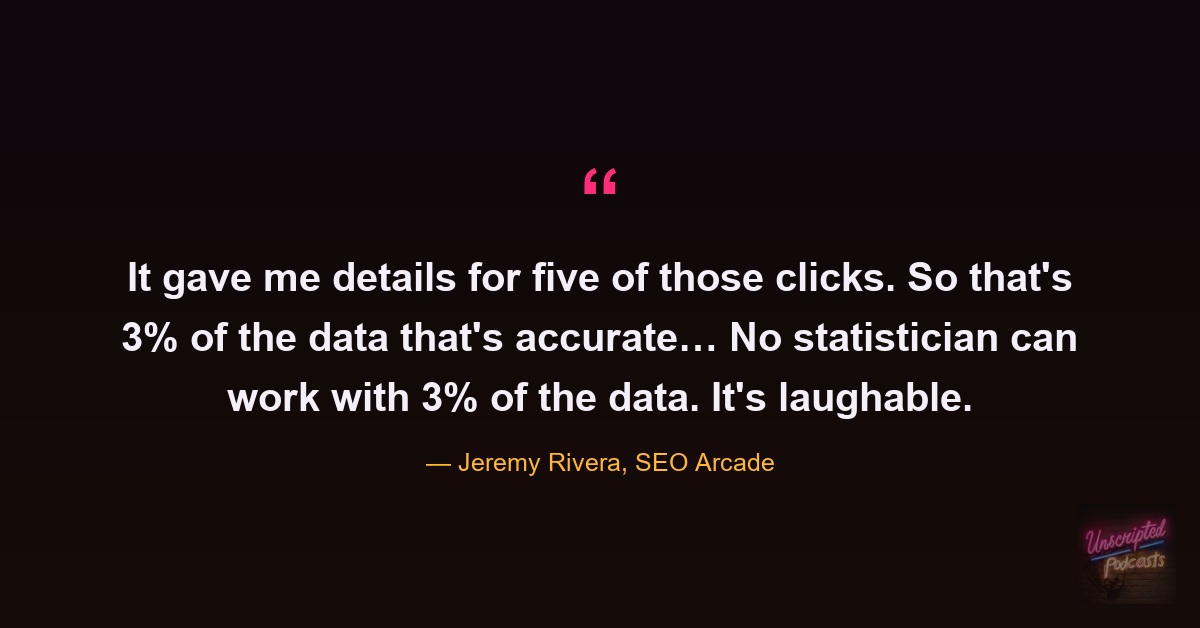
Jeremy has an unusually specific complaint about Google Search Console, and he backs it with his own numbers. He wrote an article on how accurate Search Console is. Search Console reported 149 people clicking through to it, and gave him query detail for five of those clicks. Three percent of the data.
“No statistician can work with 3% of the data. It’s laughable,” he said. “But that’s the state of that.”
The standard answer is that you should use the API, or export to BigQuery. Jeremy tried. It took him half a day, with sixteen years of experience, because the UI had changed and the documentation had not. The reward was going from five clicks of query detail to twelve.
His wider point is about who Search Console is sold to. A small business owner who has it set up at all is in the top ten percent by sophistication, and that person is never going to stand up BigQuery. Nobody tells them the numbers are a sample.
The overlap signal
The core of SEO Arcade came out of a manual process that used to cost him about three hours a page. Take a seed keyword. Look at the ten URLs ranking for it. Pull the top hundred keywords each of those pages ranks for. Paste them all into one sheet. What he first saw as a problem was the duplicates, the same phrases appearing across multiple competitors. Then it landed.
“That’s the signal. That’s how I can tell that Google sees the overlap. If for this particular phrase 10 out of 10 URLs all co-rank for one of those phrases, that is a higher priority, that is more relevant to the core phrase.”
Jeremy Rivera
And it works in reverse. A phrase only one competitor ranks for is either a fluke or an opening. “So you could flip it on its head and say, okay, what are the terms and phrases that just one of our competitors really does well for? And boom, there you go, longtail research.” One pull, two lists: your priority terms and your unclaimed ones.
Turning a keyword list into a number the CFO can read
Traffic estimates were the easy half. Search volume from the AdWords API, an organic click-through-rate curve from the Advanced Web Ranking study, and you can approximate how many people land on a page at a given position.
The second half came from a client question. Back at Raven Tools, after TapClicks bought them, a marketing manager asked how many additional signups a year of content investment would produce. Not traffic. Signups. Jeremy knew the free trial rate and the free-to-paid rate, which is structurally a lead rate and a sale rate.
So the chain finishes: traffic, times conversion rate, times sale rate, times revenue per sale. Then, because nobody ranks first for everything, he layers scenarios on top. Top three for half of these terms looks like this. A quarter of them looks like this. That is no longer a keyword list. That is a proposal.
He is blunt about why the last steps matter, because most SEOs stop at the rankings and call the job done. “You’ve got to have the hallelujah moment where you reach into their wallet and get the money, or you get them to be a lead and then you get them to be money.”
The keywords you are not allowed to say
The step Jeremy says our industry skips outright is the negative list. In PPC, half the job is deciding what not to bid on. In SEO, almost nobody has that conversation, whether the red lines come from legal, from YMYL claims, or from brand ego.
His example is a client who wanted to own the phrase “space cooler” and forbade both “swamp cooler” and “portable evaporative cooler”, which is what the product actually was and what people were searching for. He warned them there was a ceiling. A year later they were number one for “space cooler” and had hit it. So he put the banned language back on the homepage in context, as “not your mama’s swamp cooler”, and tripled their traffic in three months. No tool would have told him to do that, which is where my own favourite theme shows up:
“Well, a tool is just a tool. You have to have a brain.”
Mark A Preston
Soft ROI, support tickets, and link building that is not a DR number
The most useful five minutes is the least glamorous. Jeremy tells in-house and agency SEOs to go read their support team’s tickets. Answering documented customer problems pays twice: you reach people with that problem who are not customers yet, and you keep the users who would otherwise have churned.
“There are soft ROI benefits to a fantastic SEO campaign: reducing churn, increasing retention, enabling upsells. All three of those things are in the C-suite’s mind… Those are three lines on your CEO’s spreadsheet that you can strongly argue that you can have an effective SEO campaign to address. And if you’re not thinking that way, you should be.”
Jeremy Rivera
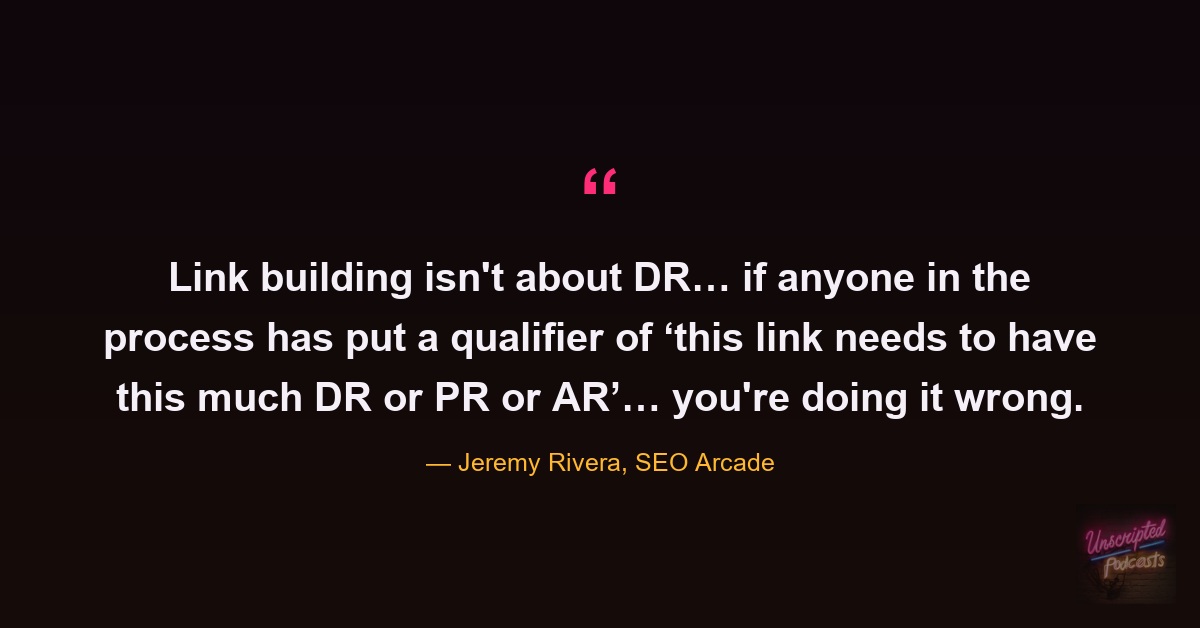
He closes on link building. If anyone in your process has set a DR or PR threshold as the qualifier, you are doing it wrong, because PBNs farm exactly that metric in order to sell it to you. What he argues for instead is a real subject matter footprint: a named person, an author profile, guest articles, podcast appearances, sameAs schema tying it together. Expertise is hard to fake, which is why it is worth having. After the first Helpful Content Update, Cyrus Shepard and Lily Ray both noted that around 80% of the sites hit had no business model beyond AdSense.
Listen to the full episode
The full hour also covers the Realtor who added 200 pages of white text on a white background because his cousin told him to, ChatGPT giving three different answers to the same car payment question, and why Jeremy thinks the skyscraper method built a cement nightmare.
- Watch the full interview on YouTube
- Subscribe to the Unscripted SEO Interview Podcast for more unedited, unrehearsed conversations
Connect with Jeremy Rivera
Jeremy has been in SEO since 2007 and founded SEO Arcade, the ROI forecasting tool discussed throughout this episode. At the time of recording he was also at CopyPress. He has since gone on to host this podcast himself.
- SEO Arcade
- JeremyRiveraSEO.com
- On X as Jeremy Rivera SEO
Want the repeatable version? The keyword-scoring and revenue-forecasting process Jeremy walks through in this episode is written up as a step-by-step play in the SEO SOP: Score Keyword Relevance by Co-Ranking Overlap, Then Forecast the Revenue — including the negative-keyword step most SEOs skip, and a free printable PDF inside The Vault.
Recorded 28 October 2023.