
Ask Jon Gillham why his AI detector flagged an article and you get a line most founders would never say on a podcast: “Our answer is we don’t know.” Jon founded Originality.ai, a content quality assurance platform covering AI detection, plagiarism checking, fact checking, readability, and grammar and spelling. I got him on Unscripted SEO to ask what a tool like that can tell you, and where it runs out.
Recorded September 19, 2024. We’re publishing this episode more than two years after we taped it, so every number and every “right now” you read below is a September 2024 statement. Features Jon describes as in progress may have changed since. Where I add a newer figure, it links to its source and carries its own date.
You can hear all 38 minutes on the Unscripted SEO Interview Podcast. Here’s what’s in it.
Originality.ai started with a billing question
Jon’s product came out of a pricing problem at his own agency. He ran a portfolio of his own sites with a team of writers and editors, sold the extra capacity as a content marketing service, and then watched GPT-3 writing tools like Jasper change the conversation with clients. Did your writers use AI? Was that okay? And how do you charge for it?
“Because who gets the efficiency lift as a result of it? And so we had policies in place, but we really had no certainty about who was or wasn’t using it.”
Copyscape had been the default plagiarism tool, and Jon calls it “woefully inadequate in the era of AI-powered writing tools.” So he built a QA tool and ended up “launching it the weekend before ChatGPT came out.”
He describes the product now as a “toolkit for anybody that functions as a copy editor.” That person might carry the title of SEO or content marketer. If you’re the one who has to sign off before something goes live, Jon is talking about you.
The people who built the detector can’t explain its calls
A classifier learns patterns nobody can list for you, and Jon doesn’t pretend otherwise. I asked whether the tell is the windy intro, or some artifact left behind by the machine. His reply opens this article, and he knows how it sounds: “We built it. What do you mean you don’t know?”
His explanation is an analogy. Picture a very intelligent person in a room reading millions of records of AI-written content and millions of records of human-written content, until they can sort new samples by instinct. They couldn’t fully tell you how. A classifier goes through a similar process.
So you’re trusting a score with no reasons attached. That’s a real limit when you’re deciding what to do about a writer, and Jon’s the one who said it.
How to test a false positive claim yourself
You test a detector by feeding it text whose source you already know and counting its mistakes. Jon walked me through the two by two grid. You know whether a sample is human or AI. The detector doesn’t. Its call lands in one of four buckets, and the one that hurts is known human work predicted as AI.
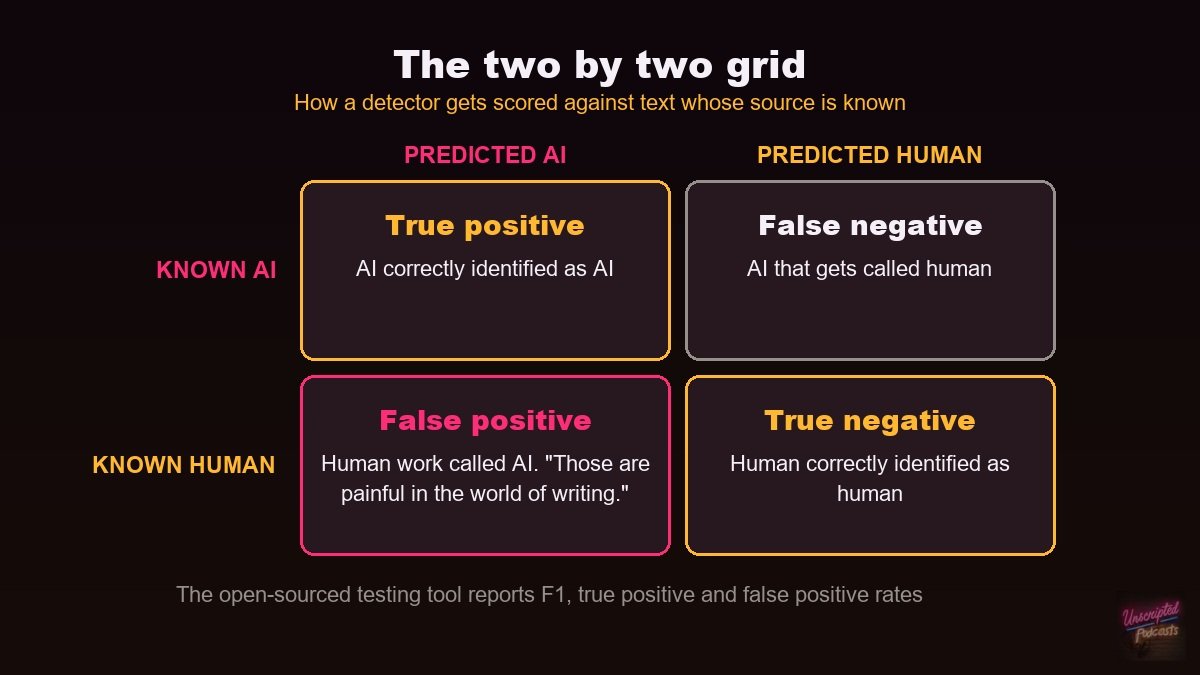
“Those are painful in the world of writing,” he said. Originality’s response was to open-source data sets and a testing tool that lets you put in API keys for multiple detectors, including theirs, and run your own data set against them. You get an F1 score, a true positive rate and a false positive rate.
Keep in mind who’s talking: Jon sells a detector. The useful part of this section is that you don’t have to take his word for the numbers, because the method is yours to run.
Run this test on your own content with the SEO SOP: Test an AI Detector’s False Positive Rate on Your Own Content. The one-page PDF is free inside The Vault.
His fact checker depends on what Google returns
Jon called fact checking “probably the lowest performing part, and highest potential” of the tool, and at recording it was still in beta. The process is RAG: identify a fact, search it in Google, scrape the results, feed them to a large language model, and ask for a judgment given the context of the article.
When it works, he says, it’s “pretty magical.” His example: is the boiling point of water 90 degrees Celsius? The quick answer is no. If the article is about hiking a specific mountain, the model can work out the elevation and tell you that could be true up there.
I pushed on the weak spot, which is that you’re dependent on the quality of the SERPs themselves. He agreed, and added that some facts sit “deeper in human knowledge than is easily searchable on the web.” That’s why he positions his fact checker as an aid that hands an editor source links and a few spots to go look.
“No LLM, even with great enrichment from RAG, should be the arbiter of truth.”
Jon thinks AI-filled SERPs threaten Google’s reason to exist
Jon’s read of the updates starts from one question: “If their search results are filled with nothing but AI, why would anyone go to Google?” This is his opinion, and he framed it that way. He sees the Helpful Content Update as “an outsourcing of the ability to tell what is human,” with Google leaning on user-generated content like Reddit and Quora because it struggles to separate human and AI content algorithmically.
He’s blunter about the March 5, 2024 manual actions, calling them “more of a psyops than an update.” In his telling, the press release was the point, and the manual actions on the eve of the rollout made the update look bigger than it was. Originality published a study of the March 2024 manual actions if you want the sites behind that argument.
On tape he also put a number on AI in search: “about 13% of the top 20 results.” That’s Originality’s own measurement from September 2024. Their running study of AI in Google results has since moved on, with a written timeline that lists 17.31% for September 17, 2025 (checked November 6, 2026).
Readability scores: what Jon said, and what the page says
Jon told me Originality looked at the top 20 Google results and which readability scores tracked them, and that the grade eight advice was “wrong high.” I answered that we need to dumb it down even more, and he said yes, with the caveat that it depends on the industry and that “being way, way too high or way too low was a problem.”
Check the source before you act on that exchange. Originality’s readability study, as it reads today, advises a grade 12 reading level and reports no significant correlation between readability and Google rank. That’s a different picture from the tape, and I can’t tell you from here why they differ. Jon also sent me a how-to for checking readability in Google Docs, which is a walkthrough and not the study.
Where to find Jon Gillham and the Originality.ai studies
When I asked Jon what mix of AI you should use, he answered with a line you’ll want to hear in his own voice: “if the value that is being provided on that page is words, then AI shouldn’t be used.” The episode has the rest of his reasoning, and I break that test down for agencies on SEO Arcade in Jon Gillham’s words vs data test. My own take, starting with a writer I was sure about, is at what Jon taught me about spotting AI writing.
If you came for the AI question, two other guests landed in different places. Erica D’Arcangelo won’t publish AI work under her own name, and Stew Fortier of Type builds an AI writing tool and takes on what happens when AI content becomes training data. We also quoted Jon at Human Certified Content in does Google penalize AI content.
These are the links Jon sent me after we recorded:
- How much AI is in Google search results
- The March 5, 2024 update and manual action study
- AI bot blocking, which we didn’t get to on tape
- How to check readability in Google Docs
Most of Jon’s work is at originality.ai, and you can find him on LinkedIn and X. Subscribe to the Unscripted SEO Interview Podcast wherever you listen, so the next conversation lands in your feed.
This episode is supported by our sponsors: uSERP, a link building agency; ClearLead Digital, which does property management seo for property managers; Oleno, which builds marketing context for Claude and ChatGPT; and OppAlerts, a link building database.
Sponsor disclosure: uSERP, Oleno, ClearLead Digital and OppAlerts are paid sponsors of the Unscripted podcast network. Links to them are marked as sponsored. Jon Gillham has no connection to them.