🎧 Listen to this episode
📺 Watch the interview
🎙️ Unscripted SEO Podcast · Second Interview
The Tail Can’t Wag the Dog — Tom Malesic on Agency Culture, Toxic Clients and Remote Teams
Thirty years in, 2,600 small-business clients, and a book built so the top five could leave tomorrow without costing anyone their job.
Tom Malesic came back for a second run on the Unscripted SEO Podcast, and this one went nowhere near where the first one did. Round one was about the website being the centre of all your marketing. Round two is about the part nobody puts in the case study: culture, the customers you should fire, and what actually holds a fully remote agency together after twenty-nine years.
Tom is founder and president of EZMarketing, which he has run since 1996 — his thirtieth year in digital marketing, and roughly 2,600 small businesses served along the way.
The SEO Villain Origin Story
Tom’s start is the kind of thing you don’t believe until he tells it. It’s 1996. He’s a sales guy at a friend’s web design shop — hired after being shown a hotel site on a 14.4 modem and asked “do you think you could sell this?” A jewellery store owner tells him she wants to buy two websites: one for the shop, one for a Pride jewellery line. His boss refuses the second on the grounds of who the customer is.
“Do you want my laptop now or do you want two weeks’ notice?” The boss took the laptop immediately. Tom walked down the street, told her the bad news and the good news — “I just started my business thirty-five seconds ago and I’d love you to be my first customer” — and she asked if it was the same price. It was. That was EZMarketing.
Core Values Are Your Culture, Not a Poster
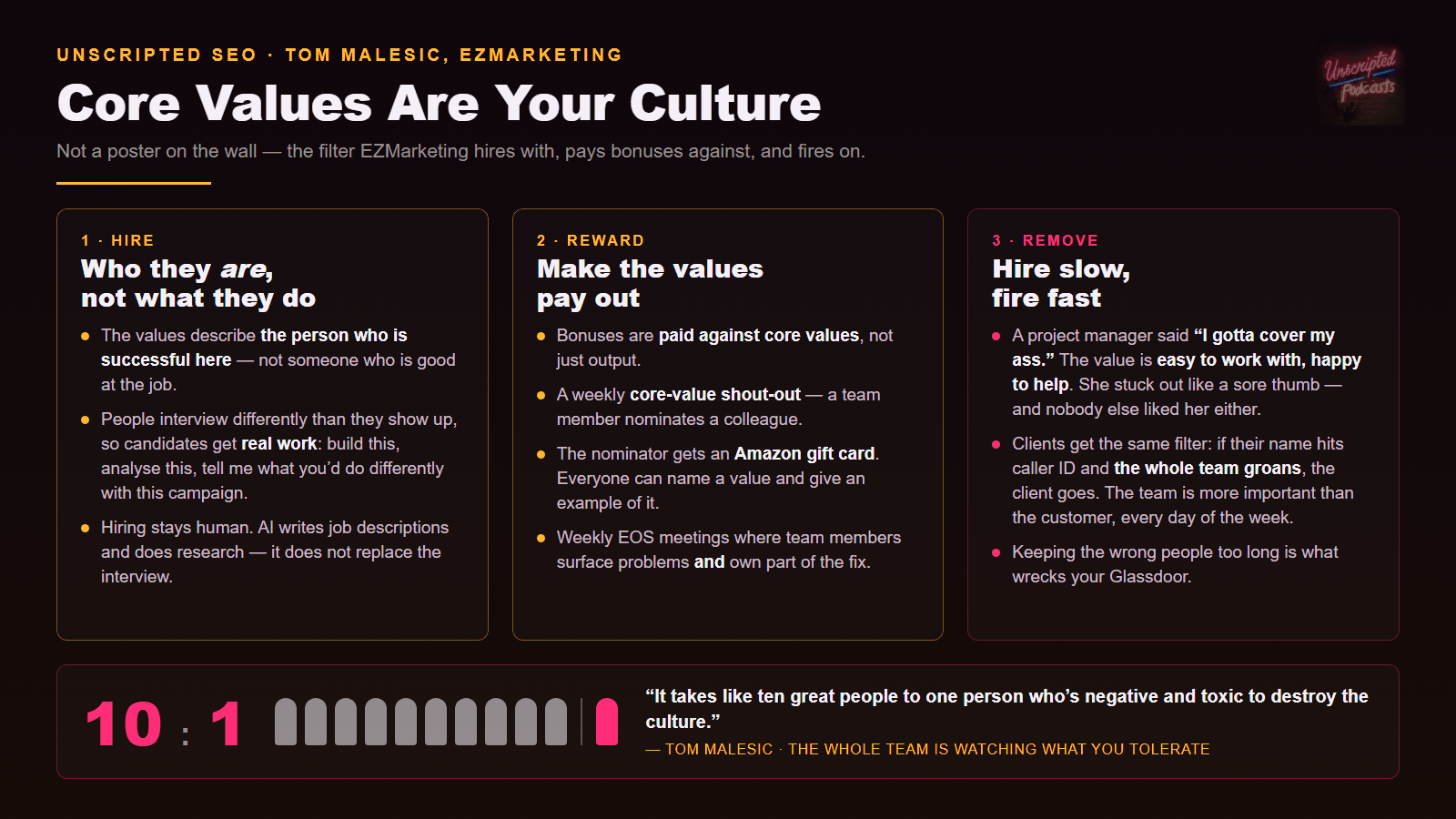
Tom used to think core values were nonsense you stick on a wall. He changed his mind when he understood that they aren’t a description of who is good at the job — they’re a description of who the person is. Get that right and the wrong hire announces themselves.
His example: a project manager who told him, “Boy, Tom, I gotta cover my ass.” EZMarketing’s core value is easy to work with, happy to help. She wasn’t happy to help, she was covering. Nobody else liked her either, and that was probably why. The values aren’t decorative at EZMarketing — they pay bonuses against them, and once a week someone nominates a colleague for a core-value shout-out and gets an Amazon gift card for it.
“When you have a whole company of the people that are who you are, and you hire the wrong person who isn’t who you are, man, that person sticks out like a sore thumb.”
— Tom Malesic
The cautionary tale he reaches for is Southwest. He was their biggest advocate — the funny flight attendants, the easy boarding, every business book written about them. Now he pays for his bag, gets a boarding order, picks a seat. Leadership changed the culture and changed the thing everyone loved. “They should change their stock symbol from LOVE to just like the next guy.”
The Tail Can’t Wag the Dog
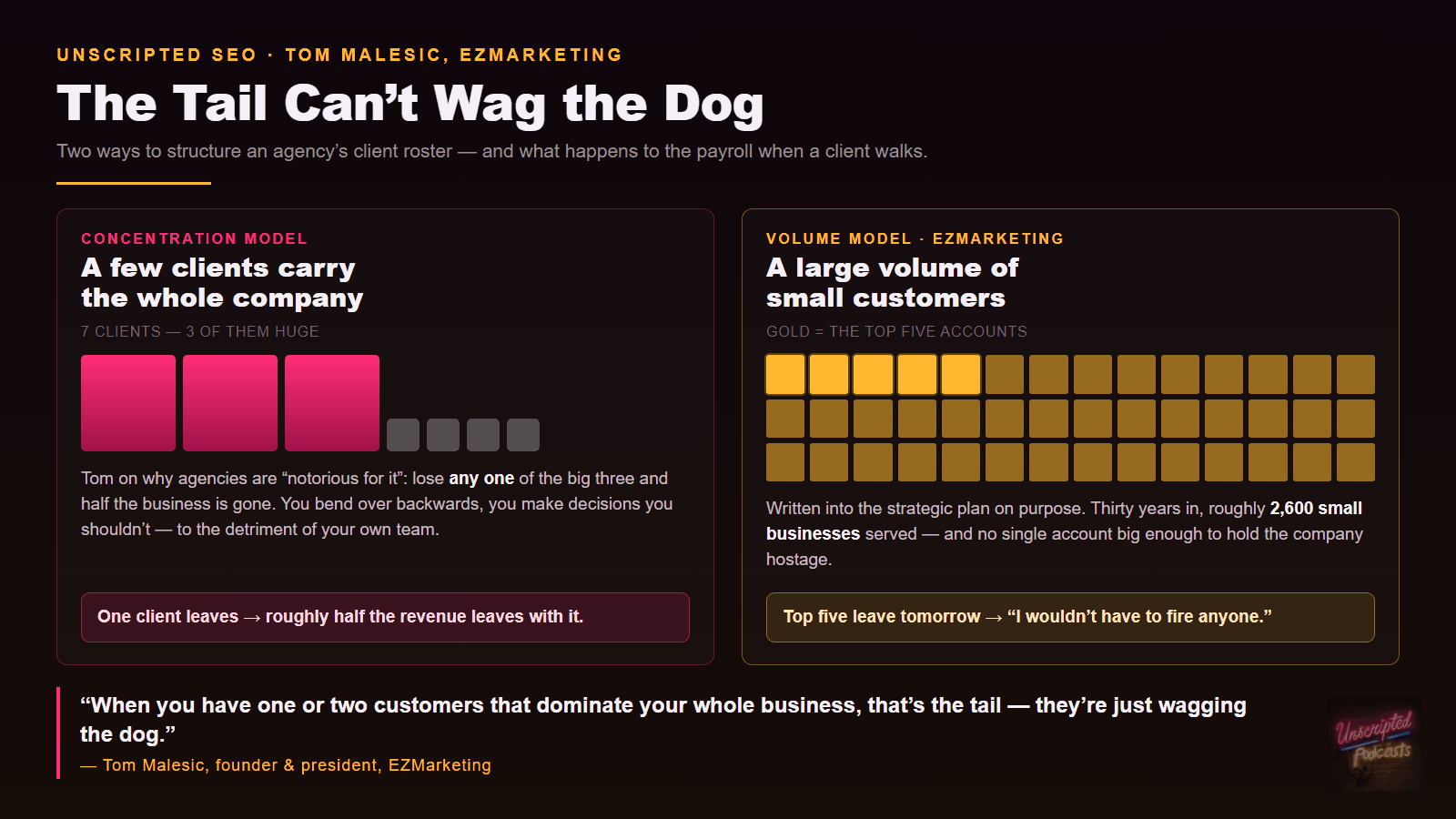
The line comes from a boss Tom had in college, selling vacuum cleaners door to door. It became a deliberate part of EZMarketing’s strategic plan: build on a large volume of small customers, so that no single account can hold the company hostage.
“My business is built on a large volume of small customers. My top five customers could leave tomorrow and I wouldn’t have to fire anyone.”
— Tom Malesic
Jeremy’s counter-example: an agency that won a content contract with Indeed, hired a stack of writers to service it, and then watched it evaporate region by region as AI arrived — Europe, then South America, then Asia, then half of North America. All the infrastructure built to process the whale went with it. Take on too much of one client and you stop being an agency; you become a vestige of their org chart.
Fire the Customer Who Yells at Your Team
Tom’s test is simple: if their name comes up on caller ID and the whole team groans, that customer has to go. He had a sixty-five-year-old business owner call and yell at an employee who had taken exceptional care of him, and she rang Tom in tears. He called the man back: you can’t yell at her, if you have a problem yell at me, and now we’re going to hang up and you’re going to call and apologise to her. He did.
“Every day of the week the team is more important than that customer. You can get another customer, but a high-functioning team who knows that you care — that’s more important.”
— Tom Malesic
It runs the other way too. Keeping the wrong people too long is what wrecks your Glassdoor and your culture at the same time. Tom reckons it takes ten good people to offset one toxic one, because the whole team is watching what you tolerate. Hire slow, fire fast.
You Can’t See Your Own Blind Spots
Tom tells new clients that they will be more valuable in their first ninety days than they can imagine, because they can still see everything the company does that makes no sense. After that they stop noticing — “you don’t see that mustard stain on your shirt anymore.”
Jeremy’s version of the same problem came out of interview-led SEO work with agentic AI consulting in Nashville on a Florida client — Permacast Walls. He interviewed both the CEO and the installer, and the most useful material came from the guy in the field. Customers kept asking whether people could dig under the fence line, so there is a real anti-dig feature on the concrete security walls — and it was nowhere on the website. If everybody is asking and it isn’t on the site, connect the dots.
The Leads You Already Have
Every local service business asks for more leads. Almost none of them work the ones they have. Jeremy pointed to Jake Melendy’s lead-response study, which mystery-shopped local businesses and found only about two per cent followed up on a contact more than once, and half never answered the same day. On one client’s Facebook page there were twelve messages nobody had ever replied to. Warming one of them up turned into a hundred-thousand-dollar renovation job.
Tom sees the same refusal from the other side. He told a manufacturer his phone number belonged in the navigation and got back: “The last guy wanted to do that too. I don’t really want people to call me.” There is a flower shop in Cookeville that has stripped its phone number from its website, from Yelp and from its Google Business Profile because the owner doesn’t like the sound of a ringing phone. An AI voice agent is now good enough to take a flower order and text the details through. The ceiling is usually the owner’s comfort level, not the market.
Running a Fully Remote Agency on EOS
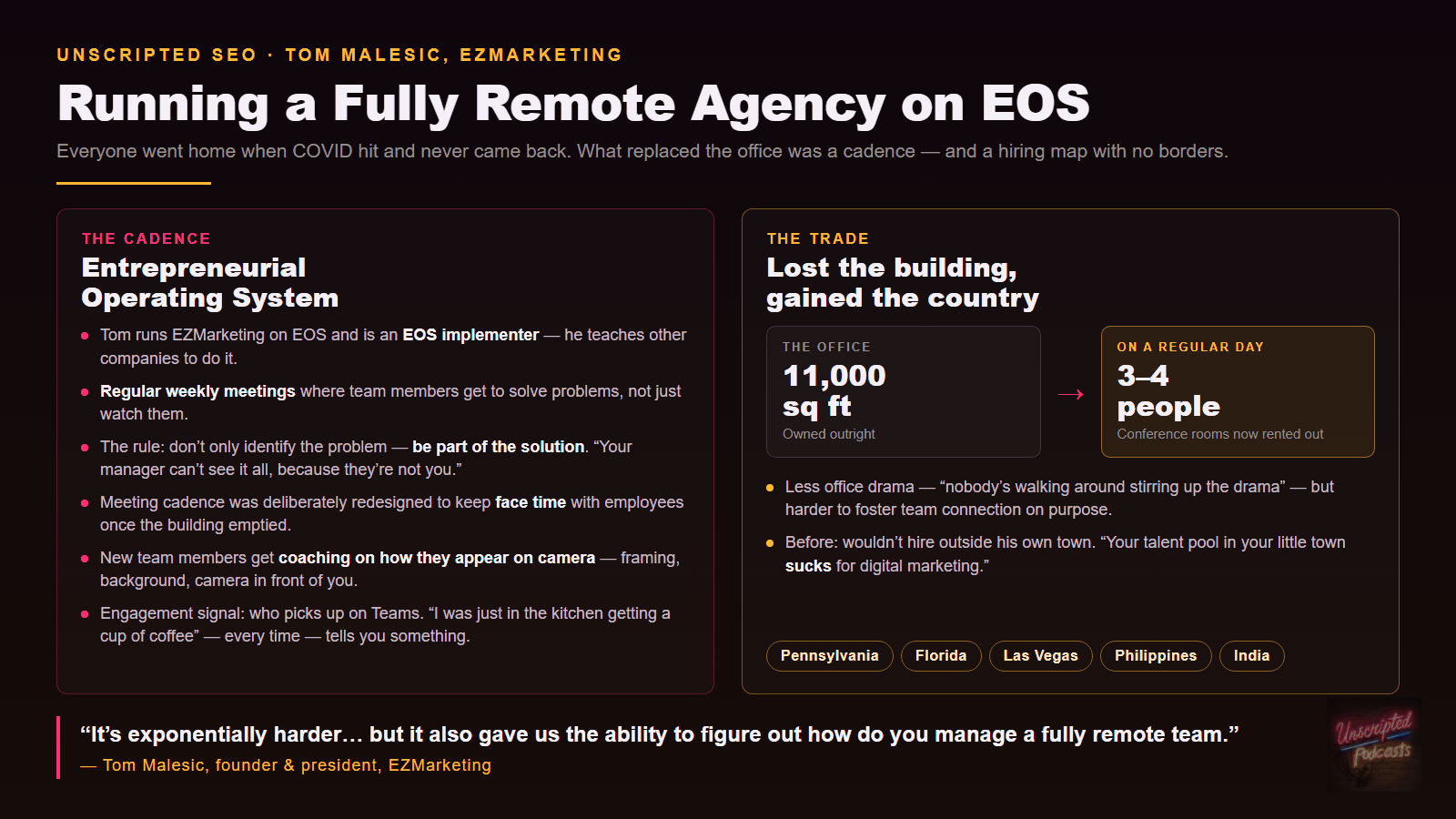
EZMarketing runs on the Entrepreneurial Operating System — Tom is an implementer and teaches it to other companies. The people component is the bit he cares about: weekly meetings where team members are expected to surface problems and be part of the solution, because a manager cannot see what the person doing the job sees.
COVID sent everyone home and they never came back. Tom still has an 11,000 square foot office building with three or four people in it on any given day; he now rents the conference rooms out. What he got in exchange was a hiring pool that isn’t limited to his own town — team members in the Philippines and India, a new SEO hire in Florida, and no functional difference between Pennsylvania and Las Vegas. Jeremy’s friend Right Thing SEO’s Michael McDougald splits the difference with a Nashville co-working space — somewhere to take a meeting without carrying a lease.
One Agent Per Client
The automation that actually moved the needle for EZMarketing is content. They built a platform, Hats.ai, that fronts about seventy different AI models, and they train a dedicated agent per client: what the business does, how it talks, what it always says, what it never says. The client approves the work, the feedback goes back into the agent, and it compounds.
“It better understands that customer than any one of our team members does. It’s hard to know everything about every client when you have a hundred clients.”
— Tom Malesic
Hiring, by contrast, he has barely automated. Job descriptions and research, sure. The rest stays human — and where he does test candidates, it’s with work: build this, analyse this, tell me what you’d do differently with this campaign.
New This Month: CIPA and ADA Demand Letters
The freshest thing in the conversation is a warning. Tom’s clients have started receiving demand letters claiming their sites aren’t compliant with California privacy law, on top of the ADA accessibility claims that have been circulating for years. EZMarketing has a fix in place, a campaign going out to every client explaining the cost, and an ongoing monitoring plan — and every new site they build now ships compliant by default. If you handle small-business websites, this is landing in inboxes right now.
Advice for Anyone Starting Out
Be open to being lucky. Tom’s framing is that the more he did, the luckier he got, and the more he noticed the luck the more of it arrived. Imposter syndrome is near-universal in SEO because the ground moves so fast that everyone feels behind — and that feeling, handled right, is what keeps you learning.
“I never want to be the smartest person in the room. If I’m the smartest person in my company, we have a big problem.”
— Tom Malesic
The kids who finished top ten in your high school class aren’t reliably the ones who succeed in business, because after school it stops being about being smart and starts being about tenacity. Figure out the one thing you’re genuinely good at, then hire around everything else. Tom built EZMarketing’s first websites himself and now cheerfully admits he can’t log into WordPress.
About Tom Malesic
Tom Malesic is founder and president of EZMarketing, a full-service digital marketing agency in Pennsylvania serving small businesses since 1996. He is the author of multiple marketing books and an EOS implementer. This is his second appearance on the show — his first, on why the website is the centre of everything, is here.
More from this topic